
Heath tiger beetle
Cicindela sylvatica
Description
How to identify
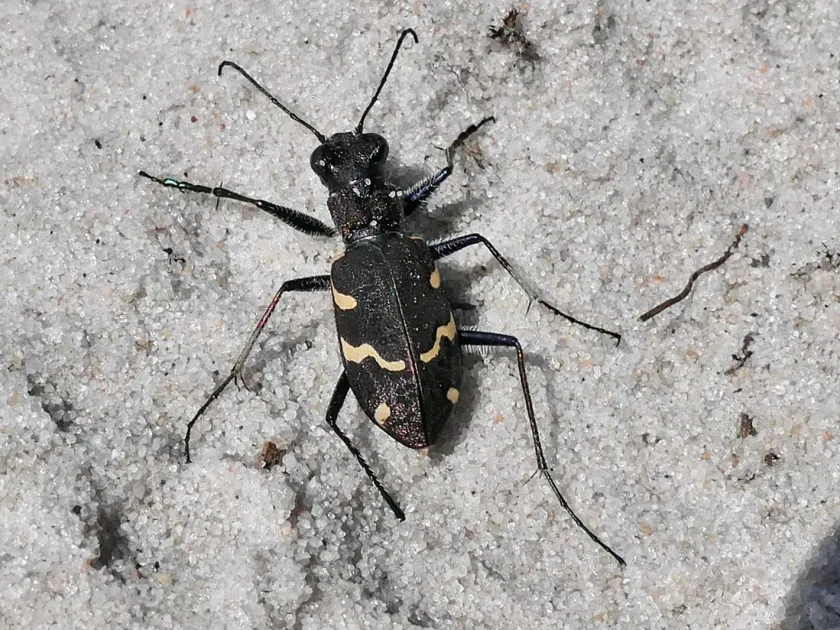
The Heath tiger beetle Cicindela sylvatica is a predatory beetle belonging to the ground beetle family (Carabidae) and the order Coleoptera. Adult beetles measure between 14 and 17 mm in length and feature a dark brown or blackish color with a subtle metallic sheen.
The wing covers (elytra) are marked with distinct, often broken or jagged light-colored bands. The head is large, equipped with prominent, curved mandibles designed for capturing and subduing prey.
They possess large, protruding eyes that provide excellent vision for hunting while moving rapidly across the soil surface. Their legs are long and slender, facilitating the high-speed movement characteristic of the genus.
The larvae are specialized, living in vertical burrows within sandy soil. They have a distinctively powerful head capsule and a body adapted for maintaining position within their soil tunnels while waiting for prey.
This species favors open habitats with light, sandy substrates, frequently appearing on forest edges, clearings, and agricultural fields situated on sandy soil types.
What it damages
Adult tiger beetles are generally beneficial predators that help manage other insect populations. However, under certain conditions, their presence can be problematic for agricultural crops due to their soil-based lifestyle.
Damage is primarily caused by larvae that build vertical burrows. These tunnels can physically disturb the root systems of young seedlings, leading to reduced nutrient uptake and potential plant wilting.
While not classified as a major agricultural pest, high populations in sandy fields can lead to mechanical stress on newly emerged vegetables or cereal crops. The localized soil disturbance around the root zone is the main point of concern.
Direct consumption of plant material by these beetles is negligible, as they are strictly predatory. The damage is considered incidental, occurring as a byproduct of their burrow-building activities in the soil.
Vulnerability of crops increases during dry spells when soil moisture is low and root integrity is already compromised, making the burrowing activity more destructive to the young plant infrastructure.
When it appears
The activity period for adult Heath tiger beetles begins in late spring and persists through the warm summer months. They are most active on sunny, warm days when they hunt across the soil surface.
Larvae remain in the soil for a prolonged developmental period, often spanning two or more years. They overwinter deep within the soil profile, below the frost line, to survive colder temperatures.
Mass emergence of adult beetles typically occurs in June and July. This period represents the window of highest activity for the species in agricultural settings.
As evening approaches or temperatures drop, the beetles become significantly less active, retreating into their burrows or hiding beneath organic debris on the field floor.
The lifecycle duration is highly temperature-dependent, with soil heat levels playing a crucial role in the speed of larval maturation and the timing of emergence.
Signs of infestation
The primary sign of larval presence is the appearance of small, perfectly round holes in dry, sandy soil. These are the entrances to the vertical burrows used by the larvae for ambush hunting.
Adult presence is easily identified by visual inspection of field margins during sunny weather. The beetles are highly reactive and will take flight quickly when disturbed, landing a short distance away.
Wilting of young, delicate seedlings located near these visible soil holes can be a secondary indicator of larval activity affecting the root zone.
High densities of these burrows in a localized area indicate a strong population of larvae, which should be monitored to assess the risk of crop damage.
Visible soil disturbance around the base of plants, caused by the construction and maintenance of these burrows, serves as a clear warning sign for farmers to inspect the area.
Control measures
Effective management begins with regular soil cultivation, such as inter-row hoeing, which collapses the larval burrows and disrupts their developmental cycle.
Improving soil organic matter and structure through amendments makes the substrate less favorable for this species, as they prefer loose, sandy, nutrient-poor soil.
Applying mulch across the soil surface creates a physical barrier that prevents adult beetles from reaching the soil and makes burrow construction impossible for larvae.
In cases of severe infestation, targeted soil insecticides may be used, though this should be minimized to protect other beneficial ground-dwelling predators that share the habitat.
Encouraging biological control agents, such as birds that prey on beetles, is a sustainable way to keep populations below economic injury levels without resorting to chemical interventions.
Taxonomy
- Latin name
- Cicindela sylvatica
- Order
- Coleoptera (beetles)
- Family
- Carabidae
- EPPO code
- CICNSI
Discussion
No discussions yet — be the first.