
Moroccan tiger beetle
Cicindela maroccana
Description
How to identify
The Moroccan tiger beetle (Cicindela maroccana) belongs to the order Coleoptera and the family Carabidae. These beetles are predatory insects known for their slender bodies, long legs, and large, sickle-shaped mandibles used for hunting.
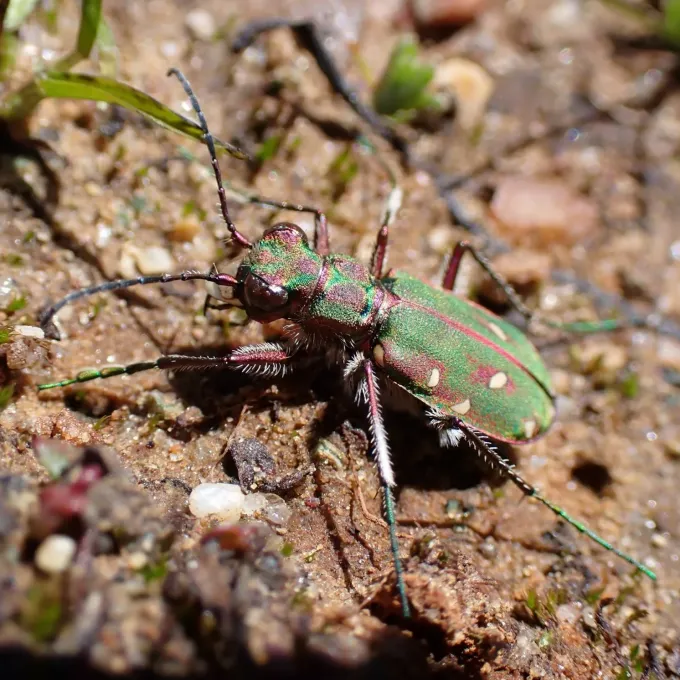
Adults typically display a metallic sheen, ranging from bronze-green to dark black, often with distinct cream-colored spots on their elytra. Their eyes are exceptionally well-developed, providing sharp vision for hunting in open, sunny environments.
The larvae possess a unique anatomy characterized by a long, soft body with a hump on the fifth abdominal segment. This hump is equipped with hooks that allow the larva to anchor itself firmly inside its vertical soil burrow.
The larva’s head is flat and heavily sclerotized, acting as a living plug that seals the entrance to its burrow. When prey passes by, the larva strikes with lightning speed from this concealed position.
The life cycle involves complete metamorphosis, where larvae spend their time in subterranean burrows while adults roam the surface. Their presence is highly dependent on environmental temperature and soil composition.
What it damages
Although tiger beetles are generally considered beneficial predators that consume various agricultural pests, the Moroccan tiger beetle can become a concern in specific agricultural settings when populations reach high densities.
Damage to crops is primarily caused by larval burrowing activity. As larvae create numerous vertical tunnels in the soil, they can disrupt the root systems of young vegetable or cereal crop seedlings.
The soil structure surrounding the roots is often compromised by these tunnels, leading to localized dehydration and weakened plant anchorage. This stress makes young plants more susceptible to drought and pathogen entry.
While direct herbivory by these beetles is minimal, the indirect impact of soil disturbance can lead to reduced germination rates and stunted growth in affected rows during early development stages.
The extent of damage is usually localized to specific areas with compacted soil, where larvae prefer to build their permanent, multi-seasonal burrows.
When it appears
Adult beetles typically emerge in late spring, around April or May, and remain active through the summer months. They thrive in hot, sunny conditions and are most energetic during the peak of the day.
Mating and egg-laying occur shortly after emergence. Females deposit eggs individually in damp but open, unshaded soil, providing the emerging larvae with optimal conditions for establishing their initial burrows.
The larval stage is prolonged, often lasting one to two years. Larvae are active within their burrows throughout the growing season, retreating deeper into the soil during cold winter months to survive.
Pupation occurs within the soil, and the emergence of a new generation of adults usually takes place in late summer. These young adults remain active until late autumn before seeking overwintering sites.
Temperature fluctuations directly influence the speed of the life cycle. Warmer years often result in higher survival rates and larger populations the following season.
Signs of infestation
The most reliable sign of an infestation is the presence of small, perfectly round holes in the soil surface, typically 3-5 mm in diameter. These vertical burrows are often concentrated in open areas or along field borders.
Surrounding the entrance to the burrows, one might observe minor soil displacement or small piles of substrate. During warm, sunny days, adult beetles can be spotted moving quickly across the ground.
Wilting or yellowing of seedlings in isolated patches is a potential indicator of larval root interference. Checking the soil around the base of such plants often reveals the characteristic tunnel structures.
A count of these entrance holes per square meter serves as an effective monitoring method for farmers. This helps in determining if the population density warrants intervention measures.
Visual inspections should be conducted in the morning hours. Tiger beetles are highly sensitive to movement and vibration, making them difficult to approach once they are fully warmed by the sun.
Control measures
Deep autumn plowing is the most effective cultural method to manage Moroccan tiger beetle populations. This process destroys the vertical burrows, exposes larvae to natural predators, and disrupts their development cycle.
Chemical control should be reserved for instances where the economic threshold is exceeded. Soil-applied insecticides, when used locally, can protect seedling roots during the most sensitive growth phases.
- Regular mechanical cultivation of row spaces to disturb larval habitats.
- Rotation of crops to vary soil disturbance patterns.
- Encouraging natural predators, such as birds, which forage on open fields.
- Ensuring adequate soil moisture to prevent extreme stress on root systems.
Because adult tiger beetles are themselves significant predators of many harmful agricultural insects, control measures should be targeted to preserve these beneficial populations whenever possible.
Integrated Pest Management (IPM) strategies emphasize using biological control agents and mechanical cultivation over broad-spectrum chemical sprays, maintaining a healthy ecological balance in the field.
Taxonomy
- Latin name
- Cicindela maroccana
- Order
- Coleoptera (beetles)
- Family
- Carabidae
- EPPO code
- CICNMC
Discussion
No discussions yet — be the first.