
Dune tiger beetle
Cicindela maritima
Description
How to identify
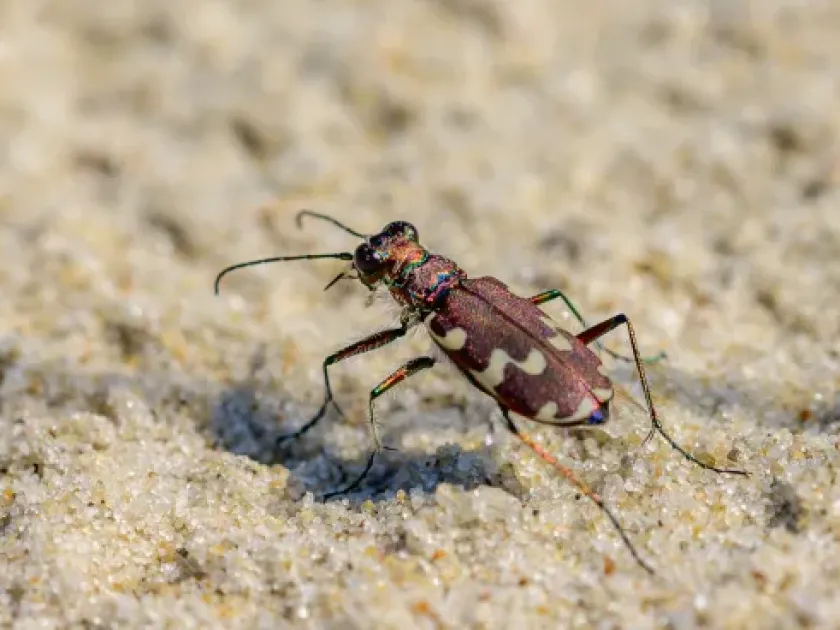
The dune tiger beetle (Cicindela maritima) is a predatory insect belonging to the family Carabidae (ground beetles). Adults are typically 12–15 mm in length and possess a distinctive metallic appearance with pale, irregular markings on their elytra.
The insect is easily identified by its large, prominent mandibles and long, slender legs designed for rapid movement across sandy surfaces. They are highly active predators during daylight hours.
Larvae live in deep, vertical burrows within sandy soils. Their head and pronotum are flattened and serve as a "lid" to block the burrow entrance while they lie in wait for passing prey.
These beetles are primarily associated with coastal dunes, sandy riverbanks, and open sandy areas. They prefer environments with sparse vegetation where they can hunt effectively.
Taxonomically, they represent a group of ground beetles that are well-adapted to unstable sandy substrates, playing a significant role in local ecosystem food webs.
What it damages
The dune tiger beetle is not considered an agricultural pest. Its diet consists exclusively of other small insects and invertebrates, making it an efficient natural predator.
It does not feed on plant foliage, roots, or seeds. Therefore, it causes no direct damage to crops, and it should not be targeted by plant protection programs.
In fact, the presence of Cicindela maritima can be beneficial as it consumes larvae and small insects that might otherwise cause harm to agricultural crops.
Reports of crop damage associated with this species are non-existent in professional agronomic literature. Confusion often arises because the beetle is seen in large numbers in fields with sandy soil.
Agronomists should view these beetles as neutral or beneficial elements of the field's biodiversity rather than threats to production.
When it appears
Adult beetles are active from late spring through late summer. They require warm temperatures and high levels of sunshine to hunt successfully, often peaking in June and July.
The larval stage is long-lived, spanning multiple years of development in the soil. They overwinter deep within their burrows to survive cold temperatures.
Seasonal activity levels are strongly correlated with soil surface temperature. During cooler or overcast days, the beetles become sluggish and remain within their shelter zones.
Reproductive activity occurs in the early summer months. After mating, females deposit eggs directly into the loose, warm sand where conditions for development are optimal.
By the end of August, the population of adult beetles naturally declines as they complete their mating and egg-laying cycles for the season.
Signs of infestation
The most prominent sign of their presence is the appearance of small, perfectly circular holes in sandy soil, which serve as entrances to larval burrows.
Observations in fields may reveal adult beetles scurrying across bare soil patches, characterized by quick bursts of movement followed by sudden stops.
A lack of evidence regarding damaged leaves, stems, or roots in areas where these beetles are abundant confirms their role as predators rather than plant-feeders.
If an agronomist notices these insects, they should inspect the area for the presence of actual plant pests, as the beetles are likely there due to an abundance of prey.
Visual identification of the characteristic pale pattern on the elytra is a reliable method to distinguish them from other ground beetles found in agricultural fields.
Control measures
No control measures are necessary for Cicindela maritima. Because they are not pests, managing them with insecticides is unnecessary and counterproductive to ecological balance.
The use of broad-spectrum pesticides can harm the natural predatory beetle population, potentially leading to an increase in actual crop-damaging pests.
If the burrows are causing issues in specific non-crop areas, simple mechanical leveling of the soil is the most effective way to discourage the beetles from settling.
Integrating agricultural practices that improve soil structure and promote cover crops can naturally shift the beetle population toward more suitable, non-agricultural habitats.
Professional agronomic practice emphasizes preserving such beneficial predators, as they contribute to the natural suppression of harmful insect populations in field margins.
Taxonomy
- Latin name
- Cicindela maritima
- Order
- Coleoptera (beetles)
- Family
- Carabidae
- EPPO code
- CICNMA
Discussion
No discussions yet — be the first.