
Green tiger beetle
Cicindela hybrida
Description
How to identify
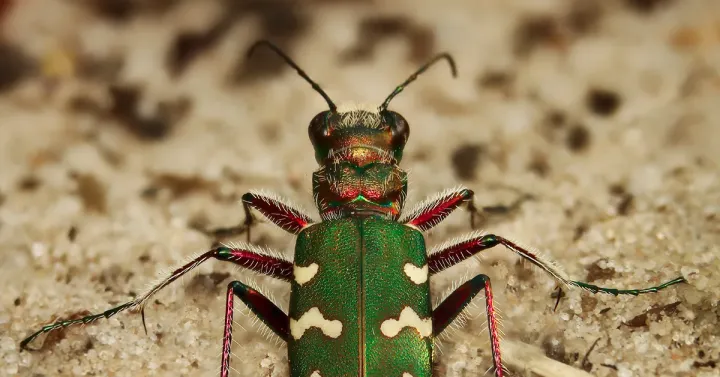
The Green tiger beetle (Cicindela hybrida) is a member of the ground beetle family (Carabidae). These beetles are typically 12–16 mm long, featuring a bronze-brown or greenish metallic sheen with distinct pale markings on their wing covers.
They possess large, protruding eyes that provide excellent vision for hunting prey on the ground. Their mandibles are long, sickle-shaped, and powerful.
Larvae are elongated, whitish-yellow in color, and have a large sclerotized head. They live in vertical burrows in the soil and use special dorsal hooks to anchor themselves while waiting for prey.
Adults are highly alert and agile. They move rapidly across sunny ground and take flight immediately when sensing vibrations or movement.
The life cycle involves complete metamorphosis, and the transition from egg to adult often takes several years, depending on environmental temperature and food availability.
What it damages
While often classified as beneficial predators in ecology, their larvae can occasionally pose a threat to agricultural crops in sandy, well-drained soils.
Damage occurs when larvae, while occupying their burrows, feed on the roots of young seedlings, which can lead to plant stress or death.
Crops most affected are those planted in light, sandy substrates where these beetles find their habitat conditions ideal for burrowing.
Root damage disrupts nutrient uptake, often causing visible wilting or patchiness in the crop field during the early growth stage.
However, significant economic losses are uncommon as the beetle generally focuses on preying upon other smaller ground-dwelling insects.
When it appears
Adult beetles emerge in late spring as temperatures rise, typically when soil temperatures exceed 15 degrees Celsius.
They are most active throughout the warm summer months, patrolling fields, paths, and clearings for prey during the sunniest parts of the day.
Larvae remain active in their soil burrows for the duration of the growing season, only retreating deeper as winter approaches.
The species overwinters in the soil, with both larvae of various instars and some adults surviving the cold months in deep hibernation.
Peak activity for field scouting is during mid-day in clear weather when adults are actively foraging on the surface.
Signs of infestation
The presence of these beetles is marked by numerous small, perfectly round vertical holes (burrows) found in open, sandy patches of a field.
Adults are easily spotted due to their fast, darting movements on the ground; they will fly off quickly if approached.
Crop damage is identified by stunted or wilting plants within small, localized patches rather than widespread field devastation.
Careful excavation around the roots of wilting plants may reveal the presence of a vertical larva burrow leading down into the soil.
- Visible vertical burrow holes in sandy soil
- Sudden wilting of young crop plants
- High density of fast-moving metallic beetles on the surface
Control measures
Direct chemical intervention is rarely required because this beetle is usually not considered a major agricultural threat.
Mechanical cultivation or hoeing between rows is highly effective at destroying the soil burrows, which prevents larval development.
Maintaining a balanced crop rotation and managing weeds in field borders help limit the hospitable sandy patches the beetle prefers.
Encouraging natural predators such as insectivorous birds and small mammals is the most sustainable way to keep populations in check.
In cases of severe localized infestation, targeted use of soil-applied insecticides may be considered, but only after careful monitoring.
Taxonomy
- Latin name
- Cicindela hybrida
- Order
- Coleoptera (beetles)
- Family
- Carabidae
- EPPO code
- CICNHY
Discussion
No discussions yet — be the first.