
Green tiger beetle
Cicindela campestris
Description
How to identify
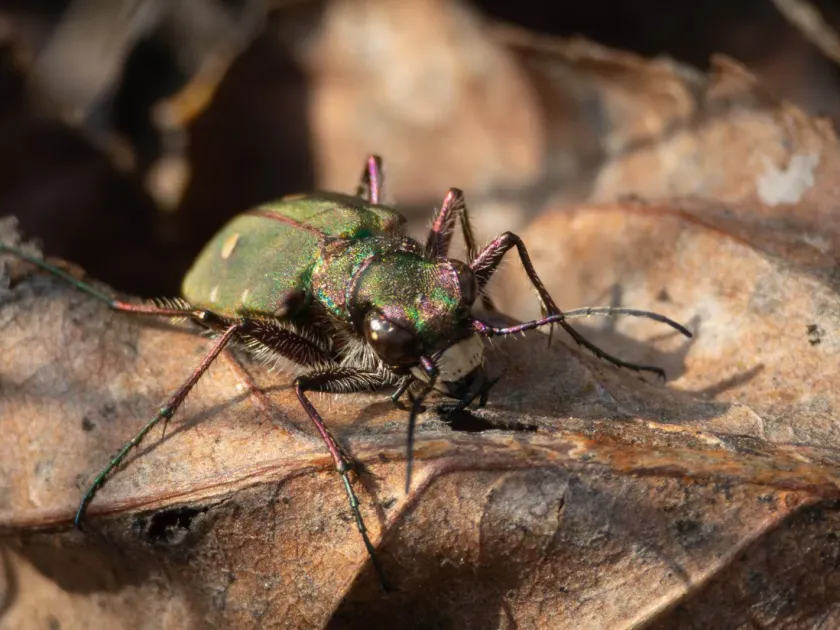
The green tiger beetle (Cicindela campestris) is a predatory insect belonging to the family Carabidae. It is characterized by its brilliant metallic green body and distinct creamy-white spots on the elytra.
Adult beetles typically measure between 12 and 15 mm in length. They are known for their extreme speed, both in running across the ground and in flight when disturbed.
The larvae live in deep vertical burrows in the soil. They possess large, powerful mandibles and a flat head that acts as a plug to seal their burrow entrance.
Green tiger beetles have large compound eyes, which allow them to detect movement with precision, making them highly efficient hunters in open, sunlit fields.
The life cycle of this beetle is relatively long, often lasting two to three years depending on environmental temperatures and food availability in the soil habitat.
What it damages
While primarily considered beneficial predators that help control other harmful insects, green tiger beetles can occasionally become an agricultural issue.
When populations reach high densities, the digging activity of adults can disturb the soil surface, potentially impacting the root development of young crop seedlings.
Larvae, residing in subterranean tunnels, may incidentally damage the fine root hairs or germinating seeds of sensitive crops during their quest for prey.
The economic impact of this beetle is generally considered minor, as they are often more valuable as natural biological control agents than they are detrimental.
Damage is most likely to occur in sandy, loose, or uncultivated field margins where the beetle finds ideal nesting conditions for its larvae.
When it appears
Adult green tiger beetles emerge from overwintering in late spring, usually from April to May, once the soil has sufficiently warmed up.
They are most active during the peak of summer, particularly during sunny days when they hunt for small insects across the soil surface of field paths.
By late autumn, adults seek shelter for hibernation, usually moving deeper into the soil profile or hiding under dense leaf litter to survive the winter freeze.
The larval stage is present throughout the entire growing season, continuously occupying their burrows in the soil and waiting for suitable prey.
The overall seasonal rhythm is strictly controlled by photoperiod and temperature, which triggers both the emergence of adults and the developmental phases of the larvae.
Control measures
Direct control measures are rarely required, as the species is widely recognized as a useful predator that consumes various agricultural pests.
If management is necessary due to high population numbers, mechanical tillage and soil cultivation are the most effective methods to disrupt larval burrows.
Maintaining crop health and ensuring a healthy, balanced field ecosystem helps keep beetle populations at a level that does not interfere with crop development.
Field margins management, including the removal of dense weeds that might harbor the beetle's food source, can also discourage them from nesting in cultivated rows.
Chemical intervention should be avoided whenever possible, as broad-spectrum insecticides used for other pests will also destroy these beneficial predators.
Taxonomy
- Latin name
- Cicindela campestris
- Order
- Coleoptera (beetles)
- Family
- Carabidae
- EPPO code
- CICNCA
Discussion
No discussions yet — be the first.