
Tiger beetle
Cicindela
Description
How to identify
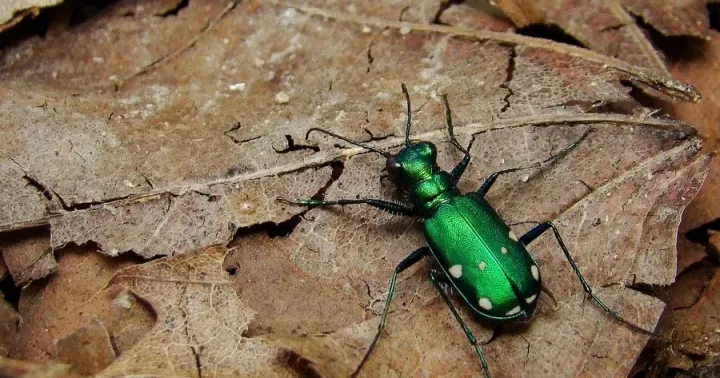
Tiger beetles (Cicindela) belong to the family Carabidae and are predatory insects. Adult beetles have a slender body, 10–20 mm long, often with a brilliant metallic coloration—green, copper, or black with characteristic light spots on the elytra.
These insects possess well-developed mandibles designed for seizing and crushing prey. They have large, prominent eyes that provide excellent vision, allowing them to detect the movement of potential prey at significant distances instantly.
Larvae have a specific appearance: they are worm-like, dirty-white or yellowish, with a heavily chitinized head and powerful jaws. A special hump with hooked structures on the larva's back helps it remain securely within its burrow.
A distinctive feature of the adults is their high speed of movement and ability to fly instantly when threatened. They prefer open, sunny areas with sandy or loamy soil, where they can easily find food.
Taxonomically, tiger beetles are classified under the order Coleoptera. Despite their predatory nature, some species can be active near agricultural lands, requiring agronomists to monitor their population levels.
What it damages
Although most tiger beetles are entomophagous, consuming small insects, in cases of high population density or a lack of natural prey, they may show activity that impacts young plant sprouts.
The greatest damage occurs in the early spring, when beetles may gnaw on the tender stems and cotyledons of industrial and vegetable crops. In particular, they are noted to target sugar beet seedlings, sunflowers, and some cereals during the germination phase.
Larvae living in vertical soil burrows can damage the roots of young plants when soil invertebrates are scarce. This leads to weakened crops, stunted growth, or the death of individual sprouts in the field.
It is important to understand that the harmfulness of tiger beetles is often secondary; however, under high population conditions, they can reduce crop stand density in fields with light soil types.
The intensity of damage depends directly on weather conditions: dry and hot spring weather drives adults to seek moist plant matter for moisture, increasing the risk of crop damage.
When it appears
The activity of adult tiger beetles begins in early spring, as soon as the topsoil warms up. The period of their peak appearance is in May and June, when mating and egg-laying occur.
Larvae remain active throughout the growing season, dwelling in their soil burrows. They go through several larval stages, feeding on small soil organisms, and overwinter at significant depths.
Adult flight continues until mid-summer. The beetles are most active during sunny hours when their metabolism peaks, making them extremely agile and fast predators.
In autumn, adults enter a winter diapause, burrowing deep into the soil or hiding under plant debris to re-emerge in the spring.
The species' developmental cycle may take from one to several years depending on the climatic zone, a factor that must be considered when planning long-term agricultural practices.
Signs of infestation
A primary indicator of tiger beetle presence in a field is the existence of characteristic vertical burrows in the soil, 3–5 mm in diameter. Remnants of the chitinous shells of other insects can often be found near the burrow entrances.
Damage to crops appears as deep nibbling or ulcers on the stems near the base, which often causes young sprouts to lodge. In cases of mass infestation, gaps or bare patches in the rows can be observed.
Visual monitoring of adults is effective: when approached by a person or machinery, the beetles quickly fly a few meters ahead, which is a key diagnostic sign.
The presence of larvae in the soil can be confirmed through soil sampling or by using traps placed in areas where pest density is suspected to be high.
A combination of root and stem damage in light sandy soils is a direct signal to implement protection measures to save the seedlings.
Control measures
The foundation of control is the agrotechnical method: deep autumn plowing destroys larval burrows and disrupts their overwintering environment, leading to a sharp decrease in the population for the next season.
Maintaining weed-free fields is an effective way to remove habitats and alternative food sources for beetles during periods when their usual insect prey is scarce.
Applying insecticidal seed treatments before sowing provides reliable protection for seedlings against damage during the most vulnerable early development stages.
In cases where the population exceeds the economic threshold, edge treatments of the fields with authorized insecticidal preparations are recommended during peak adult activity.
- Crop rotation compliance.
- Soil structure improvement.
- Use of high-quality seed treatments.
- Regular population monitoring.
Taxonomy
- Latin name
- Cicindela
- Order
- Coleoptera (beetles)
- Family
- Carabidae
- EPPO code
- CICNSP
Discussion
No discussions yet — be the first.