
Oriental latrine fly
Chrysomya megacephala
Description
How to identify
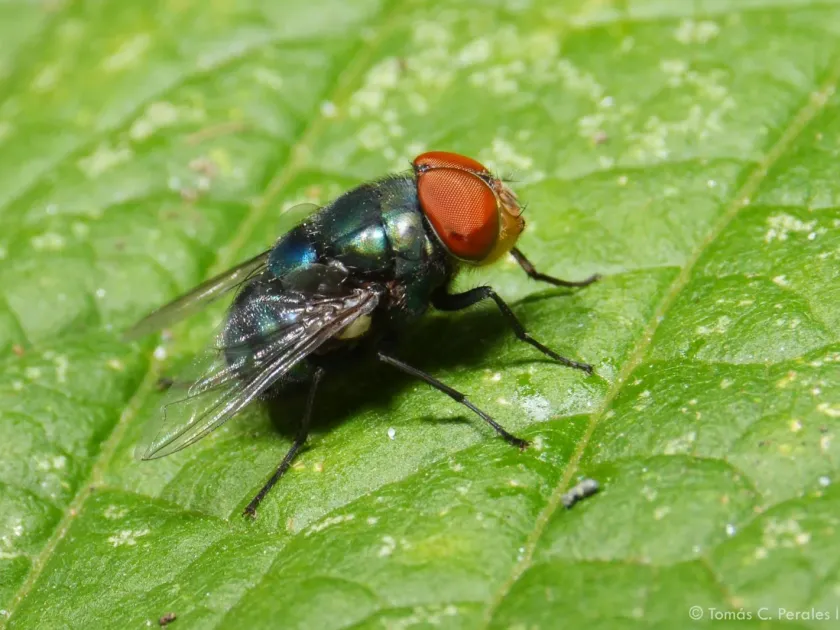
The Oriental latrine fly (Chrysomya megacephala) belongs to the order Diptera and the family Calliphoridae. Adults exhibit a distinctive metallic blue-green body with black thoracic stripes.
The head is large, featuring prominent reddish compound eyes that occupy most of the surface. This species is easily recognizable by its robust build.
Adult flies typically measure between 6 and 12 millimeters in length. Females are generally slightly larger than males, which is a common trait for this species.
The larvae are conical, legless, and creamy-white in color, specifically adapted to thrive in decomposing organic matter or liquid substrates.
The pupal stage occurs within a dark, hardened puparium, which acts as a protective shell during the fly's transformation process.
What it damages
While primarily known as a sanitation pest, Chrysomya megacephala causes indirect damage to agriculture by contaminating harvests with pathogenic bacteria.
The flies are highly attracted to the scent of decaying vegetables and fruits, where they deposit eggs, potentially leading to rapid crop spoilage.
Their presence in storage facilities poses a significant risk to food safety, as they can transmit various pathogens via their excreta and body parts.
In fields where organic fertilizers are used, the flies can create unsanitary conditions that hinder farm management and labor efficiency.
Furthermore, larvae can infest damaged fruits in the field, accelerating rot and facilitating the spread of secondary microbial infections.
When it appears
Activity peaks during warmer months when ambient temperatures consistently stay above 20 degrees Celsius, favoring rapid life cycle completion.
Under optimal conditions, the transition from egg to adult can occur in as little as 7 to 10 days, allowing for a swift population explosion.
Mid-summer and early autumn represent the highest periods of fly density, coinciding with the accumulation of organic waste and crop residues.
Development slows significantly in cooler climates, but the species remains active throughout the year in controlled environments like greenhouses.
Overwintering usually occurs in the pupal stage, buried in the soil or protected crevices near food sources, until temperatures rise again.
Signs of infestation
The most reliable sign of an infestation is the massive presence of metallic blue-green adult flies hovering around composting areas or waste sites.
Visual identification of clusters of small, white, maggot-like larvae on rotting plant tissues confirms an active breeding colony.
A foul, putrid odor emanating from organic waste piles is a strong indicator that larvae are feeding and developing within the mass.
The accumulation of small dark spots on surfaces, representing insect excreta, serves as a clear warning sign of high fly activity nearby.
- Presence of white egg masses on decaying vegetation.
- Masses of larvae actively feeding on organic debris.
- High concentration of adult flies near storage areas.
Control measures
The primary control strategy involves strict sanitation measures, focusing on the prompt removal and disposal of all organic waste and plant debris.
Implementing closed-system composting techniques is essential to prevent flies from accessing organic matter for egg deposition.
Using traps equipped with specific attractants is an effective method for monitoring and reducing the adult fly population in storage facilities.
In cases of severe infestation, the application of targeted insecticides in compliance with safety regulations is necessary for area decontamination.
Physical barriers, such as fine-mesh screening on windows and vents in storage sheds, effectively prevent the entry of flies into crop storage areas.
Taxonomy
- Latin name
- Chrysomya megacephala
- Order
- Diptera (flies)
- Family
- Calliphoridae
- EPPO code
- CHRMMC
Discussion
No discussions yet — be the first.