
Maned wolf
Chrysocyon brachyurus
Description
How to identify
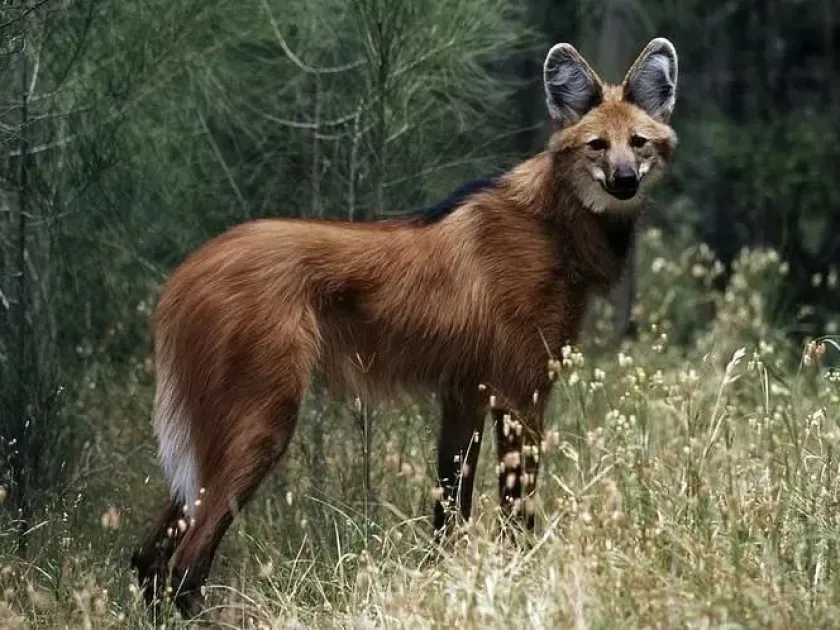
The maned wolf (Chrysocyon brachyurus) is a distinctive canid species native to South America. It is easily recognized by its reddish coat, long black-tipped ears, and elongated, slender legs adapted for tall savanna grasses.
Taxonomically, the maned wolf is classified under the family Canidae and order Carnivora. It is the only member of its genus and is biologically unique, distinct from both wolves and foxes.
The animal is primarily crepuscular and nocturnal, which limits human interaction. It is a solitary creature, preferring to roam across vast areas of grassland and scrub forests rather than staying in one location.
Identification in the field is rarely based on damage but rather on sightings or tracks. Its gait is highly characteristic, moving with a diagonal trot that allows for efficient traversal of uneven terrain.
Although it appears wolf-like, its behavior and biology are more similar to small, solitary hunters. It is an omnivore, with a diet that reflects its diverse and opportunistic natural foraging strategy.
What it damages
The maned wolf is not classified as an agricultural pest. It does not feed on crops, vegetables, or fruits cultivated in industrial farming systems, making it harmless to production.
Its diet consists largely of small mammals, birds, insects, and specific native fruits such as the wolf apple. It performs an ecological service by predating on rodent populations that can actually cause damage to agricultural fields.
Reports of crop damage caused by this species are virtually non-existent. Any physical interaction with crop fields is incidental and results in no significant economic loss for farmers.
Unlike specialized agricultural pests, this mammal does not consume foliage, seeds, or root structures. It has no biological affinity for the types of monoculture crops common in global farming.
Agronomic experts view the maned wolf as a non-target species in pest management programs. There is no evidence that this animal hinders the growth or health of agricultural vegetation.
Control measures
No protective measures are needed against the maned wolf, as it is a protected species in many parts of its range and poses no threat to farming operations or crop yields.
Farmers should focus on preserving natural habitats around their fields. Biodiversity supports natural pest control, and the maned wolf contributes to this by managing populations of agricultural rodents.
If the presence of wild animals is a concern for safety or infrastructure, non-lethal deterrents such as motion-activated lighting or secure fencing are sufficient to discourage them from entering sensitive areas.
It is strictly recommended to avoid the use of traps or chemical agents, as these are ineffective and potentially harmful to non-target wildlife and the ecosystem balance.
Best practices in agricultural management encourage coexistence with local fauna. Maintaining ecological corridors helps keep wild species within their natural territories and away from agricultural infrastructure.
Taxonomy
- Latin name
- Chrysocyon brachyurus
- Family
- Canidae
- EPPO code
- CANIJU
Discussion
No discussions yet — be the first.