
Association plant bug
Chlamydatus associatus
Description
How to identify
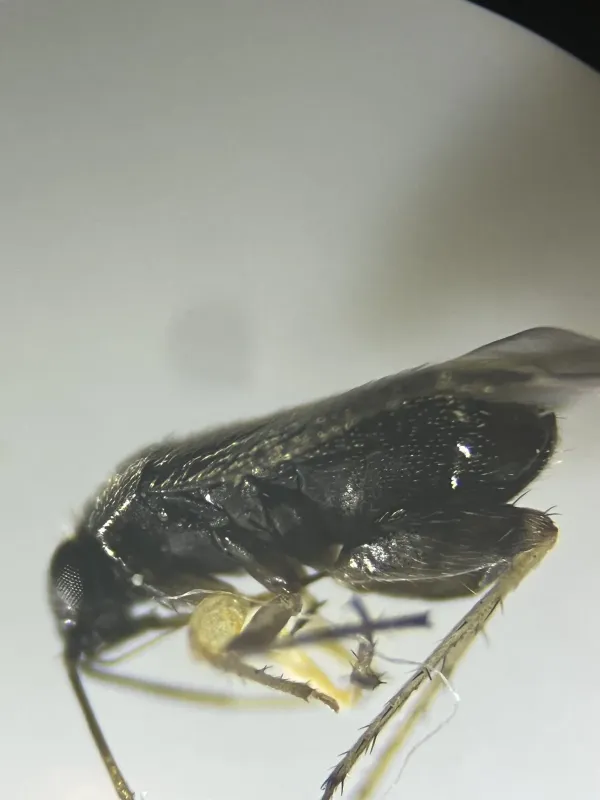
The association plant bug (Chlamydatus associatus) is a small insect species belonging to the Miridae family within the order Hemiptera. Adults typically measure between 2.5 and 3 mm in length, possessing an oval body shape and a dark, often blackish coloration.
They are equipped with functional, membrane-like wings that enable efficient movement across fields. The head and pronotum are covered with fine, short hairs, and the antennae consist of four segments, a morphological characteristic commonly found in this genus.
Nymphs resemble the adults in general appearance but are distinctly smaller and lack fully developed wings. Their coloration varies from pale green to brownish, providing excellent camouflage against the foliage of host plants.
This species is a generalist feeder that has adapted to thrive in various agricultural environments. They are often found in mixed populations with other bug species, which may complicate quick field identification without the use of an insect net.
The life cycle involves an egg stage, five nymphal instars, and the adult stage. The development is closely synchronized with the phenology of host plants, which provide the necessary nutrition for survival throughout the growing season.
What it damages
Chlamydatus associatus is a polyphagous pest known to cause significant damage to various crops, with a particular affinity for Asteraceae family members such as sunflowers, as well as legumes.
These bugs feed by piercing plant tissues with their needle-like mouthparts. During the feeding process, they inject saliva containing digestive enzymes into the plant, causing cellular breakdown and inhibiting photosynthesis.
Feeding damage is most pronounced on young leaves, terminal buds, and flower heads. Affected plant parts often exhibit deformation, chlorosis, and stunted growth, which can lead to measurable yield losses in commercial production.
When infestation levels are high, especially under drought conditions, the plants become severely weakened. The metabolic cost of repairing damaged tissues significantly reduces the plant's overall vigor and reproductive output.
The puncture wounds caused by the bugs serve as entry points for secondary pathogens, including various bacteria and fungi, which can exacerbate the physical damage and potentially lead to widespread crop decay.
When it appears
Activity begins in the spring as temperatures rise, allowing for the hatching of overwintered eggs. These eggs are usually laid in plant debris or within the tissues of host plants during the previous autumn.
The first generation of nymphs emerges in synchronization with the appearance of crop seedlings. This early stage is critical, as the small plants are particularly vulnerable to sap-sucking insects.
The species can complete multiple generations throughout the warmer months. Summer populations are typically the largest, often reaching their peak during the bud formation and flowering stages of the target crops.
As temperatures decline in the autumn, activity slows down significantly. The adult insects prepare for egg-laying, ensuring the continuation of the species' life cycle through the winter months in a state of diapause.
Effective monitoring of seasonal population dynamics is essential for successful management. Using yellow sticky traps or sweep nets during the active season helps agronomists determine the precise timing for intervention.
Signs of infestation
One of the primary indicators of infestation is the appearance of small, pale stippling or spots on the leaves. These spots are individual feeding sites that may eventually coalesce into larger chlorotic areas.
Damage to flower buds often results in curling, desiccation, or premature abscission. In sunflower crops, this can lead to irregular head development and the production of poorly filled seeds, reducing market value.
The presence of insect frass, visible as small black or dark brown dots on the undersides of leaves, confirms the active feeding presence of a bug colony within the affected area of the field.
Visible plant stress, including loss of turgor, wilting of top growth, and general growth retardation, is a common sign of heavy infestation, often appearing in clusters where bug density is highest.
A simple field diagnostic method involves shaking parts of the plant over a white sheet or into a sweep net. Finding large numbers of small, fast-moving insects confirms the presence and density of Chlamydatus associatus.
Control measures
Integrated Pest Management (IPM) is the most effective approach. Cultural controls include the thorough removal of weeds that act as alternative hosts and deep plowing to destroy overwintering egg sites.
Crop rotation and ensuring spatial separation between fields and permanent grasslands can significantly reduce the pressure of bug migration into the main crop at the start of the season.
Biological control methods, such as encouraging natural predators and parasitoids in the field, help maintain insect populations below the economic injury level, minimizing the need for chemical intervention.
When the economic threshold is exceeded, application of systemic or contact insecticides is recommended. Choosing products that have minimal impact on beneficial insects is crucial for maintaining the ecological balance.
- Perform regular field scouting with sweep nets.
- Maintain clean field borders to reduce host plants.
- Implement proper crop rotation sequences.
- Apply insecticides strictly following label directions.
- Monitor populations to optimize treatment timing.
Taxonomy
- Latin name
- Chlamydatus associatus
- Order
- Hemiptera (bugs, aphids, leafhoppers)
- Family
- Miridae
- EPPO code
- CHLAAS
Discussion
No discussions yet — be the first.