
Chilocorus nigrita
Chilocorus nigrita
Description
How to identify
Chilocorus nigrita is a species of ladybird beetle (Coccinellidae). It is vital to state that this insect is not a plant pest; it is a highly beneficial predator used in biological control programs.
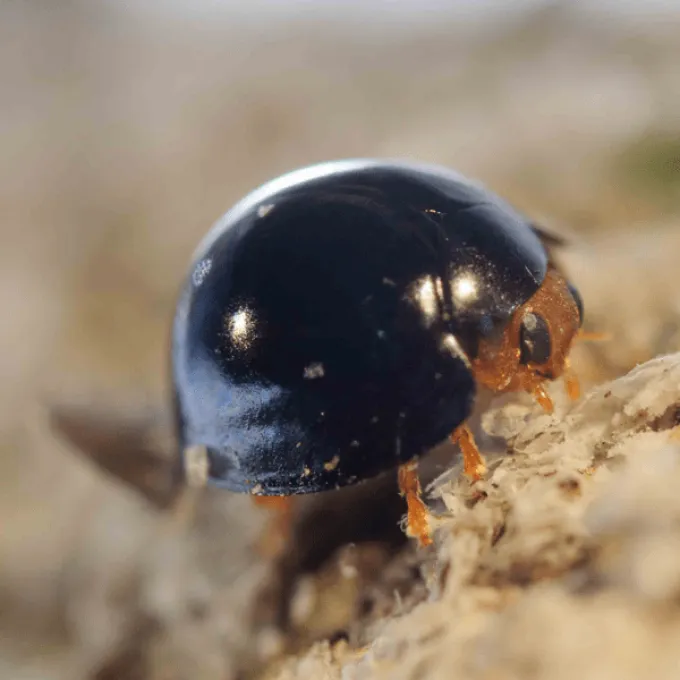
The adult beetle has a characteristic dome-shaped body. It is entirely glossy black in color, without any spots on its wing covers, which distinguishes it from many other common ladybirds.
The larvae are elongated and covered in distinctive spines. They are extremely active and can often be found crawling along twigs and branches searching for prey.
The pupal stage is dark and often remains attached to the bark or leaves of host plants, providing a form of cryptic coloration that protects it from predators.
These beetles are primarily found in orchards and plantations, particularly in citrus groves, where they focus their activity on infested areas.
What it damages
As a predatory insect, Chilocorus nigrita does not feed on plant tissues. Instead, it is a specialized natural enemy of various scale insects and mealybugs.
By consuming large quantities of scale insects during both its larval and adult stages, it prevents these pests from sap-sucking, which would otherwise stunt plant growth and reduce fruit yield.
The beetle acts as a natural guardian of the garden, suppressing populations of harmful insects that are often difficult to control with conventional chemical means.
The presence of this species is highly valued in organic and integrated pest management systems, as it reduces the need for toxic pesticide sprays.
Because it causes no damage to leaves, stems, or fruits, it is considered an essential component of a sustainable agricultural ecosystem.
When it appears
The life cycle and activity of Chilocorus nigrita are heavily influenced by temperature, with optimal development occurring in warm, stable conditions.
The insect progresses through the egg, four larval instars, pupa, and adult stages. This rapid cycle allows it to produce multiple generations during a single growing season.
Adult beetles overwinter in sheltered locations, such as under tree bark or within leaf litter, emerging when temperatures rise in the spring.
Peak populations usually coincide with the height of summer, which aligns with the high pest pressure from scale insects, ensuring the predator has ample food resources.
As autumn approaches and temperatures drop, the beetles seek out overwintering sites, signaling the end of their peak active period.
Control measures
Since Chilocorus nigrita is a beneficial organism, there is no need to control it. Rather, the goal is to protect and encourage its presence in the ecosystem.
To support a healthy population of this beetle, farmers should avoid the use of broad-spectrum insecticides that can cause mass mortality of non-target beneficial insects.
Implementing a selective pest management program ensures that harmful insects are suppressed while preserving the natural balance of predator-prey relationships.
Providing refugia, such as hedgerows or untreated perimeter zones, can offer safe spaces for the beetles to survive during intensive agricultural activities.
- Avoid the use of non-selective pesticides.
- Use selective biological pesticides when necessary.
- Monitor scale insect populations to assess the predator's effectiveness.
- Promote biodiversity within orchards to sustain the predator colony.
Taxonomy
- Latin name
- Chilocorus nigrita
- Order
- Coleoptera (beetles)
- Family
- Coccinellidae
- EPPO code
- CHICNI
Discussion
No discussions yet — be the first.