
Chilocorus bipustulatus
Chilocorus bipustulatus
Description
How to identify
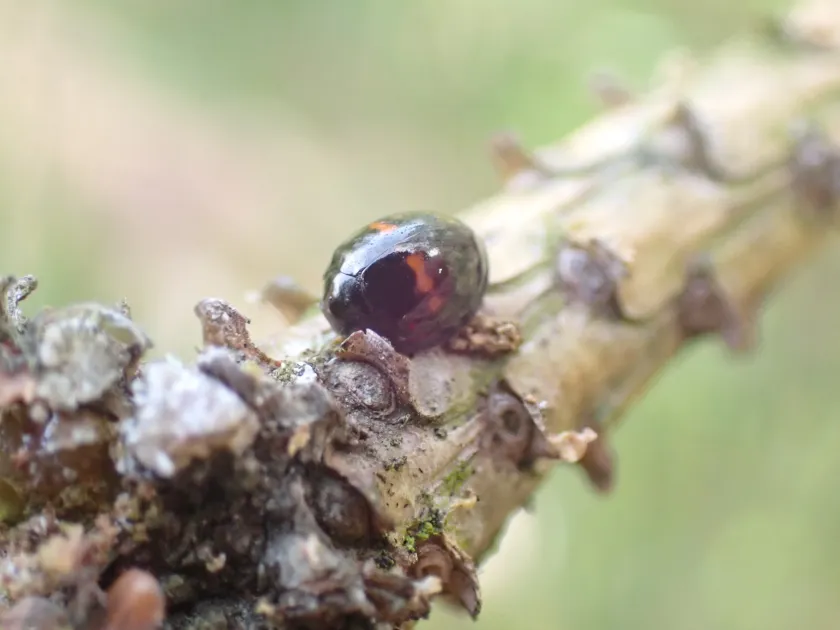
Chilocorus bipustulatus, commonly known as the heather ladybird, is a species of beetle belonging to the Coccinellidae family within the order Coleoptera. Adult beetles are small, typically measuring between 3 and 5 mm in length, with a distinct shiny black or dark brown appearance.
The elytra of the beetle usually feature three reddish or yellowish spots arranged in a transverse row, although the appearance of these spots can vary between individuals. The body is highly convex and almost hemispherical, which is a structural characteristic of the Chilocorus genus.
Larvae are elongated and covered with numerous spines, providing them with a specialized appearance distinct from many other ladybird larvae. They undergo several molting stages, growing larger and more efficient at hunting as they develop.
It is crucial to recognize that this beetle is an essential entomophage rather than a plant pest. Its presence in agricultural environments often indicates a functioning biological control system against coccids.
The life cycle involves complete metamorphosis, including egg, larva, pupa, and imago stages. Adult beetles typically overwinter in sheltered locations, such as crevices in tree bark or leaf litter.
What it damages
Chilocorus bipustulatus does not cause damage to crops. On the contrary, it acts as a valuable predator that feeds primarily on scale insects and mealybugs, which are notorious pests of woody plants and fruit trees.
By consuming harmful coccids, the beetle helps protect trees and shrubs from the damage caused by sap-sucking insects, which can lead to plant yellowing, wilting, and premature leaf drop.
The predatory activity of both larvae and adults keeps pest populations below the economic injury level, thereby reducing the dependency on synthetic chemical pesticides.
In environments where pesticides are applied excessively, the population of Chilocorus can collapse, often resulting in subsequent rapid outbreaks of scale insects that are difficult to manage.
The economic benefit of this species lies in its contribution to sustainable agriculture, as it provides free, ongoing protection against some of the most persistent orchard pests.
When it appears
The active season for Chilocorus bipustulatus begins in early spring, as soon as temperatures rise sufficiently to allow the beetles to emerge from their overwintering sites and search for prey.
Depending on the climatic conditions and the abundance of prey, the beetle can complete several generations throughout the growing season, effectively tracking the population cycles of scale insects.
Peak activity for larvae and adults typically occurs during the mid-summer months, corresponding with the period when scale insect populations are most active and visible on host plants.
As autumn arrives and daylight hours decrease, the beetles initiate the process of seeking out hibernation sites, transitioning into a dormant state to survive the cold winter months.
Overwintering occurs in a state of diapause, during which the adult beetles demonstrate high cold tolerance by hiding under loose bark or in protected debris near their host trees.
Signs of infestation
A primary indicator of Chilocorus bipustulatus presence is the observation of scale insect colonies on branches that show signs of being partially or entirely cleared by predation.
Careful visual inspection of tree trunks and branches during spring and summer often reveals the presence of adult beetles or spiny larvae actively hunting among the pest colonies.
The remains of discarded pupal skins attached to the bark serve as a reliable biological marker, indicating that the population of this predator has successfully developed at that location.
A stable or decreasing population trend of scale insects on infested trees is often a testament to the efficient control provided by a robust population of these predatory ladybirds.
Gardeners can use magnifying tools to check for the characteristic spiny larvae, which confirms that the natural predatory mechanism is active within the orchard ecosystem.
Control measures
The most important measure for protecting Chilocorus bipustulatus populations is to avoid the application of broad-spectrum insecticides, especially during periods when larvae and adults are active.
Farmers should focus on enhancing biodiversity in and around the orchard, providing natural habitats and refuge areas where beneficial insects can survive during the off-season.
If chemical intervention is absolutely necessary for other pests, selective pesticides that minimize harm to Coccinellidae species should be prioritized to maintain the ecological balance.
Implementing a regular monitoring program helps assess the predatory-prey ratio, ensuring that interventions are based on actual need rather than preventative spraying schedules.
Integrated Pest Management (IPM) strategies must include the preservation of natural predators like Chilocorus bipustulatus to ensure long-term sustainability and healthy crop yields.
Taxonomy
- Latin name
- Chilocorus bipustulatus
- Order
- Coleoptera (beetles)
- Family
- Coccinellidae
- EPPO code
- CHICBP
Discussion
No discussions yet — be the first.