

Description
How to identify
The wheat stem sawfly (Cephus pygmeus) belongs to the Cephidae family of Hymenoptera and is a significant agricultural pest worldwide.
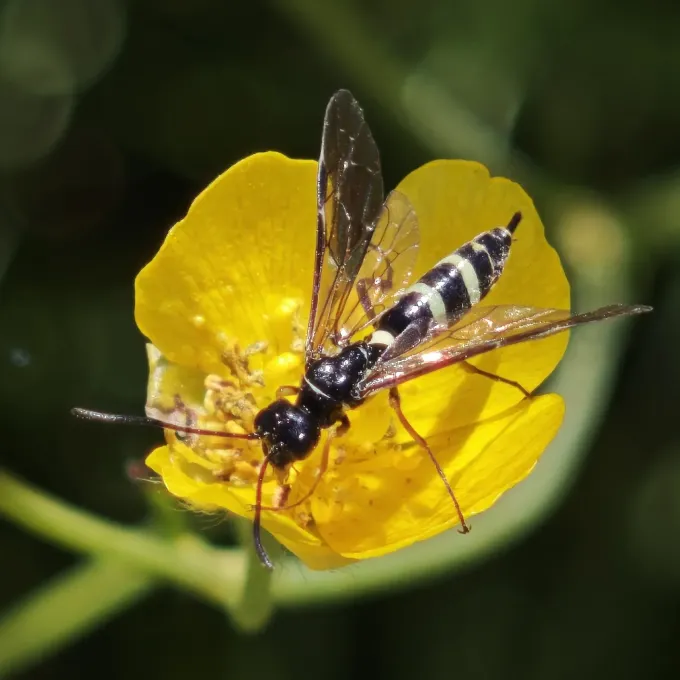
Adults are slender, wasp-like insects measuring about 8–10 mm in length, possessing a black body with yellow abdominal bands and clear wings.
The larvae, which cause damage, are legless, yellowish-white, and have a distinctive S-shaped posture with a brown-headed appearance.
They typically complete one generation per year, overwintering as mature larvae inside the base of the stems of cereal crops.
In spring, the larvae pupate within the stubble, and the emerging adults focus on finding suitable host plants for reproduction.
What it damages
Larvae feed internally on the stem tissues of wheat, barley, and rye, mining the parenchyma and disrupting the plant's vascular system.
This internal feeding inhibits grain development, leading to shriveled grains, reduced test weight, and significant yield losses in affected fields.
As the plant nears maturity, the larva cuts a circular groove near the base of the stem, drastically weakening its structural integrity.
The primary economic impact occurs when infested stems collapse and lodge, making mechanical harvesting difficult or impossible for farmers.
Even if the crop is harvested, the loss of grain quality and the inability to pick up lodged stalks result in substantial financial damage.
When it appears
Adult sawflies emerge in late spring or early summer, with the timing being highly dependent on soil temperature and humidity conditions.
Egg-laying coincides with the booting and flowering stages of cereals, as females seek out suitable stems to deposit their eggs.
Larval development continues throughout the grain-filling stages, during which the larvae move progressively down toward the stem base.
By the time the crop is ready for harvest, the larvae have typically reached the base and formed a protective chamber for the winter.
Extended dry seasons often aggravate the impact, as infested plants are less resilient and lodge faster compared to healthy wheat crops.
Signs of infestation
Field scouting often reveals individual stems with premature whitening of the head, which can be mistaken for drought or nutritional stress.
A telltale sign is the presence of fine, dark sawdust-like frass (excrement) ejected through small holes made by the larva in the stem.
Widespread, random lodging of wheat stalks is a major indicator of an infestation, especially if there have been no high-wind events.
Splitting the stem longitudinally will expose the internal tunnels, debris, and the larva itself, confirming the presence of the pest.
Visual inspection of the stubble after harvest will frequently show the larvae overwintering in the basal portions of the stalks.
Control measures
Deep tillage or plowing after harvest is an effective method to bury stubble, which significantly reduces the survival rate of overwintering larvae.
Implementing crop rotation, specifically avoiding successive wheat plantings, helps break the life cycle of the sawfly in localized areas.
Choosing crop varieties with solid or thick-walled stems is a key agronomic strategy to resist female oviposition and limit larval movement.
Systemic insecticide applications applied at the correct time during the adult flight period can suppress populations before egg-laying occurs.
Early harvesting helps to capture yield before heavy infestations cause severe lodging, significantly reducing the impact of the pest at scale.
Content graph
Connections · Wheat stem sawfly
Most often together:
Marketplace
Products · 5


Biology
Taxonomy
- Latin name
- Cephus pygmeus
- Order
- Hymenoptera
- Family
- Cephidae
- EPPO code
- CEPHPY
Community
Discussion
No discussions yet — be the first.