
Spruce web-spinning sawfly
Cephalcia stigma
Description
How to identify
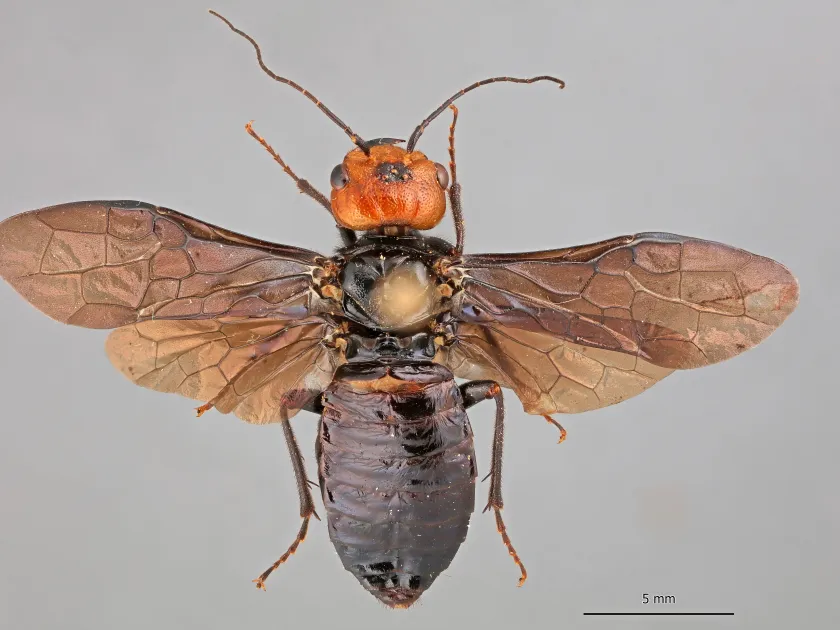
The spruce web-spinning sawfly (Cephalcia stigma) belongs to the order Hymenoptera, specifically the family Pamphiliidae. Adults are medium-sized insects with a wingspan of approximately 25–30 mm.
The body of the adult sawfly is brownish with distinct yellow markings. They possess a robust head with powerful mandibles, which are used both for feeding and for constructing protective silken webs.
Larvae, known as false caterpillars, reach lengths of up to 25 mm. They are yellowish-green, cylindrical in shape, and lack abdominal prolegs, a feature that distinguishes them from moth larvae.
The insect undergoes a complex life cycle, spending a significant portion of its time in diapause within the soil. They overwinter as larvae in chambers deep in the forest floor.
As a forest pest, Cephalcia stigma can experience periodic population outbreaks, causing localized but intense damage to spruce stands across the European region.
What it damages
The primary host for the spruce web-spinning sawfly is the Norway spruce (Picea abies). While rare, the larvae may occasionally infest other spruce species found in nurseries or arboretums.
The damage is caused exclusively by the larvae. They are gregarious feeders, meaning they feed in groups, creating communal webs on the branches where they consume the needles.
Heavy defoliation is the most common symptom. When larvae consume the majority of the needles, the spruce tree loses its photosynthetic capacity, leading to severe physiological stress.
Young spruce trees are especially vulnerable. Repeated defoliation or high infestation levels can kill saplings and young trees within a single or two growing seasons.
In mature trees, the loss of needles makes the spruce susceptible to secondary bark beetle attacks, which often prove to be the ultimate cause of tree mortality following a sawfly outbreak.
When it appears
Adults emerge from the soil in late spring or early summer, typically between May and June. After mating, females lay their eggs individually on the needles of the host tree.
The eggs hatch after a few weeks, and the young larvae immediately begin to spin silk webs to protect themselves as they feed. This feeding phase lasts through the summer months.
By late summer or early autumn, the larvae finish their development. They descend to the ground and burrow into the soil to prepare for their overwintering stage.
Inside the soil, they form chambers. Some larvae may pupate in the following spring, while others enter prolonged diapause, potentially staying in the soil for several years.
This staggered emergence and diapause strategy makes the population highly resilient to environmental fluctuations, ensuring the species survives even after harsh winters or drought.
Signs of infestation
The most visible sign of an infestation is the presence of silk webbing among the spruce needles. These webs often contain frass (larval waste) and cut needle fragments.
Branches infested with larvae will show significant thinning. You can observe half-eaten needles or needles that have been clipped at the base by the larvae.
Beneath the canopy of an infested tree, one can often find a rain of dark, granular fecal pellets, which is a tell-tale sign that active feeding is occurring above.
The foliage of affected trees may turn chlorotic or brownish, giving the crown a sickly appearance. In severe cases, the tree crown looks sparse and ragged from a distance.
Physical inspection of the branches during the active season usually reveals the presence of larvae inside the silk enclosures or feeding near them.
Control measures
Chemical control involving insecticides is most effective when applied during the early larval stage, specifically when the larvae are just emerging and beginning to feed.
For ornamental trees or high-value nursery stocks, physical removal and destruction of the web-nests can effectively stop the infestation if caught early enough.
Biological control methods, including the use of entomopathogenic fungi or bacteria, are increasingly used in integrated pest management programs to lower populations.
Promoting a healthy ecosystem by encouraging native birds and parasitic wasps helps keep the sawfly population in check naturally, as these act as significant predators.
- Monitoring with pheromone traps to predict population surges.
- Maintaining tree vigor through proper silvicultural practices to prevent secondary infestations.
- Strategic timing of pesticide application to minimize impact on non-target beneficial insects.
Taxonomy
- Latin name
- Cephalcia stigma
- Order
- Hymenoptera
- Family
- Pamphiliidae
- EPPO code
- CEPCST
Discussion
No discussions yet — be the first.