
Sakhalin spruce web-spinning sawfly
Cephalcia sachalinensis
Description
How to identify
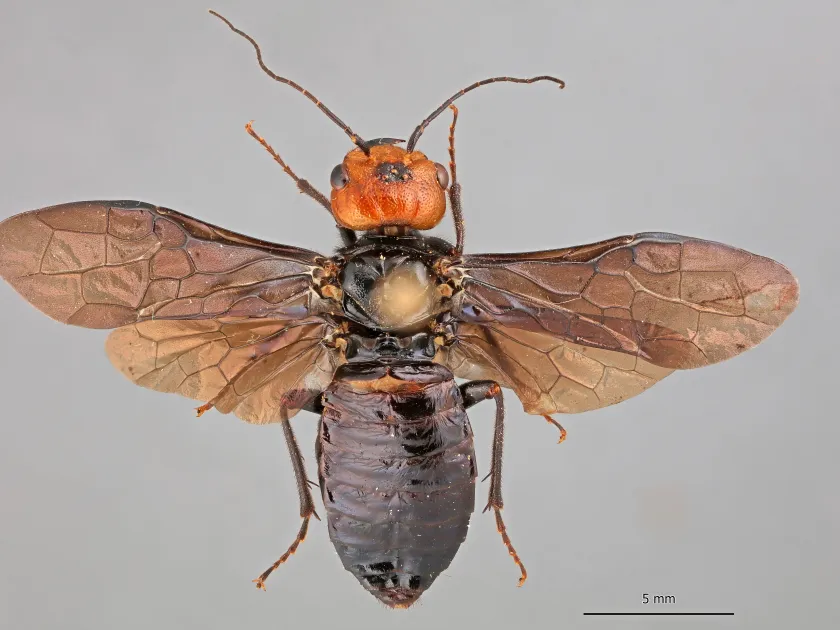
The Sakhalin spruce web-spinning sawfly (Cephalcia sachalinensis) belongs to the Pamphiliidae family within the order Hymenoptera. Adult sawflies are medium-sized, typically measuring between 10 to 14 mm in length, with a robust structure typical of web-spinning sawflies.
Adults often display a dark coloration with yellowish markings on the abdomen and head. They possess a wide head with strong mandibles, which are adapted for feeding on spruce needles during their active flight period in the early summer.
The larvae are distinct in their appearance, featuring a cylindrical body that lacks abdominal prolegs. Their color transitions from light green to a yellowish-green hue as they progress through different larval stages.
The life cycle includes a complete metamorphosis: egg, larva, pupa, and adult. Each stage is strictly regulated by environmental conditions, ensuring that the species can survive and thrive in its native habitat.
The larvae are well-known for spinning silk nests, which serve as protective shelters. These nests are critical indicators that allow foresters and gardeners to identify the presence of the infestation on spruce branches.
What it damages
This pest primarily attacks various species of spruce, with a noted preference for Ayan spruce (Picea jezoensis). Both young saplings in nurseries and mature trees in the forest are susceptible to damage caused by this insect.
Larvae feed by consuming spruce needles, leading to significant defoliation of the tree. When populations reach high levels, the loss of needles can be severe, significantly impairing the tree's ability to photosynthesize.
Repeated or intense feeding can cause the needles to yellow and drop prematurely. As the tree loses its foliage, it becomes severely stressed, making it vulnerable to opportunistic pests like bark beetles and wood borers.
In ornamental landscaping and spruce plantations, the aesthetic and commercial value is greatly diminished. Severely defoliated trees may suffer from branch dieback or total mortality if the infestation is not addressed promptly.
The long-term physiological impact on the tree includes reduced growth rates and weakened defense mechanisms. This often leads to a decline in tree health that can last for several years after the initial attack.
When it appears
Adult sawflies emerge during the first half of the summer, depending on local temperatures. Once active, the females deposit their eggs singly or in small groups on the needles of the host spruce trees.
Larvae emerge after approximately two weeks and begin their feeding cycle immediately. During this period, they construct silk-based nests, which they expand as they continue to feed and grow throughout the summer months.
After completing their larval development, they drop to the ground and burrow into the soil to pupate. They create earthen cells where they remain in diapause, waiting for the conditions necessary to complete their cycle.
The life cycle can be prolonged, with some individuals remaining in the soil for multiple seasons before emerging. This strategy is an adaptation to ensure population survival in fluctuating environmental conditions.
Weather factors such as soil moisture and temperature during the overwintering period are crucial for survival. Harsh winters without sufficient ground cover can help suppress the population naturally.
Signs of infestation
The most reliable sign of an infestation is the presence of silk nests spun between needles. These nests appear as tangled webs that accumulate debris and frass from the feeding larvae.
Needle yellowing and premature shedding are typical symptoms of damage. Close inspection often reveals partially consumed needles or needles that have been completely stripped from the shoots.
As the larvae grow, the size of the silk webs increases, making them more visible in the canopy. The canopy itself may appear thinned or patchy, particularly if the infestation is concentrated in specific branches.
In cases of high infestation, the presence of frass (larval waste) at the base of the tree or caught in lower branches is a strong indicator of an active population. The overall appearance of the tree becomes sickly and lackluster.
Signs of secondary stress, such as resin exudation from the trunk or twigs, may follow significant defoliation. This indicates that the tree is struggling to defend itself against the primary damage caused by the sawfly.
Control measures
Mechanical control involves the manual removal and destruction of larval nests. This is a highly effective method for managing the pest on ornamental trees or in smaller nursery settings.
Biological control methods include the use of entomopathogenic fungi or bacteria. These preparations offer an environmentally friendly alternative to chemical pesticides, minimizing harm to beneficial insects.
Chemical control should be employed by applying systemic or contact insecticides during the larval emergence phase. Proper timing is essential for ensuring that the treatment covers the period when larvae are most active.
- Regular monitoring using pheromone traps to assess population density.
- Enhancing habitat for natural predators, such as insectivorous birds and parasitic wasps.
- Maintaining tree vigor through proper fertilization and watering to prevent infestation.
An integrated pest management (IPM) approach is recommended to maintain long-term control. By combining monitoring, cultural practices, and selective interventions, the risk of significant damage can be effectively mitigated.
Taxonomy
- Latin name
- Cephalcia sachalinensis
- Order
- Hymenoptera
- Family
- Pamphiliidae
- EPPO code
- CEPCSA
Discussion
No discussions yet — be the first.