
Spruce web-spinning sawfly
Cephalcia fascipennis
Description
How to identify
The Spruce web-spinning sawfly (Cephalcia fascipennis) is a member of the order Hymenoptera, belonging to the family Pamphilidae. Adult insects are stout-bodied sawflies with a wingspan of roughly 25 mm and a distinct yellow and black color pattern.
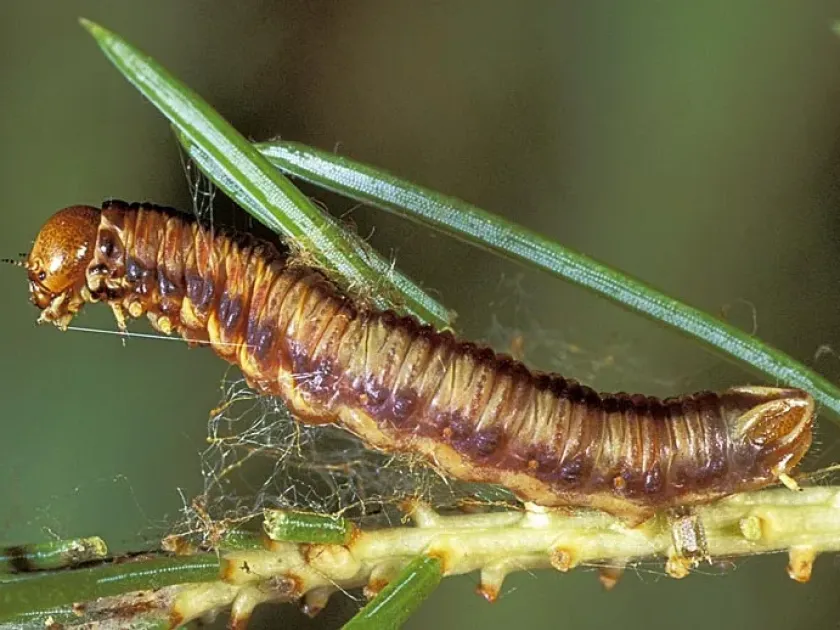
The larvae are approximately 20–25 mm long, exhibiting a greenish-yellow or brownish body color. They are identifiable by the absence of abdominal prolegs and the presence of long, thread-like appendages at the posterior end of the abdomen.
What it damages
The primary host for this pest is the Norway spruce. Under conditions of high population density, the sawfly may cause severe defoliation, leading to stunted growth, loss of vigor, and increased susceptibility to secondary infections and wood-boring beetle attacks.
While mature forests can sometimes withstand infestation, young spruce plantations, forest nurseries, and ornamental tree stands are particularly vulnerable to extensive damage caused by the feeding activity of these insects.
When it appears
Adults emerge during May and June, coinciding with the spruce flushing period. Females lay eggs singly or in small groups on the needles, ensuring that newly hatched larvae have an immediate food source.
Larval development occurs throughout the summer months. During this time, they construct elaborate silken webs that serve as communal feeding shelters, protecting them from predators and environmental stressors while they consume the needles.
Signs of infestation
The most prominent sign of infestation is the presence of webbed nests formed by larvae around spruce needles. These nests are composed of silk mixed with larval excrement, which creates a noticeable, messy appearance on the branches.
Once the needles are consumed, the branches appear thin and grayish. Over time, the defoliated needles fall to the ground, and in severe cases, the entire tree crown may lose its density and overall green appearance.
Control measures
Effective management strategies combine biological monitoring with targeted chemical treatments to minimize damage to host trees.
- Monitoring adult populations using pheromone traps to predict infestation levels.
- Applying systemic or contact insecticides when larvae are in the active feeding stage.
- Utilizing biological control agents, such as Bacillus thuringiensis, to target larvae while preserving beneficial insects.
- Implementing sanitation measures, including the removal of heavily infested branches or trees.
- Tilling the soil beneath affected trees in late autumn to disrupt the pupation cycle of the sawfly.
Taxonomy
- Latin name
- Cephalcia fascipennis
- Order
- Hymenoptera
- Family
- Pamphiliidae
- EPPO code
- CEPCFS
Discussion
No discussions yet — be the first.