
False spider mite
Cenopalpus
Description
How to identify
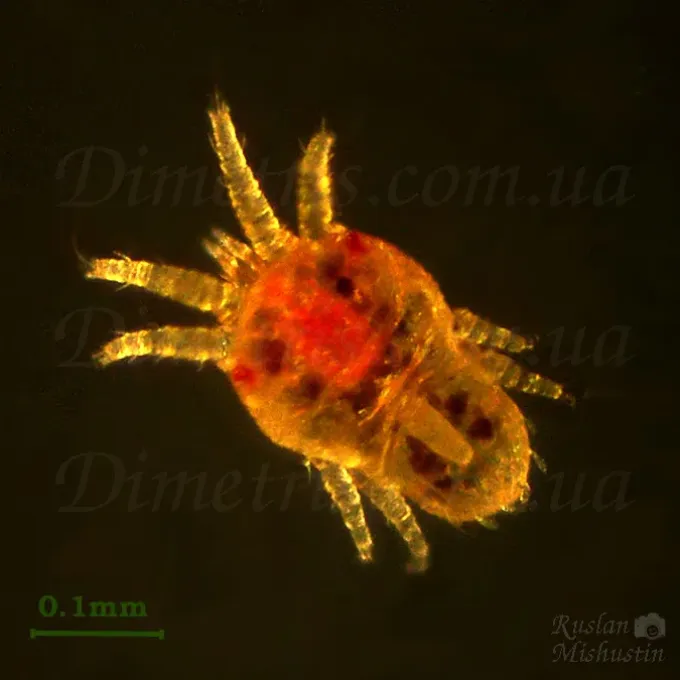
The false spider mite, belonging to the genus Cenopalpus (family Tenuipalpidae), is a minute pest usually measuring no more than 0.3 mm in length. Unlike common spider mites, these pests have a flattened, reddish-orange body and do not produce silken webbing on host plants.
The life cycle involves an egg stage, larva, two nymphal stages (protonymph and deutonymph), and the adult. Fertilized females usually overwinter in bark crevices, bud scales, or under dry leaves, becoming active as soon as spring temperatures rise.
Development time is highly temperature-dependent. During warm summer months, a single generation can complete its cycle in approximately 15 to 20 days, leading to multiple overlapping generations within one growing season.
The mite's flattened shape is an evolutionary adaptation that allows it to occupy narrow spaces, such as the space between a leaf petiole and the stem or within the structure of a developing bud, making direct contact difficult.
Identification often requires a hand lens with at least 10x-20x magnification. Observers should focus on the underside of leaves and along the midribs, where these mites prefer to feed and oviposit.
What it damages
Cenopalpus mites are polyphagous, affecting a wide range of fruit crops including apples, pears, grapes, and citrus. They damage plants by inserting their mouthparts into leaf cells to extract plant fluids, causing localized tissue death.
Direct damage to leaves disrupts the photosynthetic process, leading to chlorosis, stunted growth, and a general decline in plant vigor. This stress makes the host plant more susceptible to other diseases and environmental stressors.
Fruit damage is a significant economic concern. Feeding on the surface of developing fruits results in russeting, microscopic cracking, or permanent discoloration of the peel, which reduces the crop's market value.
Severe infestations cause premature leaf senescence and abscission. When the foliage drops too early in the season, the plant fails to accumulate enough energy reserves for the following spring, leading to poor bud development.
In nurseries or young orchards, sustained mite activity can cause severe growth retardation, potentially leading to the death of young seedlings or newly grafted rootstocks if left uncontrolled.
Signs of infestation
The initial signs of infestation are subtle: small yellow or pale stippling marks appear on the upper surface of leaves. As the population grows, these spots coalesce into larger bleached or bronzed patches.
Leaves affected by high densities of mites become brittle, lose their natural sheen, and may curl along the edges. The bronzing effect is particularly diagnostic for this genus of mites compared to other common pests.
On the fruit surface, growers may notice a characteristic rough, rusty texture. This symptom is often mistaken for fungal disease, but it is actually the result of the physical destruction of the fruit skin cells by the mites.
By late summer, the presence of empty egg cases on the undersides of leaves confirms that the population has been active. The overall canopy may look thin or dusty due to the loss of leaf integrity.
- Stippling and bronzing of leaves.
- Russeting or scarring on fruit surfaces.
- Premature leaf drop in late summer.
- Reduced vigor and stunted shoot growth.
Control measures
Integrated Pest Management (IPM) is essential for controlling Cenopalpus. Cultural practices, including the removal of dead bark and pruning of infested twigs, can significantly reduce the overwintering population.
Dormant oil sprays applied in late winter or early spring are highly effective at smothering eggs and overwintering females, providing a "clean slate" for the orchard before the growing season begins.
During the growing season, if monitoring indicates that threshold levels are exceeded, the application of specific acaricides is necessary. It is crucial to rotate chemical classes to prevent the development of pesticide resistance.
Biological control agents, particularly predatory mites from the Phytoseiidae family, play a vital role in natural suppression. Maintaining an environment that supports these predators can keep mite populations below economic thresholds.
Irrigation management is a non-chemical factor; maintaining healthy, well-hydrated trees is critical, as water-stressed plants are significantly more attractive and vulnerable to mite colonization.
Taxonomy
- Latin name
- Cenopalpus
- Order
- Mites
- Family
- Tenuipalpidae
- EPPO code
- CENOSP
Discussion
No discussions yet — be the first.