
Lemon Emigrant
Catopsilia pomona
Description
How to identify
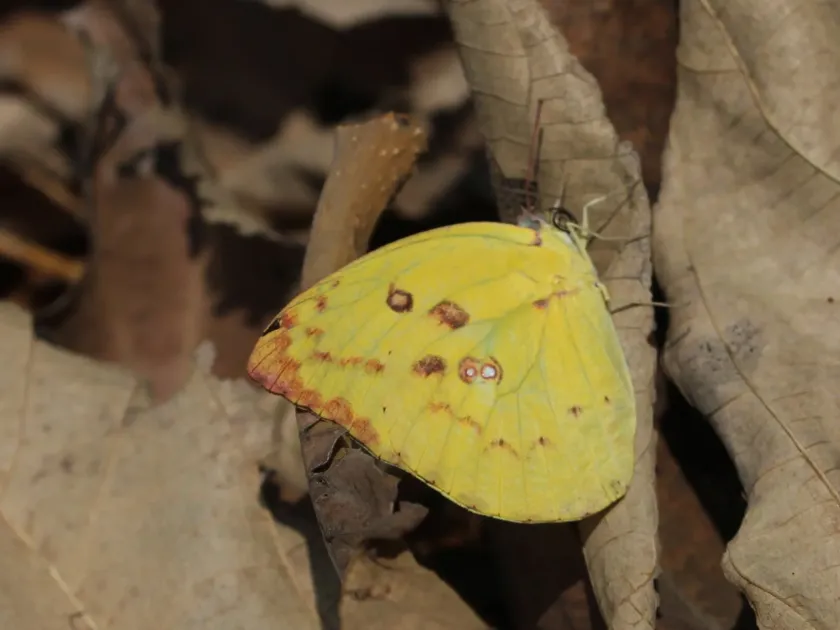
The Lemon Emigrant (Catopsilia pomona) belongs to the Pieridae family, order Lepidoptera. The adult butterfly is a large insect with a wingspan of 70-80 mm, typically featuring yellow, green, or white coloration with distinctive dark markings on its wings.
The larvae (caterpillars) of this species are bright green with longitudinal pale stripes along their sides, which provides excellent camouflage against the host plant foliage. The body is covered with fine hairs, and the head is characterized by a tough, sclerotized structure.
The life cycle consists of four stages: egg, larva (caterpillar), pupa, and adult (imago). The female deposits eggs primarily on the undersides of leaves, choosing the most succulent parts of the host plant to ensure offspring survival.
Pupation occurs directly on the plant or in its immediate vicinity. The pupa features a protective shape and color that often blends into the host plant's stems, making it difficult to detect during routine crop scouting.
The duration of the life cycle is highly dependent on regional temperatures and the availability of food sources. In tropical and subtropical climates, the species can produce multiple generations within a single growing season.
What it damages
The primary food source for the larvae are plants from the legume family (Fabaceae). In agricultural settings, the pest causes significant damage to crops such as cassia, senna, and various ornamental legume species.
Caterpillars are highly voracious, actively consuming foliage at all larval stages. During periods of high population density, they can completely defoliate a plant, leaving only petioles and the main veins behind.
Loss of leaf surface area reduces photosynthetic efficiency, which stunts plant growth and vigor. Weakened plants become significantly more susceptible to secondary infections and opportunistic plant diseases.
During outbreaks, this pest can cause substantial economic losses for commercial plantations grown for pharmaceutical purposes, as it directly impacts the quality and volume of the harvestable plant material.
Damage to apical shoots can lead to the cessation of vertical growth and disruption of the flowering and fruiting cycles, which is particularly critical for seed-producing agricultural operations.
When it appears
The activity of the butterflies is directly linked to temperature and rainfall patterns that trigger host plant growth. In tropical regions, the pest may remain active and reproductive throughout the entire year.
The peak feeding period for caterpillars coincides with the phase of intensive plant growth. During this time, adult butterflies are most active in depositing eggs on the young, nitrogen-rich leaves of the crops.
The speed of metamorphosis increases significantly at air temperatures between 25-30 degrees Celsius. In favorable humidity conditions, generation turnover accelerates, leading to rapid increases in population density.
The migratory nature of the adult butterflies allows them to quickly colonize new areas, which complicates monitoring and effective forecasting of population surges across larger agricultural landscapes.
Overwintering usually occurs at the pupal stage in protected areas or within residual vegetation, provided the regional climate allows for the insect to survive without entering a state of complete diapause.
Signs of infestation
The first visual sign of infestation is skeletonized foliage. Caterpillars begin by nibbling the edges of leaf blades, gradually progressing to complete defoliation, which becomes apparent even during casual field inspections.
The presence of frass (excrement) on leaf surfaces beneath feeding sites is a reliable indicator of active larval presence. These waste deposits often accumulate in leaf axils and on the lower canopy layers.
Another sign is the observation of the larvae themselves, which, despite their camouflage, may be detected by shaking branches over a collection tray or cloth during crop scouting exercises.
Noticeable yellowing and wilting of individual branches in the absence of drought can indicate severe damage to the leaf apparatus, preventing normal nutrient transport and sap flow throughout the plant.
Increased butterfly activity flying over fields during the day suggests an active egg-laying phase, necessitating immediate surveillance and the implementation of appropriate pest control measures.
Control measures
Mechanical control involves the manual collection of caterpillars and the pruning of heavily infested plant parts. This method is effective in small gardens or private holdings with low pest pressure.
Biological control strategies include the application of formulations based on Bacillus thuringiensis, which are environmentally friendly and effective against lepidopteran larvae during their early development stages.
The use of pheromone traps for monitoring adult butterfly populations allows for precise timing of chemical interventions, significantly reducing the number of pesticide applications required per season.
Chemical protection involves the use of systemic and contact insecticides when the economic threshold of damage is reached. It is vital to rotate active ingredients to prevent the development of insecticide resistance.
- Consistent removal of weed hosts around field margins.
- Attracting natural predators, such as predatory bugs and parasitic wasps.
- Implementing crop rotation to break the pest's reproductive cycle.
- Deep soil plowing after harvest to destroy overwintering pupae.
Taxonomy
- Latin name
- Catopsilia pomona
- Order
- Lepidoptera (butterflies)
- Family
- Pieridae
- EPPO code
- CATPPO
Discussion
No discussions yet — be the first.