
Dried fruit beetle
Carpophilus truncatus
Description
How to identify
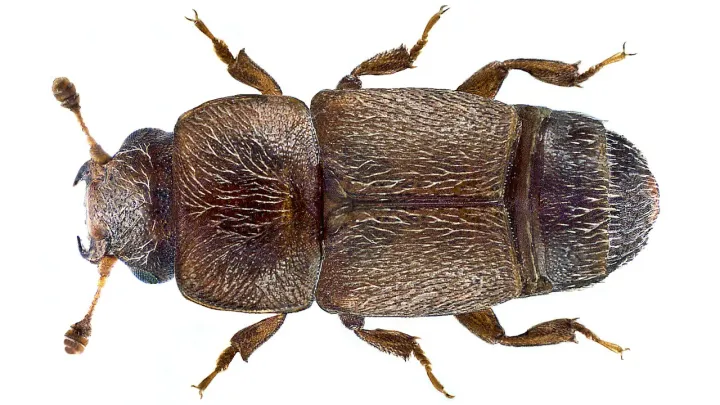
The dried fruit beetle (Carpophilus truncatus) belongs to the order Coleoptera and the family Nitidulidae. Adult beetles are small, typically ranging from 2.5 to 3.5 mm in length, and are characterized by truncated elytra that do not fully cover the tip of the abdomen.
The insect's body is elongated-oval, with a color ranging from dark brown to almost black, often featuring reddish-brown spots. The body surface is covered with fine hairs, giving the beetle a matte appearance, and the antennae terminate in a distinct club.
Larvae are whitish or yellowish with sclerotized plates on their segments. They lead a cryptic life, developing directly within the substrate they feed on, which makes early detection difficult.
Accurate species identification often requires laboratory equipment, as the Carpophilus genus contains many morphologically similar species that occupy overlapping ecological niches.
Adults are strong fliers, which allows them to actively disperse across fields and infest grain storage facilities, attracted by the scent of fermenting plant material.
What it damages
The primary food source for this species consists of the reproductive organs of plants at the milk-to-dough stage or grain with high moisture content. The beetle causes significant damage to maize crops by feeding on ears in the field and in storage.
In the field, beetles penetrate under the husk, feeding on developing kernels. This feeding causes mechanical damage, which creates ideal conditions for secondary infections, particularly fungal diseases.
Beyond maize, the pest can attack a wide range of other crops, including various fruits and seeds, especially if the produce is already damaged or undergoing decay.
In storage, the dried fruit beetle is considered a secondary pest, preferring grain masses with high moisture levels where fermentation processes have already begun.
The pest's activity leads to a sharp decrease in grain quality, discoloration, and loss of nutritional value, rendering the product unsuitable for processing or long-term storage.
When it appears
The pest's life cycle is closely tied to ambient temperature and moisture levels. Optimal conditions for reproduction and development occur at temperatures between 25 and 30 degrees Celsius.
In the field, beetle activity begins during the flowering and ear formation stages of maize. During this time, adults migrate to crops, attracted by volatile organic compounds emitted by the plants.
Generations succeed rapidly: under favorable conditions, the full life cycle from egg to adult can take about three to four weeks, allowing for multiple generations per growing season.
With the onset of unfavorable conditions, beetles enter a state of dormancy or move to protected areas, including plant debris, soil crevices, or storage facilities.
Overwintering primarily occurs in the adult stage (imago), with beetles surviving the cold season in plant debris or the upper layers of soil, resuming activity as temperatures rise in the spring.
Signs of infestation
The first sign of infestation is the presence of excrement in feeding areas within the maize ear. When husks are peeled back, clusters of adults and larvae can be observed on the kernels.
A characteristic symptom is the darkening of kernels and the development of mold growth, indicating that the beetles have transported pathogenic fungi from the soil to the ears.
In stored grain, infestations often lead to self-heating of the grain mass, caused by both the feeding activity of the pest and the stimulation of associated microbial growth.
Visual inspection of the grain mass often reveals hollowed-out kernels and fine dust, consisting of feed remnants and waste products.
- Presence of adults in pheromone traps;
- Damage to the tips of maize ears;
- Distinct fermentation odor in storage areas;
- Larvae found beneath the husks of damaged ears.
Control measures
Effective pest management relies on cultural practices aimed at reducing grain moisture and preventing mechanical damage during harvest.
It is essential to harvest promptly and thoroughly clean storage facilities of grain residues that serve as reservoirs for the pest during the off-season.
In storage environments, active aeration of the grain mass is an effective control method to maintain moisture levels that prevent insect development.
Chemical control is justified when economic damage thresholds are exceeded. During the growing season, contact and systemic insecticides registered for the specific crop should be utilized.
Pheromone traps are successfully used for population monitoring, allowing farmers to identify the start of mass migration and determine the need for control measures.
Taxonomy
- Latin name
- Carpophilus truncatus
- Order
- Coleoptera (beetles)
- Family
- Nitidulidae
- EPPO code
- CARHTR
Discussion
No discussions yet — be the first.