
Corn sap beetle
Carpophilus lugubris
Description
How to identify
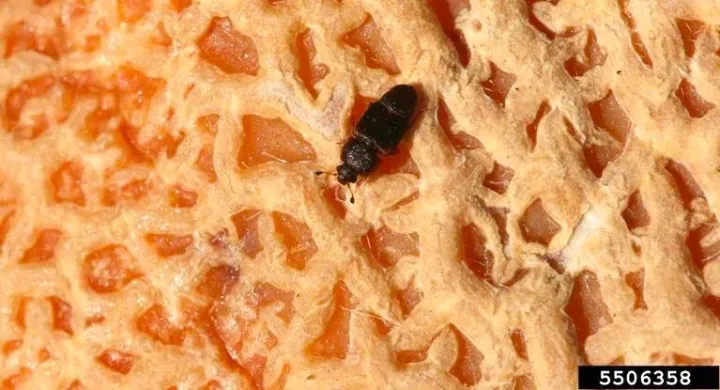
The corn sap beetle (Carpophilus lugubris) is a member of the Nitidulidae family. These insects are small, typically measuring between 3 to 5 mm in length, and have an oval-shaped body.
Adults are recognized by their dark brown to black coloration and truncated elytra, which fail to cover the tip of the abdomen, exposing the last segments. Their bodies are covered in fine, short hairs.
The larvae of this pest are creamy-white with a distinct brown head capsule. They go through several developmental stages (instars) while feeding within plant tissues.
The life cycle involves complete metamorphosis: egg, larva, pupa, and adult. In warm climates, several generations can emerge within a single growing season.
Adult beetles typically overwinter in soil, under debris, or in other protected organic matter. When temperatures rise, they emerge to seek food sources and initiate the reproductive process.
What it damages
This beetle primarily attacks corn, especially during the milk and dough stages of kernel development. Adults and larvae feed on the kernels, often entering the ear through the silk channel.
Besides direct physical damage, the beetles serve as vectors for various fungal pathogens, most notably those causing ear rots like Fusarium and Aspergillus.
While corn is the primary host, the beetle is attracted to the scent of fermentation. Consequently, it can also infest damaged fruits and vegetables that are overripe or decaying.
Severe infestations can lead to significant yield losses, particularly regarding grain quality, making the crop unsuitable for market or long-term storage due to mold growth.
The risk of damage increases significantly if harvesting is delayed, as the softer kernels become highly susceptible to adult feeding and egg-laying.
Signs of infestation
An initial sign of infestation is the presence of entry holes in the corn husk. These holes provide access for beetles to reach the developing grain.
If you peel back the husk, you may find clusters of adult beetles or larvae feeding on the kernels. The insects tend to scatter quickly when exposed to light.
Damaged kernels often display characteristic feeding marks, which are quickly colonized by white, pink, or gray fungal mycelium, indicating secondary infection.
A fermented or sour odor emanating from the corn ears in the field is a strong indicator of the beetle's presence and the subsequent growth of decay-causing microorganisms.
Visually, infested ears may show premature wilting of the husks and irregular grain development caused by the direct feeding of the larvae.
Control measures
The most effective management strategies involve cultural practices. Crop rotation is essential to prevent the buildup of beetle populations within a specific field area.
Timely harvest is critical to minimize the period during which the ears are vulnerable to attack, effectively reducing the beetle's chance to colonize the crop.
Deep plowing after the harvest helps disrupt the overwintering sites of the adults, burying larvae and pupae deep in the soil and preventing their survival.
Chemical control should be considered only when threshold levels are reached, using appropriate insecticides approved for application during the silking stage.
- Removal of crop debris and waste grain.
- Selection of corn hybrids with tighter husk coverage.
- Use of pheromone-baited traps for population monitoring.
- Management of volunteer corn and nearby weed hosts.
Taxonomy
- Latin name
- Carpophilus lugubris
- Order
- Coleoptera (beetles)
- Family
- Nitidulidae
- EPPO code
- CARHLU
Discussion
No discussions yet — be the first.