
Dried fruit beetle
Carpophilus dimidiatus
Description
How to identify
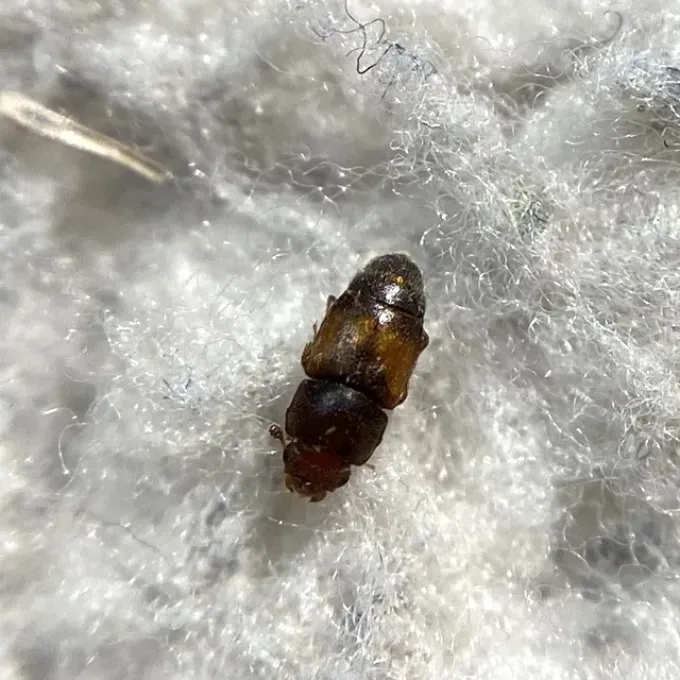
The dried fruit beetle (Carpophilus dimidiatus) is a member of the Nitidulidae family. It is a small insect, typically measuring between 2 to 3 mm in length, characterized by a flattened, oval-shaped body.
The coloration of the adult beetle ranges from reddish-brown to dark brown. A distinct morphological feature is the shortened elytra that leave the final segments of the abdomen exposed.
The entire body is covered with fine, short hairs, giving the beetle a slightly dull or velvety appearance. They possess clubbed antennae which are a diagnostic feature of the species.
Larvae are cream-colored with a darker head capsule. They are highly mobile and adapted for feeding inside tight spaces or decaying organic matter.
This beetle is known for its strong flight ability, which allows it to locate suitable hosts such as damaged crops or decaying plant material over significant distances.
What it damages
The primary crop affected by this pest is maize, particularly when the ears are in the milk or dough stage and become exposed due to other pest or bird damage.
It is also a serious pest in stored products, infesting wheat, barley, rice, sorghum, and even dried fruits, which makes it a significant threat in warehouse environments.
In the field, the beetle enters the husk of the maize ear, feeding directly on the developing kernels and creating entry points for fungi and opportunistic bacteria.
The damage significantly impacts the quality of the grain, as the associated fungal infections can lead to the production of mycotoxins, rendering the grain unsuitable for use.
For seed production, infestation is particularly destructive because larvae focus on the embryo, which leads to a direct reduction in the germination capacity of the seeds.
When it appears
The activity of the dried fruit beetle in fields begins during the warmer months, usually starting in late spring, and peaks during the crop maturation phase.
As summer temperatures increase, the metabolic rate and reproductive capacity of the pest rise, leading to rapid generation turnover in favorable conditions.
During the harvest season, the beetles undergo a massive migration from mature fields to storage facilities or areas with remaining plant residues.
In controlled storage environments, the lifecycle can continue throughout the year if the ambient temperature remains sufficiently high and the grain moisture is adequate.
The beetle overwinters in protected environments, including crop debris in the soil or structural crevices in storage bins, awaiting favorable conditions for re-emergence.
Signs of infestation
The most reliable sign of infestation in maize fields is the presence of adult beetles under the husks of ripening ears, often accompanied by visible damage to kernels.
Signs of larval activity include the presence of fine powder or "frass" near the feeding sites, which consists of insect excrement and chewed plant material.
When inspecting stored grain, an earthy or moldy smell, combined with an increase in grain temperature, often indicates that a significant beetle population is active.
Visible feeding tunnels within the grain kernels or the presence of cast skins from larval molting are clear indicators of a established infestation.
In cases of severe infestation, the surface of the grain mass may appear clumped due to the webbing or fungal growth promoted by the feeding activity of the larvae.
Control measures
Management starts with effective field hygiene, such as the rapid removal of crop residues and the prompt harvest of maize to limit the time ears spend exposed in the field.
Preventative measures in storage involve drying grain to a moisture content below 13%, which significantly inhibits the development of the beetle and associated molds.
Structural sanitation of grain warehouses, including the thorough removal of dust and old grain, is crucial to eliminate breeding niches for the beetles.
Regular monitoring using pheromone-baited traps allows producers to track population dynamics and intervene before the infestation reaches economic thresholds.
- Use of systemic insecticides as seed treatments for early-season protection.
- Application of approved fumigants to eliminate infestations in stored grain.
- Implementation of aeration systems in silos to maintain cool and dry grain conditions.
- Rotation of crops to reduce the local build-up of beetle populations.
Taxonomy
- Latin name
- Carpophilus dimidiatus
- Order
- Coleoptera (beetles)
- Family
- Nitidulidae
- EPPO code
- CARHDI
Discussion
No discussions yet — be the first.