
Shining Ground Beetle
Carabus nitens
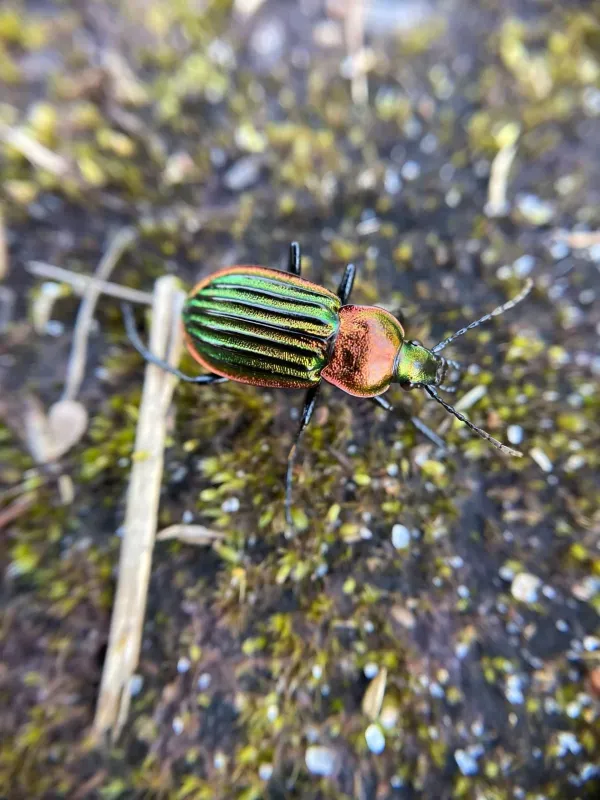
Description
How to identify
The Shining Ground Beetle (Carabus nitens) belongs to the Carabidae family of the order Coleoptera. Adult specimens feature a vibrant appearance: the elytra are golden-green with distinct longitudinal ridges, and the pronotum is typically copper-red or purple.
The body length of the beetle ranges from 12 to 16 millimeters. The body is flattened, which allows the insect to move rapidly through leaf litter and among plant stems.
The larvae of this species lead a secretive lifestyle, inhabiting the upper layers of the soil. They possess an elongated dark-colored body with well-developed mandibles adapted for capturing prey.
This species prefers open areas, heathlands, and dry meadows; however, when natural habitats are disturbed, they may congregate on agricultural fields.
It is important to distinguish this species from other members of the genus, as misidentification can lead to unnecessary use of pesticides against beneficial entomophages.
What it damages
Although many ground beetles are considered predators, certain species, including Carabus nitens, may exhibit phytophagy, damaging young shoots and succulent parts of agricultural crops.
The greatest damage is noted during periods of drought, when the beetles' natural food base decreases, causing them to feed on crops to replenish their water balance.
Cereal crops and seedlings of certain vegetables are often targeted. Beetles damage the epidermis of the stems, leading to deformation and overall growth inhibition.
Larvae pose a particular danger as they can gnaw on the root zone of young plants, which becomes a critical factor for crop survival during early development stages.
Mass appearance of the pest in a field can lead to thinning of crops and significant loss of the product's marketability, making timely population monitoring essential.
When it appears
The active life period of adult beetles begins in the spring months, immediately after the soil warms up to optimal temperatures.
A peak in population is observed in late spring and early summer, which often coincides with the phase of active vegetative growth for most field crops.
The life cycle includes hibernation, which adults spend in the soil, under rocks, or in plant debris, ensuring high survival rates in temperate climates.
Reproduction occurs in the middle of the summer season, followed by a gradual decrease in adult activity and a transition to a dormant stage until the following year.
Agronomists are advised to conduct field inspections during morning or evening hours, as the species exhibits daily activity primarily during dusk and at night.
Signs of infestation
The primary signal of the pest's presence is specific mechanical damage on the surface of plant stems and leaves, resembling rough scrapings.
Visual inspection of the soil in the root zone often reveals characteristic tunnels or accumulations of plant debris that beetles use as shelters.
The presence of beetles can be confirmed by setting Barber pitfall traps, which allow for the assessment of population density in a specific field area.
At night, beetles can be detected in affected areas using a flashlight, as their elytra have a characteristic metallic luster.
Stunted plant growth, manifesting as yellowing or wilting tops in the absence of other pathogen signs, may also indicate hidden damage to the root system by larvae.
Control measures
The foundation of protection is high-quality agrotechnics, including deep autumn plowing, which destroys the pest's hibernation sites and eliminates larvae in the soil.
Crop rotation is recommended to limit the accumulation of the pest population on the same areas over several consecutive seasons.
The use of environmentally friendly biological products based on entomopathogenic fungi helps to significantly reduce the beetle population without harming beneficial insects.
Chemical treatment of crops with broad-spectrum insecticides is justified only when damage thresholds, determined through monitoring, are exceeded.
- Adhering to sowing dates to prevent the coincidence of vulnerable plant phases with the beetle's peak activity.
- Clearing field borders of weeds where adults may accumulate.
- Using bait stations to localize and subsequently eliminate the pest.
Taxonomy
- Latin name
- Carabus nitens
- Order
- Coleoptera (beetles)
- Family
- Carabidae
- EPPO code
- CARANI
Discussion
No discussions yet — be the first.