
Violet ground beetle
Carabus nemoralis
Description
How to identify
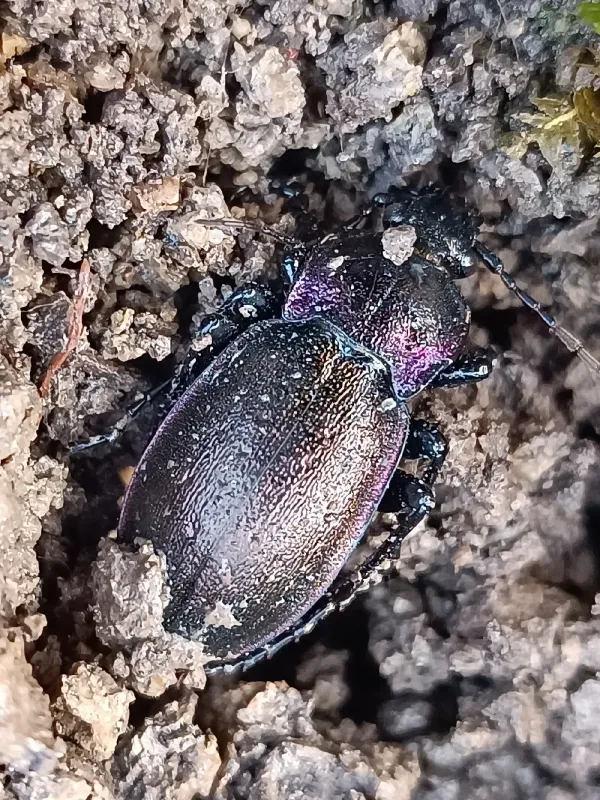
The violet ground beetle (Carabus nemoralis) is a large member of the Carabidae family, order Coleoptera. Adults typically measure between 18 and 26 mm in length and possess a distinctively shiny, dark bronze or black elytra with prominent punctate and linear striae.
The body is elongated and oval, with strong mandibles adapted for predatory behavior. However, this species is opportunistic and may consume plant tissues when its primary prey is scarce, categorizing it as a potential agricultural pest.
The larvae of this beetle are campodeiform, highly mobile, and possess well-developed thoracic legs. Their bodies are sclerotized, dark brown or black, allowing them to navigate effectively through soil cracks and ground-level debris.
This beetle is primarily nocturnal, spending daylight hours hidden under rocks, logs, or dense vegetation. They thrive in temperate, humid environments and are commonly found in shaded areas and garden peripheries.
The life cycle involves complete metamorphosis. Females deposit eggs in the soil, and the resulting larvae undergo three instars before pupating within earthen cells built in the ground.
What it damages
While primarily predatory—feeding on slugs, earthworms, and other insect larvae—Carabus nemoralis can shift its diet towards cultivated crops during population peaks or environmental stress.
Young seedlings of cereals and vegetables are particularly vulnerable. Beetles may gnaw on stems and leaves of emerging crops, often leading to total plant loss and requiring field reseeding.
Soft fruits, especially strawberries, are frequently damaged. Beetles feed on the ripening berries, creating deep, ragged cavities that render the produce unmarketable and susceptible to fruit rot pathogens.
Larval feeding can also affect the root systems of young plants, causing stunted growth and increased susceptibility to other biotic and abiotic stresses.
High levels of damage are typically observed in fields with excessive mulching or poor weed control, which provide ideal microhabitats for the beetles to thrive near food sources.
When it appears
The activity of the violet ground beetle spans from early spring to late autumn. Adult populations generally reach their maximum density during the first half of the summer season.
As temperatures drop in autumn, adults prepare for overwintering, retreating into deeper soil layers or dense piles of organic matter to survive the cold months.
Larval development is continuous throughout the warm months, with activity levels closely tied to soil moisture and ground temperature, which are essential for growth and molting.
Adult emergence following winter dormancy usually occurs when soil temperatures rise to 8–10 degrees Celsius, marking the start of the feeding and mating season.
Late summer often sees the emergence of the new generation, which may feed on remaining crops before seeking winter refugia.
Signs of infestation
Field infestations are identified by jagged, irregular bite marks along the edges of leaves on young seedlings. In severe cases, the entire seedling may be severely deformed.
Nocturnal visual inspections with flashlights can confirm the presence of beetles. They are often seen scurrying on the soil surface or climbing plants to access fruit.
On berries and vegetables, the damage appears as deep, open pits or cavities, which often attract secondary infections like gray mold (Botrytis), complicating harvest quality.
During the day, evidence of their presence can be found under artificial cover like boards, rocks, or debris scattered near the crop area, where they congregate to rest.
Digging in the soil near affected plants may reveal the presence of dark, mobile larvae, which attempt to burrow deeper into the substrate when disturbed.
Control measures
Cultural control practices, such as deep autumn tillage, are highly effective as they disrupt overwintering sites and mechanically destroy larvae in the upper soil profile.
Maintaining field hygiene by removing crop residues, weeds, and debris significantly reduces the available daytime shelters for the beetles, making the environment less hospitable.
Chemical control should be reserved for instances where the economic injury level is exceeded. Application of appropriate insecticides is most effective when conducted during late evening.
Biological control options, including the use of entomopathogenic nematodes or fungi, provide an environmentally sustainable approach to suppress larval populations without disrupting the agro-ecosystem.
Strategic crop rotation and ensuring a physical buffer zone between fields and woodland areas can minimize the migration of beetles into susceptible agricultural plots.
Taxonomy
- Latin name
- Carabus nemoralis
- Order
- Coleoptera (beetles)
- Family
- Carabidae
- EPPO code
- CARANE
Discussion
No discussions yet — be the first.