
Blue ground beetle
Carabus intricatus
Description
How to identify
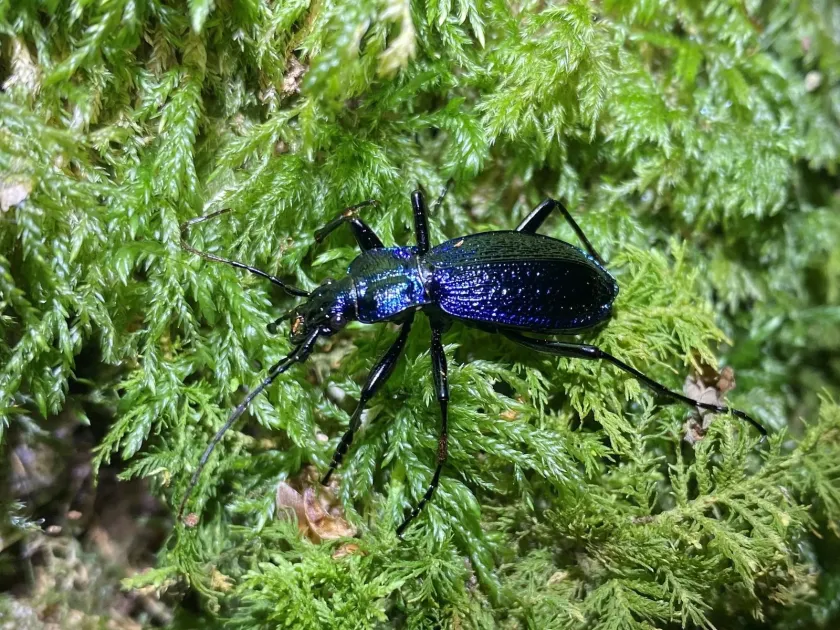
The blue ground beetle (Carabus intricatus) is a large predatory beetle belonging to the Carabidae family within the order Coleoptera. Adult specimens typically measure between 24 and 35 mm in length.
The beetle is easily identified by its striking metallic blue or violet-black coloration and elongated, flattened body. The elytra (wing covers) display a distinct, coarse texture consisting of numerous small bumps and ridges.
Its larvae are campodeiform and highly active, equipped with strong, well-developed mandibles suitable for hunting prey in soil and leaf litter.
As a nocturnal predator, the beetle spends its daylight hours hiding in dark, humid environments such as tree bark, under stones, or deep within forest floor debris.
In many regions, this species is considered rare and is protected by conservation law; it serves as a valuable natural enemy of slugs and snails in the garden ecosystem.
What it damages
While primarily carnivorous, the blue ground beetle may cause indirect damage to agricultural crops if its natural food sources are scarce or the population density is high.
Their main diet consists of gastropods, such as slugs and snails, which are notorious pests that cause significant damage to vegetable gardens and ornamental plants.
Direct damage to plants is uncommon but can occur when beetles, in pursuit of prey, gnaw on the tender stems, roots, or leaves of young seedlings.
Any mechanical damage caused by the beetles creates micro-wounds, which may make the plants more susceptible to bacterial or fungal infections.
The risk of crop damage is generally localized and most likely to occur in backyard gardens located near woodland areas where the beetle's habitat overlaps with cultivated land.
When it appears
The life cycle of the blue ground beetle commences in early spring as soon as temperatures allow, when overwintering adults emerge from their dormant state.
The peak activity period for adults is during late spring and early summer, which corresponds with their breeding and egg-laying phase in moist soil conditions.
Larvae develop throughout the summer months, progressing through several instars while actively hunting for small invertebrates within the topsoil layer.
Pupation typically concludes by late summer, followed by the emergence of the new generation of adults that seek suitable cover for winter dormancy.
This species exhibits a univoltine life cycle, meaning it completes one generation per year, with population success strongly influenced by soil moisture levels.
Signs of infestation
The presence of the blue ground beetle can be detected during night-time inspections using a flashlight, especially in areas with high humidity where mollusks congregate.
Evidence of plant damage, such as chewed leaf edges often associated with snail slime trails, suggests that predatory beetles may be active in the vicinity.
Finding shell fragments of slugs near the base of garden plants often indicates successful hunting activities by ground beetles in that area.
During the day, one might find chitinous remains of prey or the beetles themselves under decaying logs or dense garden mulch, which are typical daytime shelters.
The most reliable method for monitoring their presence is the use of pitfall traps placed throughout the garden to capture the beetles during their nocturnal wanderings.
Control measures
Because the blue ground beetle acts as a beneficial predator of garden pests, targeted extermination is not recommended; instead, focus on sustainable agricultural practices.
Maintaining a clean garden by clearing away unnecessary plant debris will reduce the habitat for slugs, thereby decreasing the beetles' interest in the cultivated area.
Physical barriers for plants are effective at controlling slugs, which ultimately removes the food source that might otherwise draw beetles to your seedlings.
Avoid the use of broad-spectrum insecticides, as these will kill the beetles and other beneficial insects, potentially leading to larger outbreaks of more destructive pests.
- Regular soil cultivation to disturb larval habitat.
- Composting plant debris away from vegetable rows.
- Prioritizing biological control to preserve natural predatory populations.
Taxonomy
- Latin name
- Carabus intricatus
- Order
- Coleoptera (beetles)
- Family
- Carabidae
- EPPO code
- CARAIN
Discussion
No discussions yet — be the first.