
Giant ground beetle
Carabus gigas
Description
How to identify
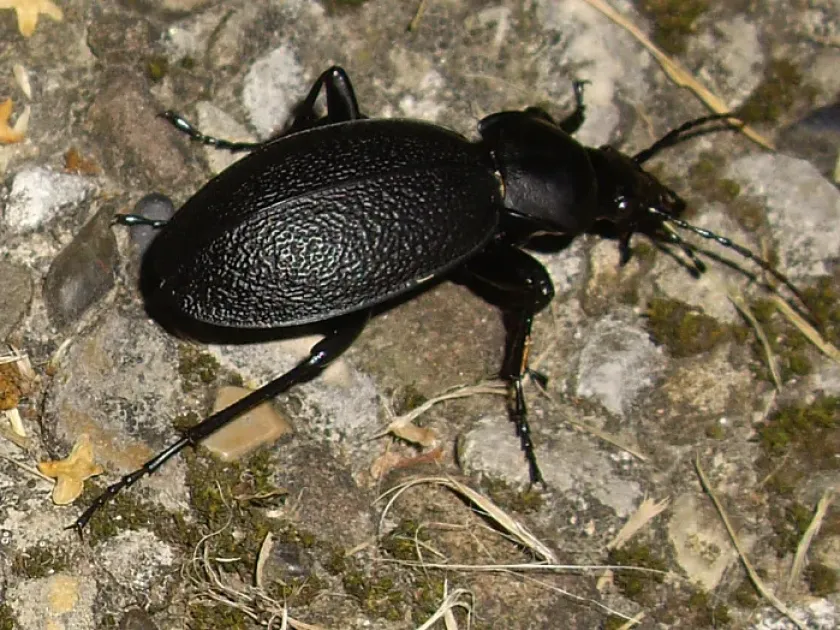
The giant ground beetle (Carabus gigas) is one of the most prominent and largest species within the family Carabidae (ground beetles), reaching lengths of up to 50 mm.
The beetle is characterized by its robust, heavily chitinized body, typically deep black in color with a slightly matte or metallic sheen depending on the environment.
It possesses powerful mandibles, which are clearly adapted for predatory behavior, allowing it to capture various insects and soil-dwelling invertebrates in its natural habitat.
Active mainly at night, this beetle spends its daylight hours buried in soil crevices, leaf litter, or under debris, making it a difficult pest to spot during regular inspections.
Its morphology is optimized for rapid movement across the soil surface, enabling it to patrol large areas of farmland and agricultural plots efficiently.
What it damages
While ground beetles are primarily considered beneficial predators, Carabus gigas can exhibit phytophagous tendencies when natural prey populations are insufficient.
The damage is particularly noticeable on young seedlings of cereal crops, sugar beets, and various vegetable species, where beetles gnaw on stems and leaf bases.
This feeding behavior results in stunted growth, thinning of crop stands, and direct destruction of young plants during their most vulnerable stage of development.
Larvae, residing within the soil, can also contribute to crop stress by feeding on the root systems, which often causes the plants to wilt or die prematurely.
The economic impact increases significantly during drought years, as the lack of soil fauna forces these beetles to seek alternative nutrition in planted fields.
When it appears
Adult giant ground beetles emerge in early spring once soil temperatures become favorable, starting their period of activity and searching for food.
The mating and egg-laying phase typically occurs from late spring into early summer, coinciding with the peak period of plant germination and early growth.
Larvae develop throughout the summer months, passing through several larval stages while feeding on available organic material or crop roots within the soil profile.
Pupation occurs in the late summer, and the new generation of adults typically emerges before the onset of autumn to prepare for the winter period.
Overwintering takes place deep in the soil or under dense vegetation, allowing the species to survive low temperatures and restart the cycle in the following spring.
Signs of infestation
The first indicator of an infestation is often irregular, jagged feeding marks on the leaves and stems of young seedlings located near the soil line.
An uneven stand of crops in specific parts of a field, characterized by gaps where plants have failed to develop, is a common sign of soil-dwelling pest activity.
By excavating the soil around wilted or damaged plants, one may find beetle larvae or signs of tunneling that indicate recent feeding activities.
Field monitoring during the night using light traps or direct observations can confirm the presence of adult beetles, helping to distinguish them from other soil pests.
The presence of large, distinct burrows in the upper soil layers during the morning can also serve as a diagnostic tool to assess the local beetle density.
Control measures
Effective management of the giant ground beetle requires an integrated approach that focuses on habitat disruption and minimizing crop vulnerability.
- Implementing proper crop rotation to break the beetle's life cycle and food availability.
- Deep autumn plowing to disturb overwintering sites and expose pupae to environmental stress.
- Using systemic seed treatments to protect young sprouts from initial beetle feeding.
- Eliminating weeds and crop residues along field margins to remove daytime hiding spots.
- Applying targeted insecticides only when population thresholds are exceeded to maintain the balance of beneficial predatory species.
Taxonomy
- Latin name
- Carabus gigas
- Order
- Coleoptera (beetles)
- Family
- Carabidae
- EPPO code
- CARAGI
Discussion
No discussions yet — be the first.