
Wetland ground beetle
Carabus clathratus
Description
How to identify
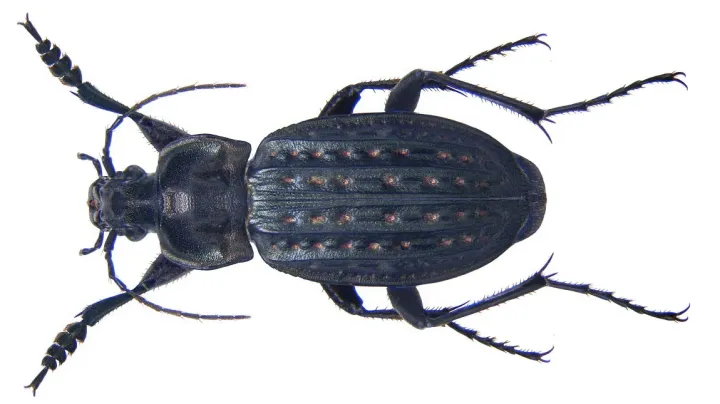
The Carabus clathratus, known as the wetland ground beetle, is a large species of the Carabidae family, reaching a body length of 20 to 35 mm.
Its coloration ranges from bronze to black with a noticeable metallic sheen. The elytra are distinguished by a unique reticulated pattern of ridges and pits.
The larvae are typically campodeiform, possessing well-developed legs and strong jaws, which makes them highly mobile predators in their natural habitat.
This beetle thrives in wet environments, such as marshes, wetlands, and damp soil near water bodies, which are its primary living conditions.
It is mainly nocturnal, spending daylight hours hiding under debris, stones, or inside damp soil, emerging only to feed or mate.
What it damages
While many ground beetles are beneficial predators, the wetland ground beetle can become an opportunistic pest in specific agricultural conditions.
Young sprouts of cereal and vegetable crops are the most vulnerable, especially during the germination and early growth stages.
Feeding damage involves gnawing on seeds, stems, and the root zone, often causing significant thinning and crop stand loss in affected areas.
The damage is usually localized to low-lying or poorly drained fields, where soil moisture levels are optimal for the beetle's survival and activity.
Economic damage is generally higher in seasons with extended periods of rainfall, which expand the beetle's habitat range across the fields.
When it appears
Adult beetles become active in early spring after the soil warms up, continuing their life cycle until late autumn when they seek winter shelter.
The mating and egg-laying period occurs during late spring and summer, correlating with the emergence of young crop shoots.
The larval stage progresses through several molts, followed by pupation, which typically takes place in specialized chambers within the soil.
Hibernation is performed mostly by adult beetles, which bury themselves deep in the soil or hide beneath dense organic litter for protection.
Typically, there is only one generation per year, though the speed of development is heavily dependent on soil temperature and humidity levels.
Signs of infestation
One of the first indicators is the appearance of bare patches in the field, particularly in depressed areas where water tends to accumulate.
Inspecting the soil around affected plants usually reveals the presence of adult beetles or larvae, particularly at dawn or dusk.
Evidence of damage includes rough, ragged leaf edges and stem gnawing, which can easily be distinguished from the patterns of specialized foliage pests.
A sudden decrease in plant stand density within a short period is a classic sign of soil-dwelling pest activity that requires immediate attention.
Small tunnel entrances or disturbed soil around the base of seedlings often serve as physical evidence of the beetle's nocturnal activities.
Control measures
The primary control strategy involves land drainage, as reducing excess soil moisture directly limits the suitable habitat for this beetle species.
Deep autumn plowing is highly effective in disrupting the overwintering sites, significantly reducing the beetle population for the following season.
Effective weed control and crop rotation cycles help remove alternative food sources and daytime cover for the beetles.
If the pest population exceeds the economic threshold, targeted insecticide treatments may be necessary to protect vulnerable young seedlings.
- Use of systemic insecticide seed treatments.
- Regular field monitoring using pitfall traps to track population density.
- Adjusting planting dates to ensure seedlings pass the vulnerable stage quickly.
Taxonomy
- Latin name
- Carabus clathratus
- Order
- Coleoptera (beetles)
- Family
- Carabidae
- EPPO code
- CARACL
Discussion
No discussions yet — be the first.