
Ground beetle
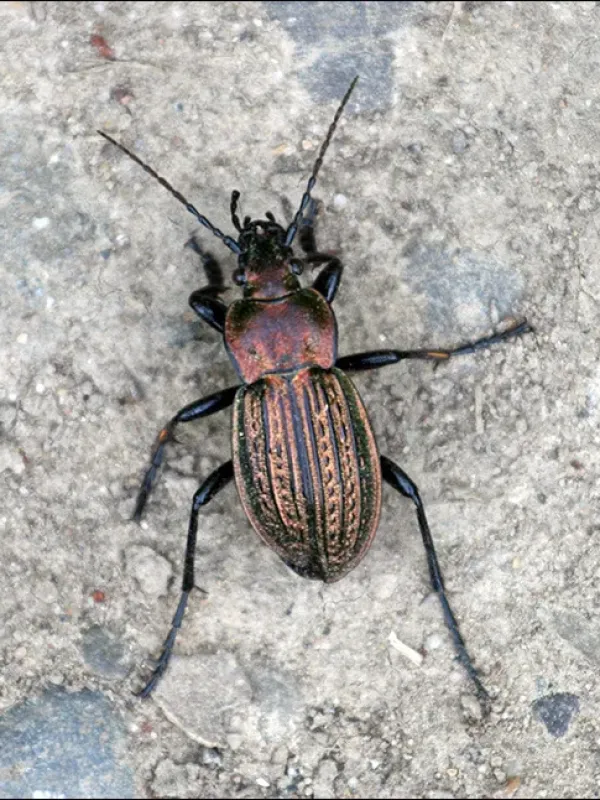
Carabus arvensis
Description
How to identify
The ground beetle (Carabus arvensis) belongs to the Carabidae family, a group of insects generally considered beneficial predators, but capable of becoming pests under specific conditions.
Adult beetles are typically 20–25 mm long, exhibiting a robust body structure with a dark, often metallic or bronze-toned surface on their elytra.
The larvae are ground-dwelling, possessing strong legs and hard, elongated bodies adapted for burrowing through the soil layers to find food sources.
These insects are primarily nocturnal, remaining hidden under debris, stones, or deep in the soil during daylight hours, which makes early detection difficult.
In agro-ecosystems, their status as a pest is often secondary, but they can cause significant damage when their natural prey population is insufficient.
What it damages
The primary damage occurs during the germination and early seedling emergence stages of cereal crops like wheat, barley, and rye.
Both adults and larvae have chewing mouthparts that allow them to feed directly on seeds, specifically targeting the embryo, which prevents germination.
Beyond seeds, the pests can feed on the tender stems of newly emerged sprouts, leading to stunted growth or total destruction of young plants.
Heavy infestation levels can result in thinning stands, requiring farmers to replant affected areas, which increases production costs.
- Consumption of seed embryos preventing germination.
- Cutting off young shoots at the soil line.
- Reducing the overall density and uniformity of crop stands.
- Weakening plants, making them susceptible to secondary pathogens.
When it appears
The lifecycle of Carabus arvensis is highly dependent on environmental factors, particularly soil temperature and seasonal moisture levels.
Overwintering typically takes place in the adult or late-larval stage, deep within the soil profile or protected beneath agricultural debris.
Activity increases in early spring as soil temperatures rise, coinciding perfectly with the sowing and early growth stages of spring cereals.
Peak damage periods often occur in cool, wet spring weather, which delays crop emergence and extends the time the seeds are vulnerable in the soil.
The beetles reproduce throughout the summer months, and the next generation undergoes development before preparing for the winter dormancy period.
Signs of infestation
The most noticeable field sign is the appearance of bare patches or thin spots in the rows shortly after the crop has been sown.
Excavating seed remnants reveals characteristic damage: embryos are missing or the seeds are partially consumed, leaving only the outer shell.
Finding adult beetles during evening inspections or using pitfall traps is a clear indicator that the population density is increasing in the area.
Yellowing of emerging sprouts, when accompanied by disturbed soil around the base, is a strong diagnostic sign of soil-dwelling pest activity.
Monitoring the soil during preparation or at the first sign of crop emergence is crucial to determine if intervention is necessary.
Control measures
Crop rotation is the most effective cultural method to manage populations, as it disrupts the life cycle and food availability of the beetles.
Deep autumn plowing remains a primary mechanical control measure, as it exposes overwintering larvae and adults to adverse conditions and predators.
Seed treatment with systemic insecticides provides essential early-season protection, safeguarding the seed from consumption during the sensitive germination phase.
If thresholds are exceeded, targeted applications of insecticides can be used to control surface-active beetles, ideally applied during evening hours.
Maintaining clean field borders and managing weed growth limits the nesting sites and alternate food sources, helping to keep beetle populations in check.
Taxonomy
- Latin name
- Carabus arvensis
- Order
- Coleoptera (beetles)
- Family
- Carabidae
- EPPO code
- CARAAR
Discussion
No discussions yet — be the first.