
Black grass bug
Capsus ater
Description
How to identify
The black grass bug (Capsus ater) is a member of the Miridae family within the order Hemiptera. These insects typically measure between 6 to 8 mm in length.
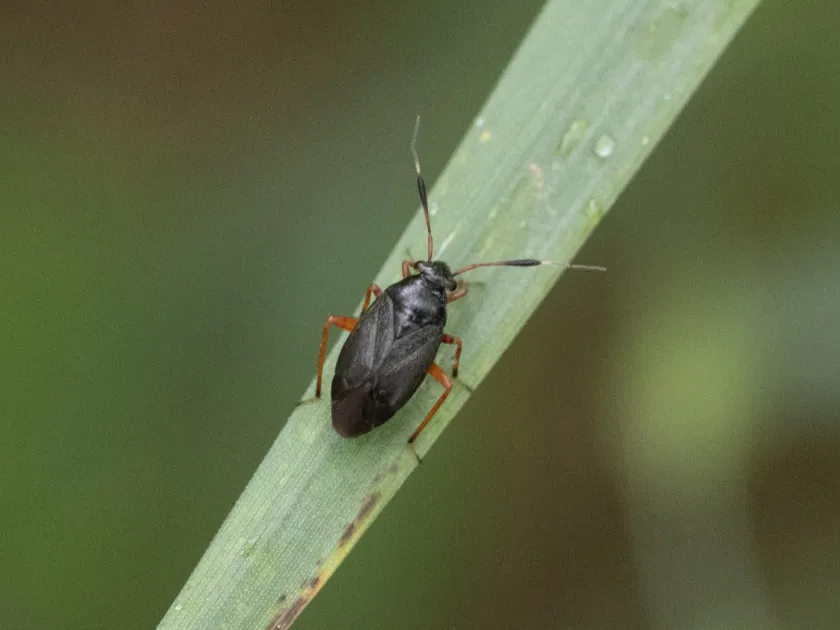
Adults possess a distinct, elongated oval shape and a dark, charcoal-black or brownish-black coloration, which makes them stand out on green foliage.
The legs and antennae exhibit a yellowish-brown hue. Males and females show slight morphological differences, with females often appearing slightly larger and more robust.
The eggs of this species are oval and light-colored, embedded securely within the host plant tissues, providing them with protection against environmental conditions.
The nymphal stages (larvae) resemble miniature versions of the adults, gradually developing their final body structures and wing size through several molts.
What it damages
This species is a polyphagous pest, though it primarily targets cereals such as wheat, barley, and oats, as well as various wild meadow grasses.
Damage is caused by the bug piercing the plant tissue with its mouthparts to suck out cell sap, simultaneously injecting salivary enzymes into the plant.
This feeding activity causes small white or yellow spots to appear on the leaves, which eventually wither, leading to chlorosis and reduced photosynthetic capacity.
When infestation occurs during the heading phase, it leads to stunted grain development, resulting in shriveled kernels and significant yield loss.
Extensive feeding can lead to overall plant weakness, making crops more susceptible to secondary fungal infections or environmental stress factors.
When it appears
The life cycle begins in spring, as the bugs overwinter in the egg stage, deposited within the stems of cereal grasses or crop residues.
Nymphs typically emerge in late spring or early summer, coinciding with the rapid vegetative growth stage of cereal crops, which is the most vulnerable period.
Adults are usually observed from mid to late June. During this time, they become highly mobile, spreading across fields to feed and find mates.
The species usually completes one generation per season, though development speed can be influenced by temperature and local climatic conditions.
As summer draws to a close, the adult population declines as they finish laying eggs for the next season's population cycle within the crop stubble.
Signs of infestation
The first indicator of an infestation is the presence of numerous tiny, discolored punctures on the leaf surface where the bug has fed.
These spots often coalesce, causing the leaf tissue to turn yellow and eventually die off, which can affect the plant's overall vigor.
Field scouting is best performed during the early morning hours, as the bugs are more sedentary and easier to spot on the upper parts of the plants.
- Premature yellowing and desiccation of leaf tips.
- Formation of hollow or poorly developed grain heads.
- Visible dark excrement on the plant foliage and stems.
Uneven ripening across the field and a lack of proper grain filling are significant indicators that Capsus ater has caused damage during the sensitive heading phase.
Control measures
Integrated Pest Management starts with cultural practices, such as proper crop rotation and the destruction of crop residues immediately after harvest.
Controlling weeds on field margins and adjacent non-crop areas is crucial, as these areas often serve as reservoirs for the bug population.
Chemical control should only be implemented if the pest population exceeds the economic threshold, using approved insecticides according to local regulations.
Effective applications target the nymphal stages, as they are less mobile and more susceptible to control measures before they cause extensive damage.
Always adhere to strict pre-harvest intervals and safety protocols when using chemical pesticides to ensure the final crop is safe and meets market standards.
Taxonomy
- Latin name
- Capsus ater
- Order
- Hemiptera (bugs, aphids, leafhoppers)
- Family
- Miridae
- EPPO code
- CPSSAT
Discussion
No discussions yet — be the first.