
Fiery searcher
Campalita auropunctatum
Description
How to identify
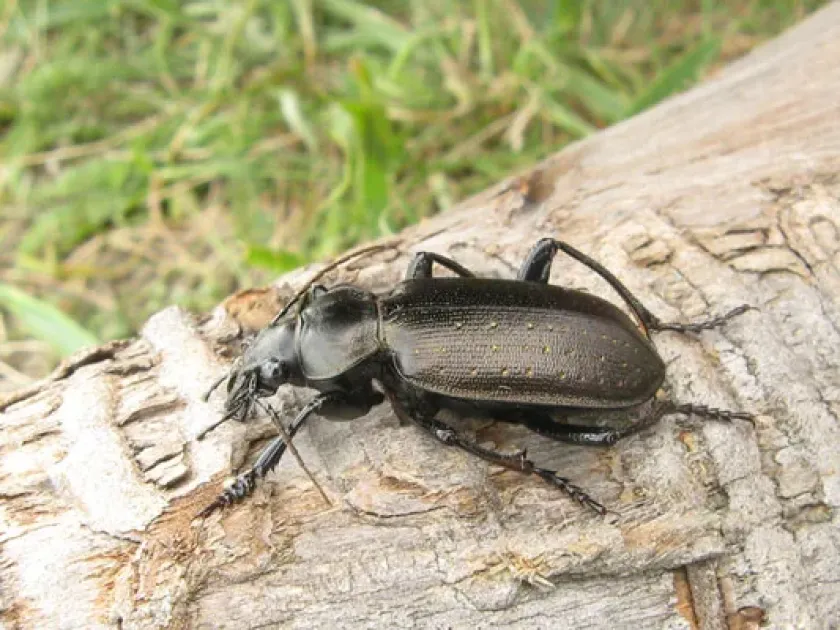
The fiery searcher (Campalita auropunctatum) belongs to the Carabidae family of the Coleoptera order. Adult beetles reach 20–30 mm in length and feature a distinctive metallic bronze or greenish coloration.
The elytra are densely punctured and marked with rows of golden-colored pits, which is the defining characteristic of this species. The body is robust and oval, equipped with powerful mandibles.
The larvae are campodeiform, meaning they have an elongated body with well-developed legs, which allows them to be highly mobile and active hunters within the soil layer.
Unlike most ground beetles which are strictly predatory, this species is a mixotroph. It can consume both small invertebrates and vegetative parts of plants, depending on food availability.
These beetles are diurnal and highly active. Their ability to move long distances enables them to colonize new fields rapidly, making them a significant factor in some agricultural ecosystems.
What it damages
The fiery searcher primarily targets cereal crops, including wheat, barley, rye, and oats. In years of high population density, these beetles can cause substantial economic losses.
Adult beetles damage grain crops by consuming the developing kernels within the ear. This feeding behavior reduces both the quantity and the quality of the harvested grain yield.
The larvae, while generally predacious, can also damage young seedlings by feeding on roots and underground stems, leading to stunted growth or total plant loss in early spring.
The severity of the damage is often patchy, localized in specific areas of the field. However, in favorable conditions, the infestation can spread quickly across entire planting blocks.
Because these beetles act as both predators of other pests and as plant feeders themselves, their presence in fields requires careful assessment before taking any drastic control measures.
When it appears
Adult beetles overwinter in the soil or under debris. They emerge in the spring as soon as temperatures rise, beginning their active feeding and mating phase shortly thereafter.
Egg-laying occurs in the soil during the late spring. Larvae go through three distinct instars, feeding throughout the summer months before reaching maturity for the new generation.
The new generation of adults usually emerges in mid-to-late summer. This is when they are most likely to be found on cereal crops, potentially causing harm as the crops approach maturity.
Climatic factors heavily influence their life cycle. Warm, dry summers generally increase their survival rate, while high humidity can facilitate the spread of natural fungal pathogens.
As autumn temperatures drop, the beetles seek shelter in the soil to enter a dormant state, where they will spend the winter months protected from extreme cold.
Control measures
The primary control strategy involves good agricultural practices such as crop rotation. This disruption prevents the buildup of larval populations in the soil over successive seasons.
Deep autumn tillage is a highly effective method for reducing the population. By disturbing the soil structure, farmers can expose overwintering beetles to cold temperatures and predators.
Chemical control should only be considered if the population density exceeds the economic threshold. Selective insecticides are preferred to minimize harm to other beneficial predatory insects.
- Monitor populations regularly using soil sampling techniques.
- Encourage natural biodiversity in the fields to support biological control agents.
- Optimize harvest times to reduce the window of exposure for maturing crops.
Integrated Pest Management (IPM) for this species focuses on balance. Since the beetle provides valuable pest control services, unnecessary pesticide applications should be strictly avoided.
Taxonomy
- Latin name
- Campalita auropunctatum
- Order
- Coleoptera (beetles)
- Family
- Carabidae
- EPPO code
- CMLAAU
Discussion
No discussions yet — be the first.