
Calosoma sycophanta
Calosoma sycophanta
Description
How to identify
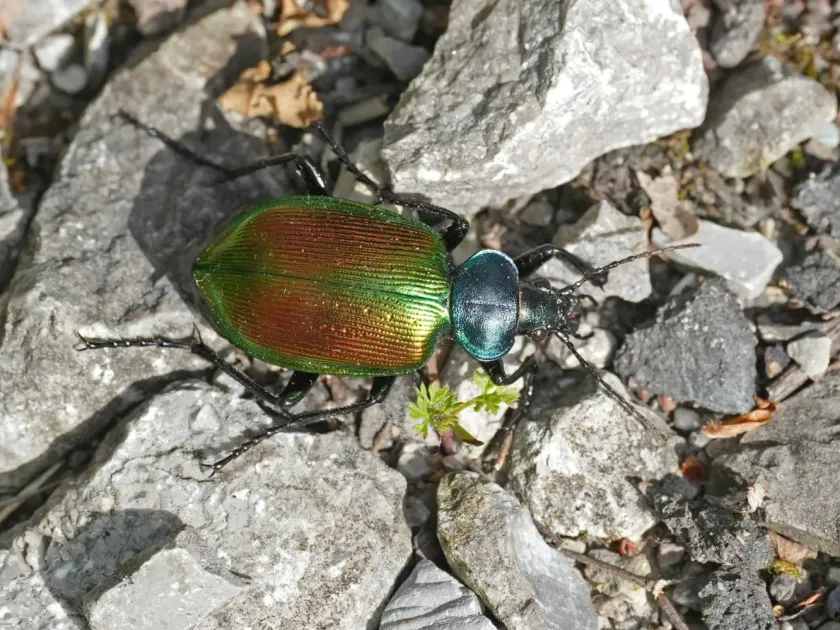
Calosoma sycophanta, commonly known as the caterpillar hunter, is a species of ground beetle (family Carabidae) renowned for its size and metallic coloration.
The adult beetle typically measures between 25 and 35 millimeters in length, featuring brilliant, golden-green elytra with a slight metallic luster.
The head and pronotum of the beetle are darker, often deep blue or black, and the mandibles are robust, reflecting its role as a specialized predator.
The larvae of this species are dark-colored, campodeiform, and exhibit high agility, allowing them to traverse tree trunks rapidly to hunt for food.
This species is well-adapted for climbing, and both adults and larvae spend a significant amount of time in tree canopies hunting their prey.
What it damages
Contrary to being a plant pest, Calosoma sycophanta is highly beneficial for forestry and horticulture as a natural biological control agent.
Its primary food source is the larva of the gypsy moth (Lymantria dispar), a notorious defoliator that can cause severe damage to trees if left unchecked.
A single adult beetle or larva can consume hundreds of caterpillars during its lifecycle, significantly suppressing pest outbreaks in infested areas.
By preying on various lepidopteran pests, the caterpillar hunter plays a crucial role in maintaining ecological balance within woodlands and managed orchards.
Misclassifying this beetle as a pest is a common error; it is, in fact, an ally of the grower and should be protected for its role in natural pest suppression.
When it appears
Adult beetles typically emerge from their overwintering sites in the soil during late spring, when temperatures consistently rise above 10-12 degrees Celsius.
Their activity period coincides with the emergence of their primary prey, the spring-feeding caterpillars of various moth species.
The beetles remain active throughout the summer months, focusing their energy on hunting and reproductive activities to ensure the continuation of the next generation.
In late autumn, as temperatures drop, both adults and late-instar larvae seek refuge in the soil or under deep leaf litter to enter a state of dormancy.
The reproductive cycle is synchronized with the availability of food sources, ensuring that the larval stage has ample prey for rapid growth and development.
Control measures
No control measures should be taken against Calosoma sycophanta, as it is an essential beneficial insect that contributes to the health of the ecosystem.
The most important management practice is to avoid the indiscriminate use of broad-spectrum chemical insecticides, which can devastate predator populations.
When pest management is necessary, growers should select biorational products that specifically target the pest while minimizing risks to natural enemies like ground beetles.
Maintaining diverse habitats with sufficient vegetation and leaf cover provides the necessary conditions for these beetles to survive and thrive during winter.
By fostering a balanced ecosystem, gardeners and foresters can rely on the natural predation of Calosoma sycophanta to maintain healthy tree populations.
Taxonomy
- Latin name
- Calosoma sycophanta
- Order
- Coleoptera (beetles)
- Family
- Carabidae
- EPPO code
- CAOOSY
Discussion
No discussions yet — be the first.