
Calosoma retusum
Calosoma retusum
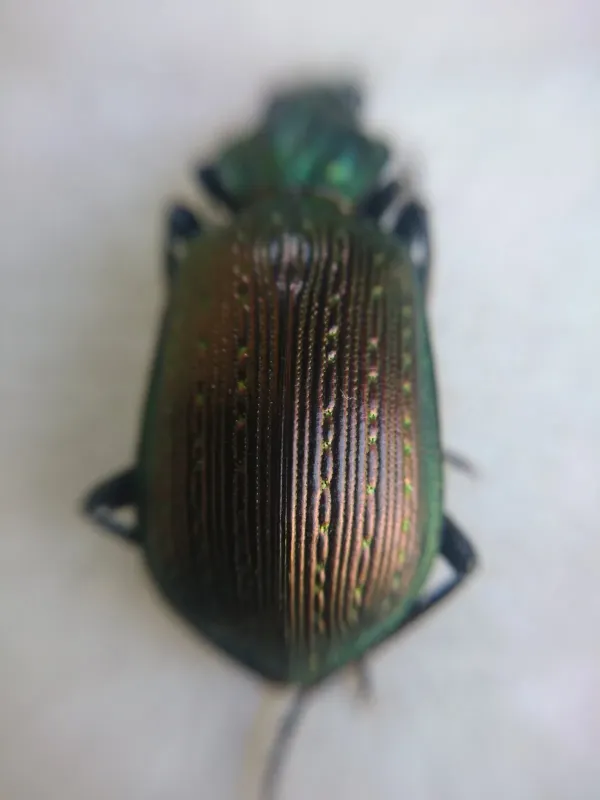
Description
How to identify
Calosoma retusum is a member of the Carabidae family within the order Coleoptera. This species is a large ground beetle characterized by the distinct metallic luster of its elytra.
Adult beetles possess well-developed mandibles designed to capture and hold prey effectively. Their bodies are oval and flattened, facilitating rapid movement across the soil surface and through dense vegetation.
The larvae are active predators, exhibiting an elongated body shape and robust legs that allow them to navigate the topsoil layers in search of food sources.
The coloration of the adults ranges from dark bronze to greenish-black, which provides camouflage in their natural habitat.
While primarily known as entomophagous insects, in specific agricultural ecosystems of South America, they can exhibit destructive behavior that disrupts the balance of local organisms.
What it damages
The primary pest potential of Calosoma retusum arises during periods of mass reproduction, when the predatory activity of both beetles and larvae impacts crop development.
In the agroecosystems of Argentina, this species is often associated with soybean fields, where it can damage both agricultural pests and young plant seedlings.
The damage is expressed through the mechanical destruction of the epidermis and tissues of young plants, which subsequently creates entry points for secondary fungal and bacterial infections.
Maximum damage occurs during the seed germination and seedling emergence phase, when plant tissues are succulent and highly susceptible to the beetle's mouthparts.
Economic losses are generally considered moderate, but in years of high population outbreaks, protective measures are necessary to prevent crop thinning.
When it appears
Adult activity begins in the spring when consistent positive temperatures allow the soil to reach the thermal levels required for insect metabolism.
Population peaks typically occur during the summer months, coinciding with the active vegetative growth phase of field crops, which increases the risk of plant damage.
The life cycle involves complete metamorphosis: egg, three larval stages, pupa, and adult. Mature beetles may overwinter in the soil or under plant debris.
Reproduction is linked to the warm season, with females laying eggs directly into the soil to ensure larvae have immediate access to food resources.
In autumn, insect activity declines, and they enter diapause within the soil profile at depths of up to 20 centimeters to successfully survive the winter.
Signs of infestation
A primary indicator of the pest's presence includes gnawed leaf margins or completely destroyed plant seedlings observed throughout the field.
During night or evening inspections, active individuals can be spotted moving rapidly between crop rows on the soil surface.
The presence of specific exit holes in the soil, created when beetles emerge from overwintering sites, serves as evidence of high population density.
Characteristic damage to cotyledon leaves, featuring irregular edges, points to the activity of adults with developed chewing mouthparts.
To confirm the species, the use of Barber pitfall traps placed around the perimeter of the field is highly recommended for surveillance.
Control measures
Management of Calosoma retusum is based on an integrated pest management (IPM) system, incorporating both agrotechnical and chemical control methods.
- Implementing crop rotation to disrupt the insect's life cycle.
- Proper soil tillage to destroy overwintering and pupation sites.
- Applying insecticides during periods of mass seedling emergence if the economic threshold is exceeded.
- Using perimeter border sprays to suppress the migration of adult beetles into the field.
Chemical control must be conducted with careful consideration of environmental risks and the need to preserve beneficial entomofauna present on the farm.
Monitoring population numbers using pheromone or light traps allows for precise timing of chemical applications, thereby minimizing the overall pesticide load.
Taxonomy
- Latin name
- Calosoma retusum
- Order
- Coleoptera (beetles)
- Family
- Carabidae
- EPPO code
- CAOORE
Discussion
No discussions yet — be the first.