
Forest caterpillar hunter
Calosoma maderae
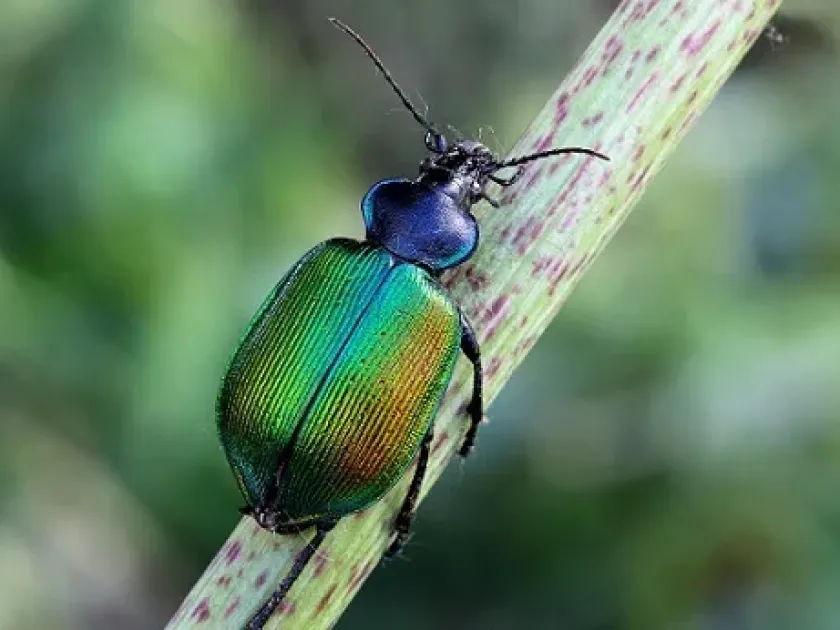
Description
How to identify
The Forest caterpillar hunter, known scientifically as Calosoma maderae (often referred to in the context of Calosoma sycophanta due to similar behavior), belongs to the Carabidae family of ground beetles. Adults are striking insects, usually measuring between 25 and 35 mm in length, characterized by a brilliant metallic green or bronze-purple sheen on their elytra.
These beetles possess highly developed mandibles designed for hunting caterpillars and other soft-bodied insects. Their robust, oval-shaped body allows them to move rapidly both on the forest floor and across the branches of trees, making them highly efficient hunters in vertical environments.
The larval stage is equally predatory and aggressive. The larvae are elongated, dark-colored, and highly sclerotized, adapted for crawling and burrowing. Throughout their three developmental instars, they are voracious feeders that play a significant role in regulating insect populations.
Identification is aided by their distinct metallic appearance and the chemical secretions they release when threatened. Unlike many other ground beetles, this species is frequently observed climbing trees in search of prey, which is a key behavioral trait for field identification.
While often considered beneficial, their status as a potential nuisance arises when they move into cultivated crops in high numbers. Distinguishing them from other local ground beetles is essential for integrated pest management programs to ensure accurate ecological monitoring.
What it damages
The Forest caterpillar hunter is fundamentally a predator, but its economic impact can be complex. In agricultural settings, they may inadvertently prey on beneficial insects, such as parasitoid wasps or other beetle species that provide natural pest control, thereby disrupting the ecological balance.
In orchards and nurseries, their hunting behavior can lead to mechanical injury of succulent plant parts, such as buds or young shoots, as they climb to reach prey. While minor, these wounds can serve as entry points for bacterial or fungal pathogens that compromise plant health.
Excessive populations of these beetles can cause concern during periods of harvest or maintenance, as their defensive secretions are malodorous and can cause mild skin irritation. This creates a management challenge for manual labor in high-density areas.
Their role as generalist predators means they do not discriminate between pest species and neutral or beneficial organisms. During outbreaks, they may consume insects that are crucial for pollination or that serve as prey for other important predators in the food chain.
Overall, damage caused by Calosoma maderae is often indirect. The disruption of established natural control systems, combined with potential mechanical injury to young vegetation, necessitates careful monitoring in areas where biological pest control is a primary strategy.
When it appears
The life cycle of the Forest caterpillar hunter is strictly seasonal, influenced by temperature and the availability of prey. They overwinter as adults, finding shelter in deep soil layers, tree bark crevices, or under dense organic debris to survive freezing conditions.
Activity begins in late spring, typically when soil temperatures reach a critical threshold. As soon as adult beetles emerge, they engage in intense feeding to build up energy reserves for reproduction, which coincides with the emergence of many lepidopteran larvae.
Egg-laying occurs in the soil, with larvae developing throughout the summer months. The larval stage is relatively rapid, requiring high protein intake, which is why their life cycle is closely synchronized with the peak density of forest and agricultural pests.
Pupation takes place in earthen chambers underground, a phase that protects the developing insect from predators and environmental fluctuations. New adults usually emerge in late summer, representing the next generation that will be responsible for winter survival.
This annual cycle ensures the species remains abundant in environments where their specific prey is consistently available. Their long lifespan, which can span several years, allows them to maintain a stable population density despite annual weather variations.
Control measures
Managing the Forest caterpillar hunter should focus on non-toxic, ecological approaches. Because they are often beneficial, broad-spectrum chemical interventions are strongly discouraged as they lead to a total collapse of the local predator complex.
Habitat management is the most effective way to control their presence near crops. Removing excess deadwood, leaf litter, and vegetation debris at the edges of fields reduces the available sites for hibernation, making it less attractive for the beetles to stay close to crops.
In greenhouses or high-value orchards, light traps or pheromone-based monitoring tools can be used to track their density. If levels become unmanageable, these same tools can be adjusted to act as removal traps, reducing population pressure without using insecticides.
Promoting a healthy, diverse agricultural ecosystem is key to ensuring that predator populations stay in check naturally. When the food supply is balanced and not concentrated in one area, the beetles are less likely to form dense, problematic swarms.
- Keep field margins clear of dense overwintering debris.
- Avoid broad-spectrum pesticide use to preserve the predator ecosystem.
- Use physical barriers or sticky bands around trees in nurseries.
- Incorporate crop rotation to maintain ecological stability.
Taxonomy
- Latin name
- Calosoma maderae
- Order
- Coleoptera (beetles)
- Family
- Carabidae
- EPPO code
- CAOOMA
Discussion
No discussions yet — be the first.