
Gold-net beetle
Calosoma inquisitor
Description
How to identify
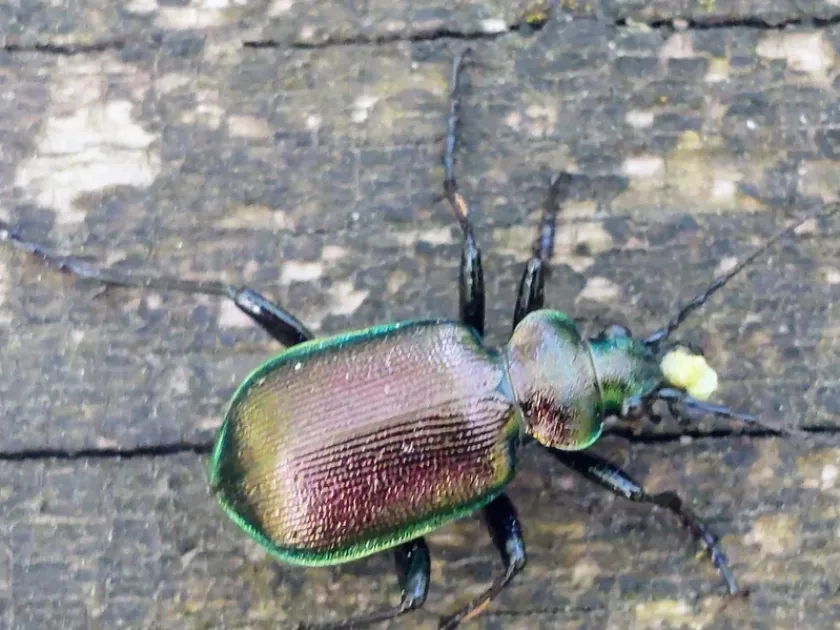
The Gold-net beetle, also known as the caterpillar hunter (Calosoma inquisitor), is a species of ground beetle belonging to the Carabidae family, typically 15-22 mm in length.
Adults exhibit a distinctive metallic luster on their elytra, ranging from brassy green to copper or near-black, making them easily identifiable in woodland habitats.
The beetle has a robust, oval-shaped body with a finely punctured head and pronotum, which distinguishes it from other related species within the genus.
Their larvae are highly mobile, campodeiform predators that possess powerful mouthparts for capturing and consuming prey in both soil and canopy layers.
The insect undergoes a complete metamorphosis, transitioning through egg, larval, pupal, and adult stages to complete its annual life cycle.
What it damages
While primarily a beneficial predator that feeds on harmful caterpillars, it can occasionally be problematic in nurseries where it disrupts local insect dynamics.
The primary diet consists of moth larvae, specifically those of oak-feeding pests like geometrids and silk moths, which often defoliate trees.
In certain scenarios, intense predation by Gold-net beetles can deplete populations of other beneficial insects, creating an ecological imbalance in forest stands.
Young saplings in nurseries may suffer minor bark damage caused by beetles attempting to reach hidden prey, which could lead to secondary infections.
The ecological impact is generally positive, but in high densities, their aggressive foraging behavior can become a point of concern for forest managers.
When it appears
Adults typically emerge from their overwintering sites in the soil during early spring, usually coinciding with the onset of oak bud burst.
Peak activity is observed during late spring and early summer when the biomass of moth larvae is at its highest, providing ample food for the beetles.
Mating occurs shortly after emergence, followed by egg-laying in the soil, which marks the start of the next generation's development.
Larvae develop throughout the mid-summer months, undergoing pupation in the soil to emerge as new adults before the end of the season.
As autumn approaches, adult beetles seek shelter in deep soil or thick leaf litter to enter diapause and survive the harsh winter temperatures.
Signs of infestation
One of the most common signs of their presence is observing adults climbing tree trunks during the day to hunt for caterpillars in the canopy.
Finding remnants of partially consumed caterpillars on leaves or branches is a clear indicator of the presence of an active predator like the Gold-net beetle.
Diagnostic evidence also includes characteristic scratch marks on the smooth bark of young saplings caused by their sharp claws and mandibles.
Ground-level monitoring often reveals larvae moving swiftly through the forest floor litter, especially in areas with high pest caterpillar density.
The metallic sheen of the beetle against the bark is often visible to the naked eye during daytime forest health inspections.
Control measures
Since the Gold-net beetle is largely considered a beneficial forest inhabitant, direct control measures are rarely necessary or recommended.
If management is required in nurseries, physical barriers placed around tree trunks can effectively prevent beetles from climbing into the crowns.
Avoid the use of broad-spectrum chemical insecticides, as these are highly toxic to ground beetles and will destroy natural pest control mechanisms.
Encouraging habitat diversity within forest stands provides a natural buffer, ensuring that beetle populations remain within stable, non-problematic levels.
Routine monitoring using simple pitfall traps allows foresters to track population trends and determine if any intervention is truly warranted.
Taxonomy
- Latin name
- Calosoma inquisitor
- Order
- Coleoptera (beetles)
- Family
- Carabidae
- EPPO code
- CAOOIN
Discussion
No discussions yet — be the first.