
Calosoma cancellatum
Calosoma cancellatum
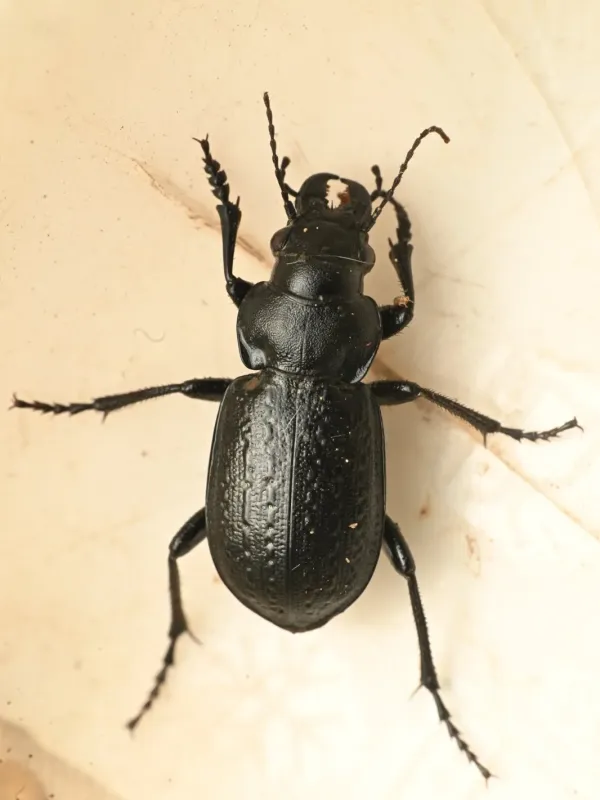
Description
How to identify
Calosoma cancellatum is a member of the Carabidae family, commonly known as ground beetles. The adult beetle is a robust insect, typically measuring 20 to 25 mm in length, with a distinct metallic sheen on its body.
The key morphological feature of this species is the reticulated (net-like) sculpture on its elytra, which consists of raised longitudinal ridges and fine transverse lines.
Larvae are elongated and flattened, possessing well-developed legs that facilitate movement through soil, where they typically reside during development.
While often classified as beneficial predators of other insects, this species can display herbivorous behavior when prey populations are insufficient for their survival.
Being primarily nocturnal, these beetles are rarely seen during daylight hours, as they remain hidden under soil clods or debris to avoid desiccation and predators.
What it damages
This beetle is considered a facultative herbivore, meaning it may feed on plant tissue as a supplementary food source or when environmental conditions are unfavorable.
The damage is most severe during the seedling stage of various crops, where adults chew on stems and cotyledons, often causing significant stand reduction.
Signs of damage include ragged, irregular edges on leaves and stems severed at the soil line, which can lead to the total loss of individual seedlings.
Dry weather conditions exacerbate the damage, as a lack of moisture often corresponds with a reduction in the beetle's primary insect prey, forcing them to turn to crops.
Secondary infections often take hold at the injury sites, significantly weakening the plant and further reducing the total crop yield potential.
When it appears
The life cycle of Calosoma cancellatum is heavily influenced by soil temperature, with activity commencing as soon as the ground warms in the early spring.
Peak adult activity and reproductive phases usually occur between late spring and early summer, coinciding with the rapid growth stages of agricultural crops.
Larval development proceeds through the summer months, leading to the emergence of a new generation of adults by late summer or early autumn.
Monitoring efforts should be focused on the seedling stage, as this is when crops are at their most vulnerable to feeding damage from adult beetles.
Overwintering occurs in deeper soil layers or beneath leaf litter, where the insects remain dormant until the following spring season.
Signs of infestation
The presence of this pest is often detected through observation of damaged seedlings in the early morning before the beetles have sought shelter.
Pitfall traps installed at ground level are the most reliable way to monitor beetle populations and determine the necessity of intervention measures.
Daytime observations are often inconclusive; however, turning over soil clumps or searching near crop residue may reveal hidden specimens.
Foliar injury patterns that appear overnight are a strong indicator of nocturnal beetle activity, particularly when observed across a uniform field area.
The detection of characteristic odor secretions when a beetle is disturbed can also assist in confirming the identity of the pest on the field site.
Control measures
Effective management requires an integrated approach that focuses on reducing overwintering sites and protecting seedlings during their most sensitive stages.
Deep fall tillage is a primary cultural control method that exposes overwintering adults and larvae to extreme cold and predatory pressures.
- Implementing crop rotation to disrupt the life cycle of the beetle in the affected fields.
- Rigorous weed control practices to eliminate alternative shelter and food sources for the adults.
- Use of insecticide seed treatments to provide early-season protection for vulnerable young seedlings.
- Application of contact insecticides during the evening hours if population thresholds exceed acceptable levels.
Biological control agents, such as specific entomopathogenic fungi, are being explored as sustainable alternatives to traditional chemical pesticides for beetle management.
Taxonomy
- Latin name
- Calosoma cancellatum
- Order
- Coleoptera (beetles)
- Family
- Carabidae
- EPPO code
- CAOOCN
Discussion
No discussions yet — be the first.