
Calosoma calidum
Calosoma calidum
Description
How to identify
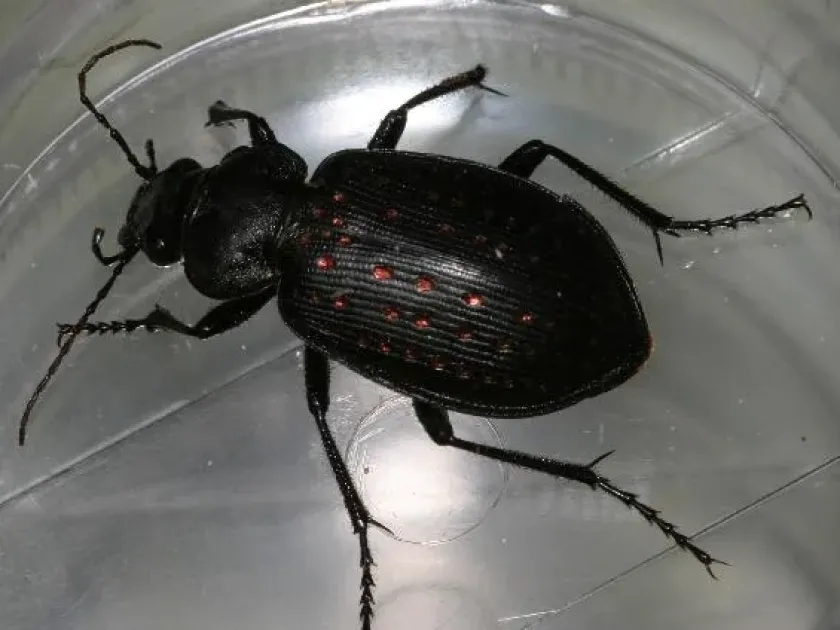
Calosoma calidum, commonly known as the fiery searcher, is a member of the Carabidae family within the order Coleoptera. Adult beetles typically grow to a length of 20 to 25 mm.
The beetle is characterized by its black, slightly metallic exoskeleton. The elytra feature three rows of distinct pits, which are often coppery or bronze in color.
Larvae are campodeiform and highly mobile, featuring well-developed legs that facilitate rapid movement through the soil and across the surface in search of food.
These insects are primarily nocturnal, which helps them avoid avian predators and high daytime temperatures while allowing for efficient foraging.
Their morphological structure, including robust mandibles, enables them to effectively interact with various substrates and food sources in agricultural environments.
What it damages
While often classified as a beneficial predatory beetle, Calosoma calidum can become a pest in agricultural settings when its natural prey is scarce.
The primary concern is the damage caused to young crop seedlings, particularly wheat, barley, and corn, during the germination and early growth phases.
Beetles and their larvae may consume developing seeds or gnaw on succulent stems, leading to weakened plant stands and potential crop loss in affected areas.
Root damage caused by larval activity can stunt plant development, making the crop more susceptible to environmental stressors and secondary diseases.
In high-density populations, the cumulative damage can result in significant stand reduction, requiring replanting or additional chemical interventions.
When it appears
Adult activity typically begins in late spring, triggered by the warming of the soil to temperatures conducive to beetle emergence from overwintering sites.
The life cycle involves complete metamorphosis, consisting of egg, three larval stages, pupa, and adult, with adults often overwintering in the soil.
Egg-laying reaches its peak in late spring, as soil moisture levels provide optimal conditions for the survival and development of the emerging larvae.
Larvae remain active throughout the summer, foraging in the topsoil layers for organic matter, small insects, or crop tissues if other food sources are depleted.
By autumn, as temperatures drop, the population prepares for overwintering, burrowing deep into the soil to survive the cold winter months safely.
Signs of infestation
Field signs include patches of sparse emergence or dead seedlings that show evidence of mechanical feeding damage or hollowed-out seeds.
Visual confirmation of the pest can be obtained by nocturnal monitoring or using soil pitfall traps to estimate population density on the farm.
Plants affected by larval feeding often exhibit yellowing and stunted growth before ultimately wilting or dying, creating visible gaps in the crop rows.
The presence of chitinous beetle remnants near damaged seedlings often confirms the involvement of Calosoma species in the observed field issues.
A distinctive odor, which the beetles release as a defense mechanism, is often noticeable in fields with high infestation rates during evening inspections.
Control measures
Effective management relies on sound agricultural practices, such as crop rotation, which disrupts the life cycle and reduces habitat suitability.
Deep autumn plowing is a critical cultural practice that exposes overwintering adults and larvae to predators and harsh environmental conditions.
The use of insecticidal seed treatments is recommended to provide systemic protection for young seedlings during the most vulnerable stages of growth.
Maintaining clean fields by eliminating weeds reduces the availability of secondary food sources, thereby suppressing beetle reproduction rates.
- Utilize pitfall traps for population monitoring.
- Implement deep tillage to disturb soil habitats.
- Apply systemic insecticides only when economic thresholds are exceeded.
Taxonomy
- Latin name
- Calosoma calidum
- Order
- Coleoptera (beetles)
- Family
- Carabidae
- EPPO code
- CAOOCL
Discussion
No discussions yet — be the first.