
Calosoma alternans
Calosoma alternans
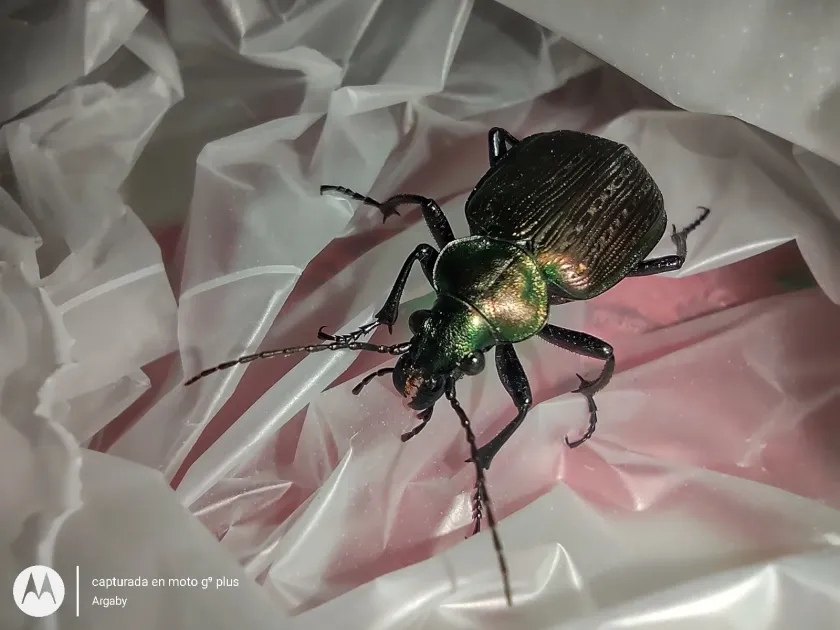
Description
How to identify
Calosoma alternans is a member of the family Carabidae, commonly known as ground beetles. While most carabids are beneficial predators, some species may cause incidental damage to crops.
The adult beetle is typically large, measuring between 20 to 30 millimeters in length, and often exhibits a metallic or dark sheen on its elytra.
These insects have an oval, flattened body shape that allows them to move swiftly across soil surfaces and hide within crop debris during the day.
Their mouthparts are strong and well-developed, designed primarily for predatory behavior but capable of consuming plant tissue when alternative food sources are scarce.
Larvae are campodeiform, meaning they are very active and have long, slender legs, facilitating their movement through the soil profile in search of prey or resources.
What it damages
Although primarily entomophagous, Calosoma alternans can become a secondary pest in agricultural systems when populations spike or prey becomes limited.
Crops such as corn, various small grains, and vegetable seedlings are the most susceptible to damage, particularly during the early vegetative stages.
Damage typically presents as ragged holes or missing tissue on leaves and stems, which can weaken the plant and hinder photosynthesis.
Extensive feeding by both adults and larvae can result in reduced plant stands and stunted growth, ultimately leading to yield loss if left unmanaged.
The damage is often localized within a field, but under favorable conditions, the pest can quickly spread across larger areas of the crop.
When it appears
The life cycle of Calosoma alternans is closely linked to seasonal climate changes, dictating periods of high activity and dormancy.
Adults generally overwinter in protected soil crevices or under dense plant residue, emerging when spring temperatures begin to rise consistently.
Peak emergence typically occurs in late spring, which coincides with the germination and early growth phases of many seasonal crops.
Reproduction follows the spring emergence, with the larval stage developing throughout the summer months as temperatures remain optimal for activity.
By late summer or early autumn, the new generation completes its development and seeks overwintering sites to survive the colder months.
Signs of infestation
The most noticeable signs of Calosoma alternans activity include irregularly shaped lesions on the foliage and base of young seedlings.
Because these beetles are nocturnal or crepuscular, they are rarely seen during the heat of the day, making evening surveys more productive.
Soil disturbance, such as small entry holes near the base of the plant, can indicate the presence of larvae or adult beetles burrowing to rest.
Symptoms of overall plant stress, such as wilting or poor vigor without evidence of fungal diseases, should prompt an inspection for beetle damage.
Monitoring for the presence of adult beetles under clods of soil or organic debris during field inspections is a key method for assessing population levels.
Control measures
Managing Calosoma alternans requires an integrated approach that combines cultural practices with targeted chemical applications only when necessary.
Deep fall tillage is highly effective in disrupting the overwintering sites of these beetles, significantly reducing the population for the following season.
Crop rotation is recommended to prevent the buildup of pest populations, as changing host crops forces the beetles to relocate to more suitable areas.
If population densities reach economic injury levels, chemical control using labeled insecticides can be employed to protect the crop during critical growth phases.
- Maintaining field hygiene by removing excess crop residue that provides shelter
- Encouraging natural bird populations which prey on ground beetles
- Using pheromone or light traps to monitor and track adult activity levels
Taxonomy
- Latin name
- Calosoma alternans
- Order
- Coleoptera (beetles)
- Family
- Carabidae
- EPPO code
- CAOOSA
Discussion
No discussions yet — be the first.