
Calosoma
Calosoma
Description
How to identify
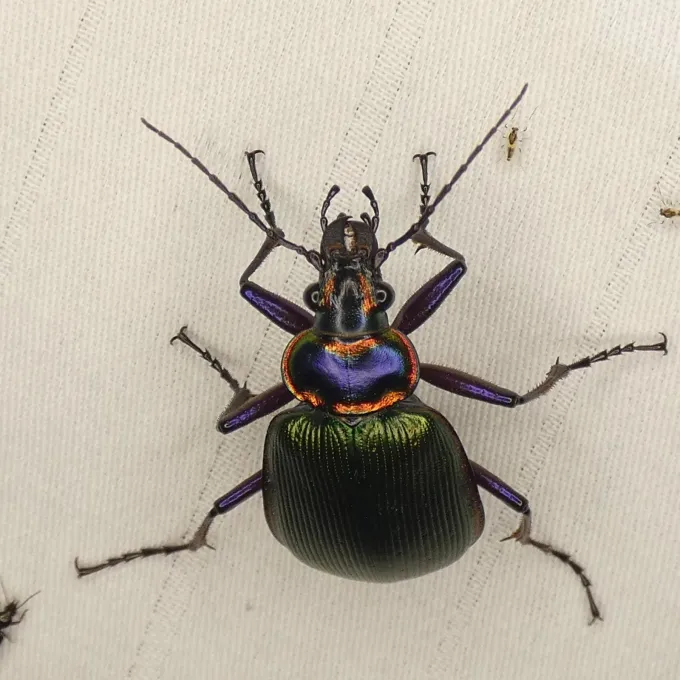
Calosoma is a genus of large, predatory ground beetles belonging to the Carabidae family. Adults are characterized by a robust body, often featuring a metallic sheen in green, blue, or bronze.
The beetle's head is equipped with powerful mandibles designed for capturing and dispatching prey. Long, filiform antennae provide excellent navigation and sensing capabilities.
Wings are well-developed, allowing the adults to move actively in search of food, including climbing trees to access high foliage.
The larvae are also highly active and predatory, possessing specialized jaw structures that enable them to consume prey efficiently.
It is crucial to recognize that biologically, Calosoma species are beneficial entomophagous insects rather than agricultural pests.
What it damages
Crucially for agronomists, Calosoma beetles do not damage crops. They are specialized predators, not plant feeders.
Their diet primarily consists of the larvae of harmful insects, such as gypsy moth caterpillars and other leaf-eating lepidopterans.
In orchards and forested areas, these beetles serve as effective natural controllers, preventing insect populations from reaching levels that could destroy foliage.
By preying on pests within tree canopies and in ground litter, they play a vital role in maintaining overall yield and plant health.
Classifying Calosoma as a "pest" is scientifically inaccurate and contradicts the principles of sustainable pest management.
When it appears
Adult activity typically begins in the spring, as ambient temperatures become sufficient to support their metabolism and hunting behavior.
During outbreaks of foliage-eating pests, the population density of Calosoma beetles often increases in response to the abundance of food.
The beetles are most active during daylight hours, when they patrol tree trunks and branches in search of active caterpillars.
Their life cycle includes overwintering as adults in the soil or forest litter, which makes their survival highly dependent on habitat quality.
As summer draws to a close, their activity levels drop, and they enter a state of diapause, remaining dormant throughout the winter months.
Signs of infestation
Because Calosoma is a beneficial insect, there are no "signs of infestation" in the traditional sense, as they do not cause any harm to the plants.
The presence of these beetles on a farm is a positive indicator of a healthy agroecosystem and strong natural population control.
If you observe a significant number of these beetles, they should be welcomed as natural allies in the biological protection of your crops.
Visual identification is easy due to their size and the rapid, agile movement of these colorful beetles along tree surfaces.
The lack of damage to leaves, fruits, or roots confirms their non-destructive nature, underscoring their role as partners in sustainable agriculture.
Control measures
Since Calosoma is a beneficial predator, no control measures against them are required; in fact, such actions are strongly discouraged.
The primary goal for an agronomist should be to preserve these beetle populations by minimizing the use of broad-spectrum chemical insecticides.
Reducing chemical inputs during peak predator activity allows Calosoma beetles to suppress pest outbreaks naturally and effectively.
To attract and maintain these beetles, maintain areas of natural vegetation and leaf litter that provide essential overwintering sites.
Integrated Pest Management (IPM) strategies should explicitly list Calosoma as a protected species that contributes to farm productivity.
Taxonomy
- Latin name
- Calosoma
- Order
- Coleoptera (beetles)
- Family
- Carabidae
- EPPO code
- CAOOSP
Discussion
No discussions yet — be the first.