
Calodromius spilotus
Calodromius spilotus
Description
How to identify
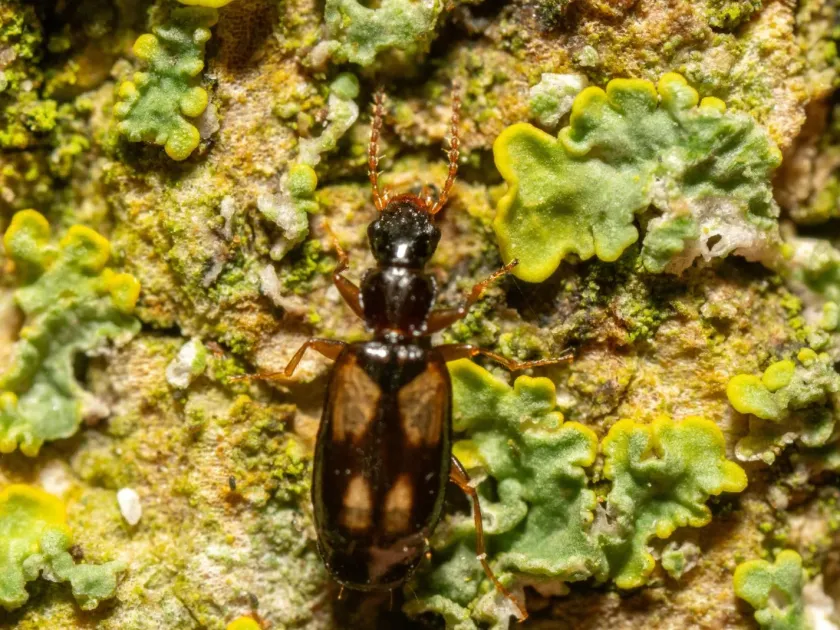
Calodromius spilotus belongs to the Carabidae family within the order Coleoptera. It is a small beetle that often remains hidden due to its secretive lifestyle and cryptic coloration.
The adult body is flattened, allowing the insect to easily enter narrow crevices in tree bark. The elytra typically have a dark coloration with distinct light spots, which gives the species its common name.
Larvae of this species go through several developmental stages and possess an elongated body with mouthparts adapted for feeding on plant tissues or scavenging.
Adults possess well-developed wings and are capable of active flight to new locations in search of suitable feeding or overwintering grounds.
The biology of the species is closely linked to dendroflora, where beetles spend a significant part of their life cycle hiding under bark or in branch junctions.
What it damages
While many ground beetles are considered beneficial entomophages, Calodromius spilotus is frequently found in orchards where it can act as a secondary pest.
Primary targets include various types of fruit trees, especially stone and pome fruits, where the beetle finds shelter and food resources.
Damage consists of feeding on the surface tissues of bark, young shoots, and buds, particularly during the early spring swelling period.
Such injuries weaken the tree's health, creating entry points for the development of secondary fungal and bacterial infections.
In cases of high infestation, beetles can cause noticeable damage to young saplings by gnawing on tender bark, which leads to the drying out of individual branches.
When it appears
Activity of Calodromius spilotus begins in early spring as soon as average daily temperatures rise above freezing point.
The peak period of adult activity occurs in April and May, when insects emerge from overwintering sites and begin to feed and reproduce actively.
During the summer, beetles are less visible as they adopt a more secretive lifestyle, hiding in the shady parts of the canopy or under exfoliating bark.
In autumn, a second wave of activity occurs as insects search for shelter to overwinter, which often coincides with the harvest period.
Beetles overwinter in the adult stage within leaf litter, organic debris, or cracks in the bark of old trees, where the microclimate remains relatively stable.
Signs of infestation
The main sign of infestation is the presence of characteristic small gouges on young shoots and around bud scales, visible upon close inspection.
When removing dead bark from tree trunks, one can often find the beetles themselves or their waste products in the form of fine frass.
The presence of specific damage is frequently accompanied by gummosis in stone fruits, which serves as the tree's defensive reaction to the injury.
Stunted growth of apical shoots during the spring season may also indirectly indicate the presence of this pest within the tree canopy.
Detecting beetles is possible through visual inspection of branches during evening hours when they become most mobile and emerge onto the bark surface.
Control measures
An effective control method is performing sanitary pruning and cleaning tree trunks of old dead bark, where these insects tend to aggregate.
Whitewashing trunks and the bases of structural branches with a lime solution containing insecticides helps kill overwintering individuals and restricts their movement.
When pest populations are high, the application of approved contact-stomach insecticides is advisable during the "green cone" growth stage.
Attracting natural enemies, such as insectivorous birds and predatory insects, plays an important role in controlling beetle populations throughout the season.
- Regular orchard inspections.
- Timely removal and destruction of leaf litter.
- Use of sticky traps on trunks.
- Adherence to proper horticultural practices.
- Application of biological pesticides during the growing season.
Taxonomy
- Latin name
- Calodromius spilotus
- Order
- Coleoptera (beetles)
- Family
- Carabidae
- EPPO code
- CDMSSL
Discussion
No discussions yet — be the first.