
Blue bottle fly
Calliphora vomitoria
Description
How to identify
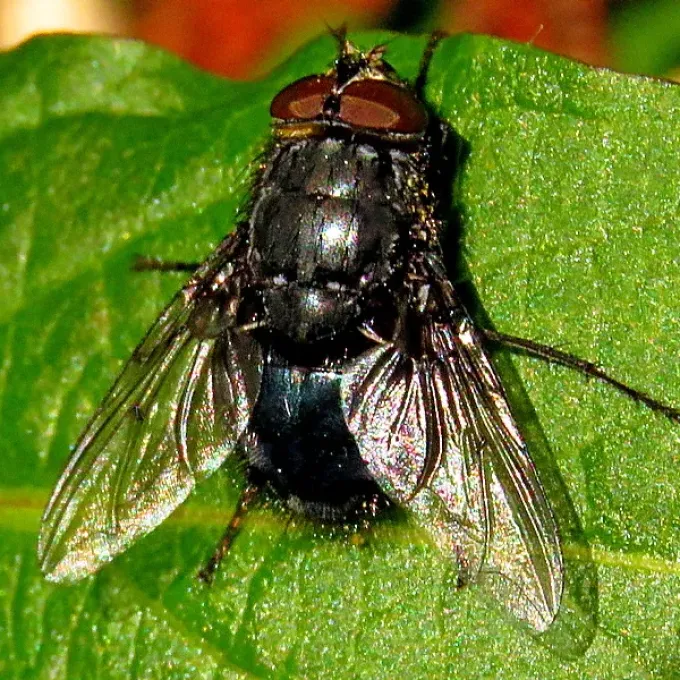
The blue bottle fly (Calliphora vomitoria) belongs to the order Diptera, family Calliphoridae. The adult reaches 10–14 mm in size and has a distinctive shiny blue or blue-black abdomen with a metallic sheen.
The fly's head features large reddish compound eyes. The body is covered with stiff bristles, and the thorax has a grayish dusting. These insects are active fliers capable of covering significant distances to find suitable breeding grounds.
The larvae are legless, maggot-like, and cream-colored. They go through three larval stages, gradually increasing in size, and possess a well-developed mouthpart for feeding on organic decay.
The pupa is hidden within a puparium, a protective shell formed from the final larval skin. The puparium ranges from dark brown to black, making it difficult to detect in soil or debris.
The fly's life cycle is highly temperature-dependent. Under favorable conditions (above +20°C), development from egg to adult can take less than 20 days, allowing for rapid population growth.
What it damages
While this species is not a primary pest of field crops, it poses a serious threat to agribusinesses involved in processing animal products. Flies damage raw materials in warehouses, markets, and meat-processing plants.
Insects act as vectors for pathogenic microorganisms, parasite eggs, and infectious diseases. By landing on food products, they contaminate them with excrement and secretions from their salivary glands.
In vegetable storage facilities and areas with food waste, the blue bottle fly accelerates rot. If fruits have mechanical damage, flies use them as a substrate to lay eggs.
Larvae entering damaged vegetable or fruit tissues promote secondary microflora growth, leading to the total loss of cargo. This makes them a major threat to agricultural product quality during storage.
The damage to horticulture is indirect: flies spread bacterioses to damaged plants, resulting in reduced yields and loss of commercial appearance during transportation and storage.
When it appears
Blue bottle fly activity begins in early spring when air temperatures reach +10–12°C. Population peaks occur in summer, particularly during periods of high humidity.
Flies are active mainly during daylight hours, preferring warm areas. They are closely associated with organic waste accumulation sites, livestock farms, and landfills near agricultural facilities.
In autumn, as temperatures drop, adults look for overwintering shelters. They often invade indoor areas, warehouses, barns, and basements where temperatures remain above freezing.
Insects usually overwinter as adults in a state of diapause, but in warm environments (such as heated storage rooms), development may continue uninterrupted throughout the winter.
At the start of the breeding season, overwintered adults lay eggs on available organic substrates, starting a new cycle that repeats multiple times during the warm season.
Signs of infestation
A primary sign of infestation is the massive aggregation of flies in areas where waste is stored or products are processed. Adults produce a loud, characteristic buzzing sound in flight.
The presence of white egg clusters on organic substrates is a direct sign of colonization. Eggs are usually laid in groups within folds or material damage.
Discovering larvae on or inside stored products indicates an advanced stage of infestation. Larvae are active and emit a specific odor of decay.
The appearance of puparia in floor cracks, room corners, or the top layer of substrate indicates that the population is finishing its development cycle and is ready for emergence.
Another sign is the appearance of excrement spots on windows, walls, and packaging surfaces, left by the flies after feeding in storage rooms.
Control measures
The foundation of control is strict adherence to sanitary and hygiene standards on agricultural sites. Timely removal and disposal of organic waste eliminates the pest's food source.
Using mesh screens on windows and doors of warehouses prevents adult flies from entering facilities. Sealing storage areas is essential for pest exclusion.
- Using sticky traps and bait stations with pheromone or food attractants for monitoring and catching adult flies.
- Applying insecticidal aerosols in zones not intended for the storage of open food products.
- Regular disinfection of facilities using approved chemicals to eliminate larval stages.
Cold treatment of stored products helps reduce insect activity and halts larval development if infestation has already occurred.
Regular monitoring is crucial, as the blue bottle fly's high reproduction rate requires immediate action upon detecting the first signs of infestation.
Taxonomy
- Latin name
- Calliphora vomitoria
- Order
- Diptera (flies)
- Family
- Calliphoridae
- EPPO code
- CALLVO
Discussion
No discussions yet — be the first.