
Caedicia
Caedicia
Description
How to identify
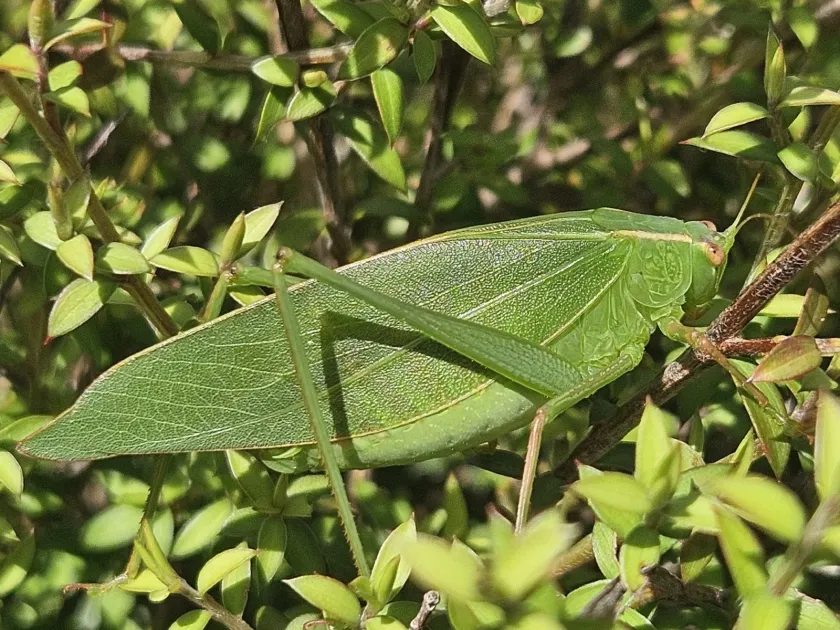
Caedicia is a genus of bush crickets belonging to the family Tettigoniidae in the order Orthoptera. These insects are characterized by their elongated bodies and vibrant green coloration, which provides excellent camouflage in foliage.
Adult specimens possess well-developed wings, enabling them to move between plants efficiently. Their mandibles are designed for chewing, making them highly effective at feeding on plant tissues.
Females are equipped with a distinctive sickle-shaped ovipositor, used to deposit eggs into plant tissues or soil, ensuring the protection of the next generation through winter.
They are primarily nocturnal insects, spending their days hidden within dense foliage. Their cryptic appearance makes detection difficult without a thorough inspection of the canopy.
For accurate identification, experts examine the shape of the pronotum and the specific acoustic patterns produced by males during mating calls in the evening.
What it damages
Caedicia species are polyphagous, meaning they feed on a wide range of ornamental and agricultural crops. They are particularly destructive to various woody plants and shrubs.
Their primary food source consists of young leaves and tender shoots. Feeding damage often appears as irregular holes or shredded leaf edges, sometimes leaving only the main veins behind.
Both adults and nymphs cause damage. During outbreaks, they can quickly defoliate significant portions of a plant, severely stressing its health and reducing growth rates.
Beyond direct feeding, females can damage stems during oviposition. These entry wounds can provide a gateway for secondary bacterial or fungal infections.
Damage to developing buds and fruit sets is particularly concerning, as it directly impacts yield and the commercial quality of nursery products.
When it appears
The life cycle of Caedicia is closely aligned with the regional growing season. Activity generally begins with the onset of warm spring temperatures.
Nymphs emerge from over-wintering eggs in spring, immediately starting to feed on fresh, nutrient-rich growth, which supports their rapid development.
Peak activity for adults usually occurs mid-to-late summer, when the population density is at its highest, leading to more visible damage to host plants.
As autumn approaches, adults engage in mating and egg-laying. The eggs are deposited in protected sites, where they remain dormant throughout the winter months.
In warmer climates, these insects may complete multiple generations within a single year, necessitating a more rigorous approach to population monitoring.
Signs of infestation
The most common sign of infestation is the presence of irregular bite marks or ragged edges on the leaves, characteristic of nocturnal chewing insects.
Spotting the insects in the canopy or on the undersides of leaves during early morning inspections is a primary indicator of an active population.
Accumulated frass (insect excrement) beneath the affected plants is a tell-tale sign that a significant number of pests are feeding in the canopy above.
The distinct chirping sounds produced by males in the evening are an auditory cue that can help confirm their presence in dense garden environments.
Look for small, slit-like scars on young stems, which indicate where females have deposited eggs, a sign that future generations are being established.
Control measures
Good agricultural practices are the first line of defense; removing plant debris where eggs might be laid can significantly reduce the following season's population.
Biological control methods, such as encouraging natural predators like birds and predatory insects, can help maintain population balance in larger garden settings.
For heavy infestations, registered insecticides specifically targeting orthopterans may be applied, following strict label instructions for crop safety.
- Utilizing light traps in the evening to monitor population levels.
- Hand-picking nymphs and adults in small, controlled areas.
- Pruning and destroying shoots showing signs of egg-laying.
The use of microbial-based bio-insecticides provides an environmentally friendly alternative, allowing for effective management without harming beneficial pollinators.
Taxonomy
- Latin name
- Caedicia
- Order
- Orthoptera (locusts)
- Family
- Tettigoniidae
- EPPO code
- CAEDSP
Discussion
No discussions yet — be the first.