

Apple sucker
Cacopsylla mali
Description
How to identify
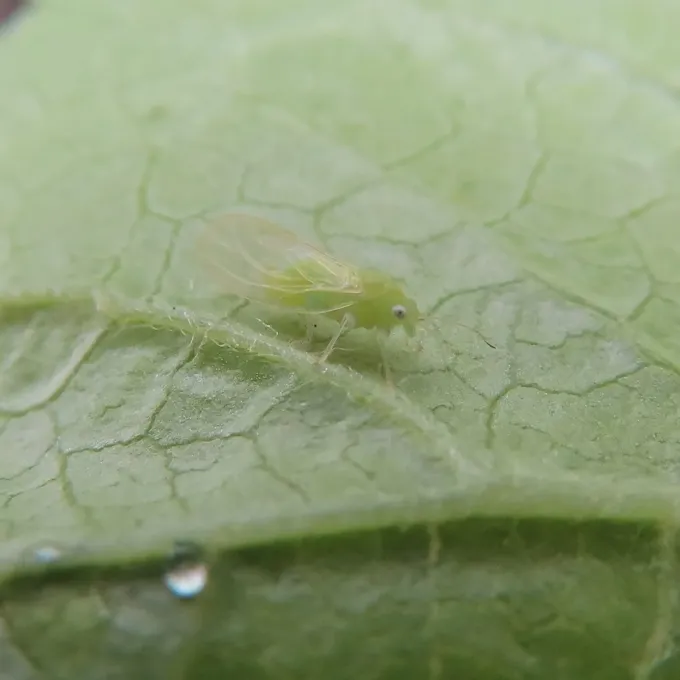
The apple sucker Cacopsylla mali is a small insect belonging to the family Psyllidae within the order Hemiptera. Adult specimens are roughly 3 mm long and possess powerful hind legs adapted for jumping.
The insect’s coloration varies by stage and season: nymphs are typically yellowish-green, while adults range from light green to brownish. They have large red eyes and wings that are held roof-like over the abdomen.
Eggs of the apple sucker are minute, elongated, and bright orange. They are laid in clusters on the bark, primarily near buds on young shoots, providing a strategic advantage for spring hatching.
Nymphs undergo five developmental instars, becoming increasingly mobile. Throughout these stages, they produce a sugary substance known as honeydew, which often covers their bodies for protection.
As they reach the nymphal stage, they develop wing pads. The biology of Cacopsylla mali is strictly linked to the phenological stages of the host tree, ensuring synchronized emergence.
What it damages
The apple sucker primarily targets the domestic apple tree. While they can be found on related Rosaceae, the primary economic impact is felt within commercial and backyard apple orchards.
Damage is caused by both nymphs and adults feeding on sap. By piercing the plant tissues of buds, leaves, and flower stalks, they extract essential nutrients, causing significant physiological stress.
Infested buds often fail to open properly, and flower clusters become distorted. This directly reduces the fruit set and can lead to total loss of the yield if the infestation is severe.
Honeydew secretion covers the foliage, creating a sticky environment that facilitates the growth of sooty mold. This fungus blocks stomata and reduces the efficiency of photosynthesis.
Trees subjected to heavy infestation show signs of stunted growth and general decline. The weakened state of the tree makes it more susceptible to environmental stressors and other diseases.
When it appears
The apple sucker overwinters as eggs on the bark of apple trees. Hatching occurs during the early spring, precisely as the buds begin to break and show green tissue.
Upon hatching, the young nymphs immediately migrate to the developing buds to begin feeding. They stay inside the buds during the early stages, protected by the tight floral leaves.
Adults emerge at the end of the apple blossom period. They are agile and capable of flight, allowing them to disperse throughout the orchard to feed on foliage during the summer months.
As autumn approaches, adult females lay their eggs on young twigs near the buds. These eggs remain dormant until the following spring, completing the annual cycle.
The species is univoltine, producing only one generation per year. This predictable life cycle allows growers to target the pest at its most vulnerable developmental stages.
Signs of infestation
The first indicator of infestation is the appearance of sticky honeydew droplets on buds. These droplets attract ants and serve as a medium for black sooty mold growth.
Leaves appear twisted, curled, or scorched. This physical deformation is a clear sign that sap-sucking activity has significantly disrupted the normal growth of the leaf tissue.
White, woolly-looking waxy masses on the shoots or buds indicate the presence of nymphs. These coverings act as a shield against predators and environmental factors.
Flower stalks exhibit characteristic distortion; they look stunted and appear glued to the branch. This prevents flowers from fully opening, which hinders successful pollination.
Observing jumping insects when shaking a branch is a definitive sign of high pest density. Their erratic movement is a hallmark of the psyllid family's behavior.
Control measures
Effective management begins with dormant oil sprays applied before bud burst to target and suffocate overwintering eggs. This is the most crucial window for control.
Post-blossom insecticide treatments are necessary if nymph populations exceed economic thresholds. Systemic insecticides are preferred for their ability to reach protected insects.
- Scrubbing bark to remove overwintering sites for eggs.
- Promoting natural predators like ladybirds and lacewings in the orchard.
- Pruning and destroying heavily infested twigs during winter.
- Monitoring the orchard regularly using sticky traps for adult activity.
Rotating chemical classes is vital to prevent the development of resistance. Monitoring is essential to ensure that applications are timed exactly to the pest's stage.
In organic settings, horticultural soaps and neem-based oils can be used to manage nymph populations while minimizing impact on beneficial insects.
Content graph
Connections · Apple sucker
Most often together:
Marketplace
Products · 17


Tanrek v.r.k.
ЗАТ Фірма Август, Росія.,селище Вурнари,
Insecticides
0
0
·
63
1 offer
140 €per 1 l
Buy

Commandor, w.r.k., (imidacloprid, 200 g/l)
Кемілайн Агро, ПП
Insecticides
0
0
·
59
1 offer
110.41 €per 1 l
Buy


Zenit w.r.k., (imidacloprid, 200 g/l)
Санрайз Кемікалз Ко. Лтд., Шанхай, Китай
Insecticides
0
0
·
51
1 offer
2.6 €per 1 l
Buy

Nuprid 200 CS
Нуфарм Австралія Лтд. , Австралія (місце виробництва: Чілі
Insecticides
0
0
·
51
1 offer
15 471.5 €per 1 l
Buy

NOMINAL, V.R.G., (TIAMETOXAM, 250 G/KG)
Санрайз Кемікалз Ко. Лтд., Шанхай, Китай
Insecticides
0
0
·
48
1 offer
19.21 €per 1 l
Buy


Nominal w.d.g., (thiamethoxam, 250 g/kg)
Санрайз Кемікалз Ко. Лтд., Шанхай, Китай
Insecticides
0
0
·
62
No offers
—
Details


Biology
Taxonomy
- Latin name
- Cacopsylla mali
- Order
- Hemiptera (bugs, aphids, leafhoppers)
- Family
- Psyllidae
- EPPO code
- PSYLMA
Community
Discussion
No discussions yet — be the first.