
Bucrates
Bucrates
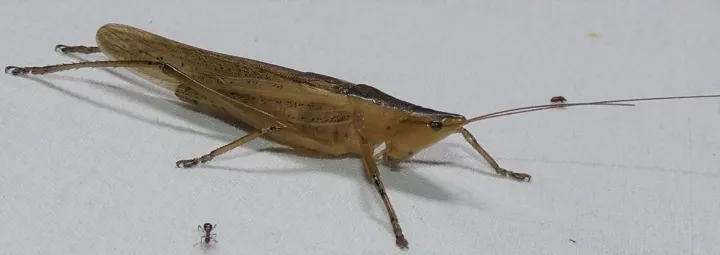
Description
How to identify
Bucrates is a genus of insects belonging to the family Tettigoniidae (bush crickets) within the order Orthoptera. These insects feature an elongated body structure and often possess camouflage coloration that blends with dry vegetation.
Adults are equipped with powerful hind legs designed for jumping and a robust chewing mouthpart. Long, thread-like antennae are their primary sensory organs, enabling them to navigate through dense plant growth effectively.
A key morphological feature of the Bucrates genus is the specific structure of the head and the pronotum. Females are typically equipped with a long, saber-shaped ovipositor, used for laying eggs into plant tissues or the soil.
Their life cycle involves incomplete metamorphosis, progressing through the stages of egg, nymph, and adult (imago). Nymphs resemble miniature versions of adults but lack functional wings.
These insects are predominantly nocturnal or crepuscular, which makes them difficult to detect during daylight hours without thorough inspection of the crop canopy.
What it damages
Pests of this genus cause damage to a wide range of crops, including cereals, vegetables, and ornamental plants. They primarily feed on the vegetative parts, specifically leaves and tender young shoots.
The most significant damage occurs during the intensive growth phase of crops, as tender tissues are particularly attractive to these insects. They are known to chew the edges of leaves, leaving irregular, jagged marks.
In cases of high population density, Bucrates can cause extensive damage to reproductive organs, such as flowers, ovaries, and young ears, leading to direct yield loss and reduced product quality.
Feeding damage often creates entry points for secondary fungal and bacterial infections, which further compromise the health of the plant and may lead to stunted growth or total plant failure.
The level of harm is directly proportional to the population density in the field and the stage of crop development. Plants are most vulnerable during the seedling and early tillering stages.
When it appears
The emergence of these pests in agricultural ecosystems usually occurs during the late spring and summer months. Nymphs begin to hatch once stable warm temperatures are achieved.
The peak population of adults is typically observed in the second half of summer, coinciding with the maturation phase of most crops. This is the period when they are most active and voracious.
The autumn season involves preparations for overwintering. Eggs deposited by females serve as the primary overwintering stage, ensuring the survival of the species until the following season.
Weather conditions, such as high humidity and moderate temperatures, foster population growth. In such seasons, sudden spikes in population density may require immediate agronomic intervention.
Monitoring efforts should commence at the earliest stage of plant emergence, utilizing visual checks or specialized traps during the evening when the insects are most active.
Signs of infestation
The primary sign of infestation is distinctive leaf damage: ragged or uneven edges resulting from their chewing mouthparts. Unlike larvae, these grasshoppers often feed in an irregular manner across the leaf surface.
At night, a reliable indicator of their presence is the characteristic stridulation (chirping) of the males. This helps identify their presence in a field even if population numbers are relatively low.
Inspecting crops at dusk can reveal individuals resting on the tops of stems. Additionally, the presence of frass (excrement) on the leaf surfaces serves as a clear indicator of active feeding.
Damaged flower buds and ovaries, which appear gnawed, suggest that the population has moved from feeding on foliage to damaging the reproductive parts of the plants.
For more precise identification and density estimation, entomological sweep netting during evening hours is recommended, allowing for a count per square meter of the infested area.
Control measures
Effective management requires an integrated approach combining agronomic and chemical methods. It is crucial to maintain field hygiene by removing weeds that serve as reservoirs and alternative food sources.
Agronomic strategies include deep autumn plowing, which helps to destroy eggs deposited in the soil, significantly reducing the survival rate of the next generation.
When the economic injury level is reached, the application of contact-stomach insecticides is necessary. All applications must strictly follow pre-harvest interval regulations.
Biological control, including the protection of natural enemies like insectivorous birds and predatory insects, plays a vital role in keeping populations under natural threshold limits.
- Implementation of crop rotation cycles.
- Timely mowing of field borders and adjacent lands.
- Application of biological insecticides for early-stage control.
- Using light traps for night-time population monitoring.
Taxonomy
- Latin name
- Bucrates
- Order
- Orthoptera (locusts)
- Family
- Tettigoniidae
- EPPO code
- BUCRSP
Discussion
No discussions yet — be the first.