

Brown mite
Bryobia rubrioculus
Description
How to identify
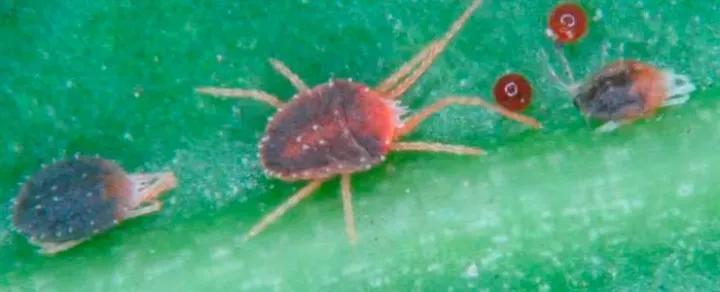
The brown mite (Bryobia rubrioculus) belongs to the Tetranychidae family. Adult mites are approximately 0.5 to 0.6 mm in length, characterized by a brownish-red body and notably elongated front legs, which are significantly longer than the other three pairs.
The eggs of this species are spherical and bright red, usually laid in crevices of the bark, near buds, or in branch forks. This stage is particularly important as it is the form in which the mite overwinters on the host tree.
Unlike the common spider mite, the brown mite does not produce silk webbing on the leaves. This unique behavior often makes it harder to detect during early stages of infestation. The life cycle consists of the egg, larva, protonymph, deutonymph, and adult stages.
This pest is highly adaptable to various environmental conditions. Under favorable temperatures, the population can complete several generations per season, leading to a rapid buildup in numbers during the warmer months.
Biological monitoring is essential, as the mites are microscopic and often go unnoticed until visible damage appears on the foliage. Identifying the red egg clusters on the bark during winter or spring is a key proactive measure.
What it damages
The brown mite primarily affects fruit trees, including apple, pear, plum, cherry, and almond trees. Both larvae and adults damage the host by piercing the leaf epidermis and extracting cell contents, which disrupts photosynthesis.
Early symptoms include stippling, where light-colored spots appear on the leaf surface. As feeding progresses, these spots merge, causing the leaves to lose their green color and take on a bronze or greyish-brown appearance.
Severe infestations cause premature leaf yellowing and shedding, which significantly stresses the tree. This loss of foliage reduces the tree's vigor and its ability to store energy for the following season, potentially leading to lower yields.
Fruit quality is also negatively impacted; fruits may become smaller, lose their market value, and in extreme cases, drop prematurely. The overall health of the tree is compromised, making it more susceptible to environmental stress and secondary pests.
In commercial orchards, if left uncontrolled, brown mite populations can cause substantial economic losses due to decreased fruit production and the long-term decline of tree vitality.
When it appears
Larval emergence from overwintering eggs typically starts during the bud-break phase in spring. Early activity is usually slow due to cooler temperatures but accelerates as spring progresses into summer.
Peak population levels are generally reached in mid-summer, when hot and dry weather provides optimal conditions for rapid development. During this time, multiple overlapping generations can be found on the trees.
As the season approaches autumn and daylight decreases, females begin laying overwintering eggs. These eggs remain on the bark, protected from winter conditions, and serve as the inoculum for the next year.
Mites are mobile and migrate across the tree, moving between branches and leaves throughout the growing season. This migratory behavior requires orchardists to be vigilant and maintain consistent monitoring.
Orchard managers should prioritize scouting during the dormant period for egg clusters and continue regular checks throughout the growing season to time potential acaricide applications effectively.
Signs of infestation
The primary sign of brown mite infestation is the bronzing of foliage. Leaves lose their deep green pigment and appear dusty or pale, starting from the lower canopy and moving upwards.
The absence of silk webs is a critical diagnostic feature distinguishing this mite from other species of spider mites. Instead of webs, growers might observe a general dulling of the leaf surface.
Affected leaves may show signs of premature aging, such as wilting or curling at the edges, before eventually dropping from the tree entirely. This creates a sparse canopy, exposing the fruit to excessive sun and heat stress.
Under magnification or with a hand lens, one can see the reddish-brown mites moving actively across the leaves. They are often concentrated along the leaf veins or on the upper surface of the leaves.
Early-season signs can be subtle, but the presence of the mite is often confirmed once the characteristic stippling and discoloration become widespread across the orchard.
Control measures
Effective control requires an Integrated Pest Management (IPM) approach that combines mechanical, biological, and chemical methods. The goal is to keep populations below the economic damage threshold.
- Dormant oil sprays applied in late winter or early spring are highly effective at suppressing overwintering eggs.
- Using selective acaricides during the growing season, timed specifically to peak mite activity periods.
- Conserving natural predators, such as phytoseiid mites, lacewings, and lady beetles, which help naturally regulate mite numbers.
- Maintaining proper orchard hygiene, including removing loose bark or pruning heavily infested branches to reduce egg sites.
Chemical control must involve rotating different chemical classes of acaricides to prevent the development of resistance. Proper spray coverage is vital to reaching the mites on both sides of the leaves.
Repeated applications may be necessary in high-pressure years. Always monitor the effectiveness of treatments and ensure that the chosen acaricide is compatible with the beneficial insect populations present in the orchard.
Content graph
Connections · Brown mite
Most often together:
Marketplace
Products · 34


Taurus, granular, (pyridaben, 200 g/kg)
Санрайз Кемікалз Ко. Лтд., Шанхай, Китай
Insecticides
0
0
·
65
4 offers
16.36 €per 1 l
Buy


Taurus z.p., Insecticide (pyridaben 200 g/kg)
Санрайз Кемікалз Ко. Лтд., Шанхай, Китай
Insecticides
0
0
·
50
4 offers
18.09 €per 1 l
Buy


Anti-Clisht k.s.
China Communications Import and Export Corporation
Insecticides
0
0
·
44
5 offers
20.3 €per 1 l
Buy


Anti-Scab Pro
ТОВ «Фабрика агрохімікатів», Черкаси, Україна
Insecticides
0
0
·
32
17 offers
18.6 €per 1 l
Buy


Biology
Taxonomy
- Latin name
- Bryobia rubrioculus
- Order
- Mites
- Family
- Tetranychidae
- EPPO code
- BRYORU
Community
Discussion
No discussions yet — be the first.