
Brumoides
Brumoides
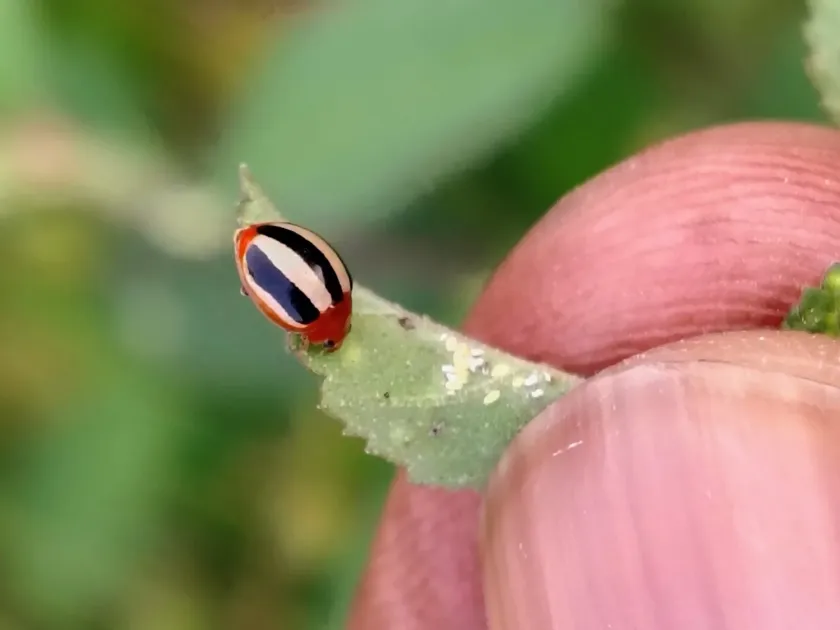
Description
How to identify
The genus Brumoides belongs to the family Coccinellidae (lady beetles), order Coleoptera. It is important to note that unlike most predatory lady beetles, certain species within this genus may exhibit phytophagous behavior or be associated with plants they cause damage to.
Morphologically, these insects exhibit the typical hemispherical or rounded body shape of lady beetles. Their coloration ranges from yellowish to orange-brown, sometimes featuring a distinct pattern of spots on the elytra, which often leads to confusion with beneficial predator species.
Identifying species within the genus requires professional examination of the adult genitalia, as external morphological traits often overlap. In field conditions, agronomists typically record the presence of beetles on the generative organs of plants.
Larvae of Brumoides possess the typical campodeiform shape with well-developed legs, enabling them to move actively across leaves and stems in search of food. Their bodies are often covered with fine setae or protuberances.
The life cycle involves complete metamorphosis: egg, larva, pupa, and adult. Pupation usually occurs on the underside of leaves or within protected plant axils, where the insect remains until the adult emerges.
What it damages
Brumoides species can damage a wide range of crops, including fruit trees and certain vegetable plants. The primary damage is caused by both adults and larvae feeding on plant tissues.
Most frequently, these insects target young leaves, flower buds, and inflorescences, creating holes or skeletonizing the leaf lamina. This disrupts photosynthesis and weakens the plant's overall vitality.
During periods of mass outbreaks, the pest can cause significant damage to reproductive organs, directly leading to reduced yields in fruit and vegetable production.
Feeding damage is often followed by secondary infections, as the punctures and ragged leaf edges become entry points for pathogenic fungi and bacteria.
The greatest threat occurs when pests feed on growth points and young shoots, leading to plant deformation and stunted development during early vegetative stages.
When it appears
The activity of Brumoides is highly dependent on regional climatic conditions and the start of the crop growing season. Typically, the first adults appear in late spring as stable warm temperatures are established.
The peak population often coincides with the active flowering phase of plants, when nutrients in pollen and delicate bud tissues are most accessible to the insects.
In hot summer months, generation development may accelerate if humidity remains at an optimal level, facilitating the survival of larval stages.
In autumn, adults prepare for diapause, seeking overwintering sites such as leaf litter, tree bark crevices, or the topsoil layer to survive the winter cold.
The number of generations per season depends on the duration of the warm period, with the pest potentially producing two to three generations annually in southern latitudes.
Signs of infestation
The primary sign of infestation is visually noticeable leaf damage: small circular holes or "windows" in the center of the leaf blades.
The presence of the insects themselves on the undersides of leaves or within opening buds provides direct evidence of site colonization.
Stunted plant growth and the withering of individual inflorescences that have been subjected to intensive feeding by larvae or adults indicate a significant infestation level.
The presence of fine webbing or excrement on the leaf surface may indicate pest foci, requiring immediate inspection of the field or orchard.
Upon closer inspection, egg clutches are typically found in compact groups on the underside of leaves, which serves as a warning signal to initiate control measures.
Control measures
Effective management begins with cultural practices: regular weeding and the removal of plant debris that may serve as shelter for overwintering individuals.
Biological control methods include the promotion of natural enemies, such as predatory bugs and parasitoid wasps, which can help suppress Brumoides populations.
If economic damage thresholds are exceeded, the application of systemic or contact-stomach insecticides registered for use on the specific crop is recommended.
It is crucial to rotate products from different chemical classes to prevent the development of resistance (pesticide tolerance) in the pest population.
Monitoring using yellow sticky traps allows for the early detection of adult migration, enabling localized treatment of hotspots before the infestation becomes widespread.
Taxonomy
- Latin name
- Brumoides
- Order
- Coleoptera (beetles)
- Family
- Coccinellidae
- EPPO code
- BRUMSP
Discussion
No discussions yet — be the first.