
Tucuman flat mite
Brevipalpus tucuman
Description
How to identify
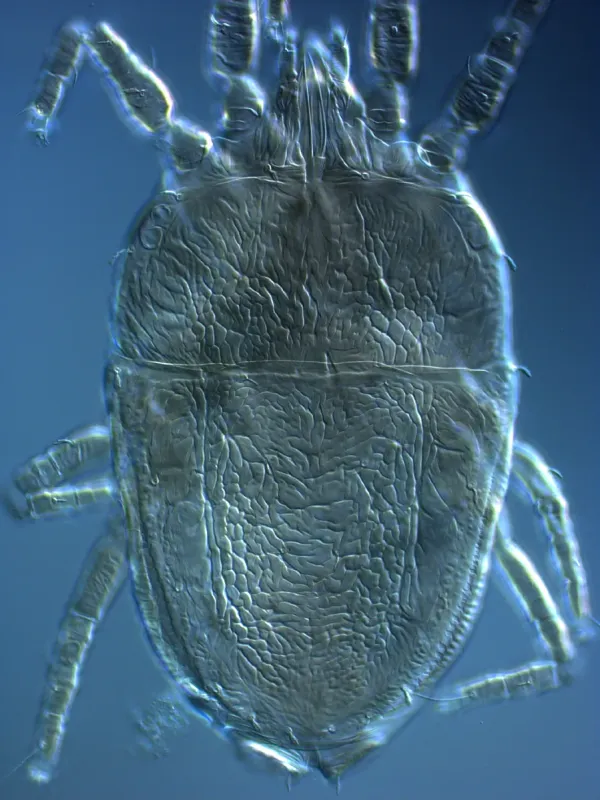
The Tucuman flat mite (Brevipalpus tucuman) belongs to the Tenuipalpidae family. These are microscopic organisms, with adults measuring approximately 0.3 mm in length, making them extremely difficult to detect.
Their bodies are characteristically flat, which gives the group its common name. They are typically reddish-brown to yellowish in color, and unlike spider mites, they do not produce any webbing.
They belong to the Acariformes order and are highly adapted to specialized plant environments. They are most commonly found on the underside of leaves and near the leaf stalks of their host plants.
The mite's life cycle consists of the egg, larva, protonymph, deutonymph, and adult stages. In some populations, females reproduce via parthenogenesis, allowing for rapid colonization during favorable warm weather.
Agronomists often use 10x or 20x magnification to identify these mites during field inspections, as they often congregate near leaf veins where they are protected from direct exposure.
What it damages
The primary hosts of Brevipalpus tucuman are citrus trees, including lemon, orange, and mandarin. The mites feed by piercing plant cells and extracting vital sap from the leaf tissues.
Beyond citrus, these mites have been observed on various ornamental plants, making them a significant concern for nurseries and commercial greenhouses that trade plant materials across regions.
The feeding activity leads to physiological stress in the host plant, reducing photosynthetic efficiency and causing general decline in tree vigor over the course of the growing season.
Heavy infestations lead to leaf drop, reduced fruit set, and significant blemishes on the fruit surface, which lowers the commercial value and prevents successful export of the harvest.
Critically, these mites serve as vectors for harmful plant viruses, most notably the citrus leprosis virus, which can cause severe economic losses in affected citrus-producing areas.
Signs of infestation
Infestation symptoms begin as small chlorotic spots on the leaves. As the population grows, these spots expand into larger necrotic areas, eventually leading to leaf curling and defoliation.
Fruit damage manifests as hardened, corky, brownish patches on the rind. This aesthetic damage renders the fruit unsuitable for the fresh market, even if the internal quality remains intact.
The presence of fine dust-like debris, including cast skins and fecal matter on the undersides of leaves, is a common indicator of a large and active mite colony.
Stunted growth of new terminal shoots and general lack of vitality in the canopy are classic signals that a tree is struggling with a high population of flat mites.
- Chlorotic spotting on foliage.
- Deformed and stunted new leaves.
- Corky, necrotic lesions on fruit skin.
- Premature leaf drop and canopy thinning.
Control measures
Chemical control involves the application of specific acaricides. Due to the rapid development of resistance, it is recommended to rotate chemical classes and use integrated pest management (IPM) practices.
Cultural control is essential; maintaining proper irrigation and pruning practices helps create a microclimate less conducive to mite outbreaks, as they prefer dry conditions.
Removing and destroying infested plant material, especially during the dormant season, significantly reduces the overwintering population and helps prevent spread in the following year.
Biological control using predatory mites of the family Phytoseiidae has shown promise in managing populations without relying solely on chemical inputs, which helps preserve beneficial insect life.
Regular field scouting using magnifying tools or sticky traps is the best way to detect early signs of infestation and apply spot treatments before the mite population explodes.
Taxonomy
- Latin name
- Brevipalpus tucuman
- Order
- Mites
- Family
- Tenuipalpidae
- EPPO code
- BRVPTU
Discussion
No discussions yet — be the first.