
Red flat mite
Brevipalpus russulus
Description
How to identify
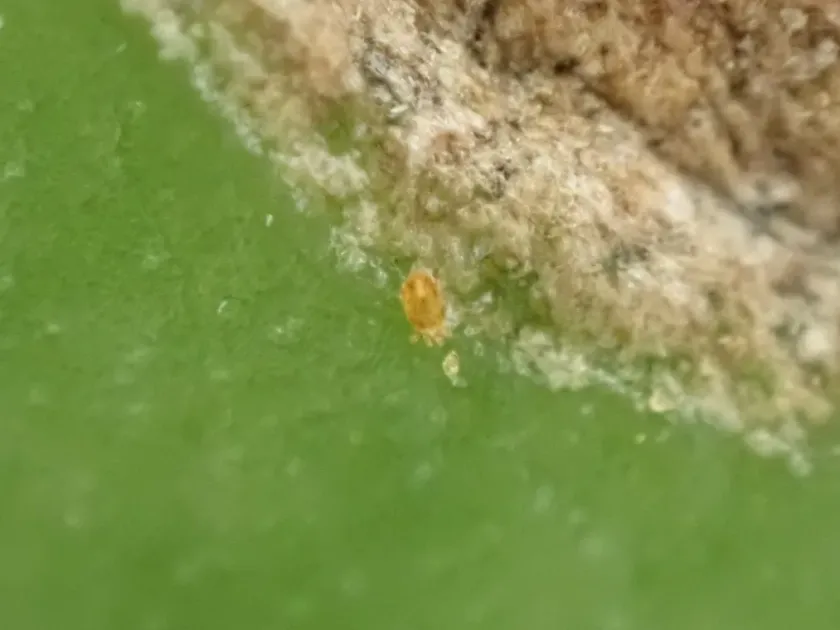
The red flat mite (Brevipalpus russulus) belongs to the family Tenuipalpidae. These mites are microscopic and characterized by a distinctively flattened body shape, which allows them to hide and thrive in the narrow crevices of plant tissues.
Adult mites typically exhibit a reddish-orange or bright red coloration. Because of their size, they are extremely difficult to detect with the naked eye, necessitating the use of a magnifying glass or microscope for proper identification.
The life cycle encompasses several stages: egg, larva, protonymph, deutonymph, and adult. Their development rate is often slower than that of spider mites, yet they can become a significant problem in warm, dry environments.
These mites overwinter as mated females, seeking shelter in tree bark, bud scales, or plant debris. As temperatures rise in spring, they emerge to commence feeding and reproduction on new growth.
Females deposit eggs singly or in small clusters. These are often placed in protected sites like leaf axils or under the bark, shielding them from environmental stress and certain chemical applications.
What it damages
Red flat mites are polyphagous, meaning they attack a wide range of hosts, including grapevines, citrus trees, ornamental shrubs, and indoor plants. They cause damage by piercing the plant epidermis.
Using their piercing-sucking mouthparts, these mites extract cell contents from the parenchyma. This localized depletion of cell sap disrupts photosynthesis and weakens the plant's overall metabolic processes.
Injury manifests as discolored patches, ranging from yellowish to bronze or gray. As the feeding continues, these spots become necrotic, leading to tissue death and a reduction in the overall surface area available for photosynthesis.
Heavy infestations typically cause premature leaf drop, shoot stunting, and reduced vigor. In agricultural settings, this significantly impacts both yield quality and quantity, particularly in fruit-bearing plants.
The wounds inflicted by the mites act as gateways for secondary infections, including various bacterial and fungal pathogens, which further degrade the health of the host plant.
Signs of infestation
A key indicator of infestation is the gradual loss of the leaf's natural sheen, followed by a dulling of the color and the appearance of bronze or grayish stippling across the leaf surface.
Close inspection of the underside of leaves may reveal the presence of adult mites and their tiny, reddish eggs. Unlike spider mites, they do not produce any webbing, making them harder to notice initially.
Stems and twigs may develop a rough, corky appearance or fine cracks due to persistent feeding. Affected plants may show stunted growth, distorted leaves, or terminal buds that fail to develop properly.
The development of necrotic blotches that resemble chemical or sun scorch is a common symptom in later stages of infestation, which eventually leads to the collapse of affected leaves.
Early intervention is crucial because signs of infestation often mirror other nutritional deficiencies or environmental stressors, frequently leading to delayed treatment of the mite population.
Control measures
Effective management begins with strict sanitation: removing and destroying infested plant material, controlling weeds that act as alternative hosts, and practicing proper pruning to eliminate overwintering sites.
Acaricides are the primary chemical tool for controlling outbreaks. Because of the risk of developing resistance, it is critical to rotate between products with different modes of action.
Biological control, utilizing predatory mites such as Phytoseiulus persimilis, can be highly effective in both greenhouses and outdoor environments to suppress mite populations naturally.
Environmental management, including maintaining adequate humidity and using proper irrigation techniques, creates a less favorable climate for flat mites, which generally prefer dry conditions.
- Regular monitoring with a 10x magnification lens.
- Application of sulfur-based treatments.
- Systemic acaricides for severe infestations.
- Quarantine procedures for all new plant stock.
Taxonomy
- Latin name
- Brevipalpus russulus
- Order
- Mites
- Family
- Tenuipalpidae
- EPPO code
- BRVPRU
Discussion
No discussions yet — be the first.