
Red flat mite
Brevipalpus phoenicis
Description
How to identify
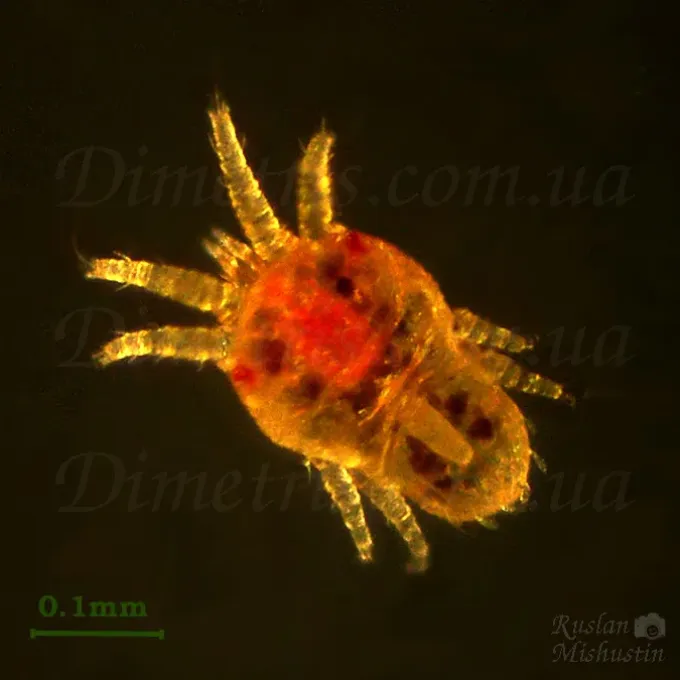
The red flat mite (Brevipalpus phoenicis) is a destructive pest belonging to the Tenuipalpidae family. These mites are extremely small, measuring approximately 0.2–0.3 mm in length, and possess a flattened body shape that allows them to hide in bark crevices and leaf axils.
Adult mites vary in color from reddish-orange to dark red. Unlike the well-known spider mites, they do not produce silk webs, which often leads to late detection of the infestation in agricultural settings.
The biology of this mite is highly adapted to warm climates. It reproduces through parthenogenesis, meaning females can lay fertile eggs without mating, leading to rapid population growth.
The life cycle includes the egg, larva, two nymphal stages, and the adult stage. In favorable temperatures around 25°C, the entire cycle can be completed in less than three weeks.
They are particularly prevalent in greenhouses and tropical regions where temperature and humidity remain constant throughout the year, supporting continuous breeding.
What it damages
This species is a generalist, infesting a wide range of hosts including citrus, coffee, tea, orchids, and various ornamentals. Their feeding habits have a significant economic impact on global plant production.
Both nymphs and adults feed by extracting cell sap from leaves, stems, and fruits. This leads to the destruction of chlorophyll-containing cells and interferes with the plant's photosynthetic process.
A major concern is that Brevipalpus phoenicis acts as a vector for various plant viruses, most notably the citrus leprosis virus, which can devastatingly impact citrus orchards.
Damage to fruits results in unsightly scabbing and deformation. This lowers the market value of the crop and, in severe cases, renders the entire harvest unsuitable for commercial sale.
Young seedlings are particularly vulnerable to infestation, as the feeding can stunt growth, cause leaf drop, and eventually lead to the death of the plant.
Signs of infestation
Initial signs of infestation appear as small, chlorotic spots on the leaf surface. Over time, these spots merge, leading to widespread yellowing, desiccation, and leaf curling.
Microscopic examination of the undersides of leaves is often necessary to confirm the presence of these mites, as they appear as tiny red moving dots.
On fruits, damage manifests as brown, corky patches. These necrotic areas do not grow out as the fruit matures, resulting in permanent damage to the fruit's rind.
The absence of fine webbing is a diagnostic feature. If an infestation shows severe damage symptoms but lacks spider-like webs, it is highly likely to be a flat mite.
Overall plant weakness, poor fruit set, and reduced vigor are clear indicators that the mite population has reached a level requiring immediate treatment.
Control measures
Effective management begins with strict quarantine protocols for imported plants. Inspecting nursery stock before integration into existing orchards is crucial for disease prevention.
Chemical control should rely on specific acaricides. It is vital to rotate different chemical classes to avoid the development of pesticide resistance in the mite population.
Biological control using predatory mites, such as those from the Phytoseiidae family, can significantly reduce mite populations in greenhouses and integrated pest management (IPM) programs.
Cultural practices, such as removing weeds that serve as alternative hosts and ensuring balanced fertilization, help plants withstand damage and recover faster from mite attacks.
- Regular field scouting with a hand lens.
- Application of systemic acaricides during peak infestation periods.
- Sanitation by pruning and destroying heavily infested plant material.
Taxonomy
- Latin name
- Brevipalpus phoenicis
- Order
- Mites
- Family
- Tenuipalpidae
- EPPO code
- BRVPPH
Discussion
No discussions yet — be the first.