
Greenhouse flat mite
Brevipalpus obovatus
Description
How to identify
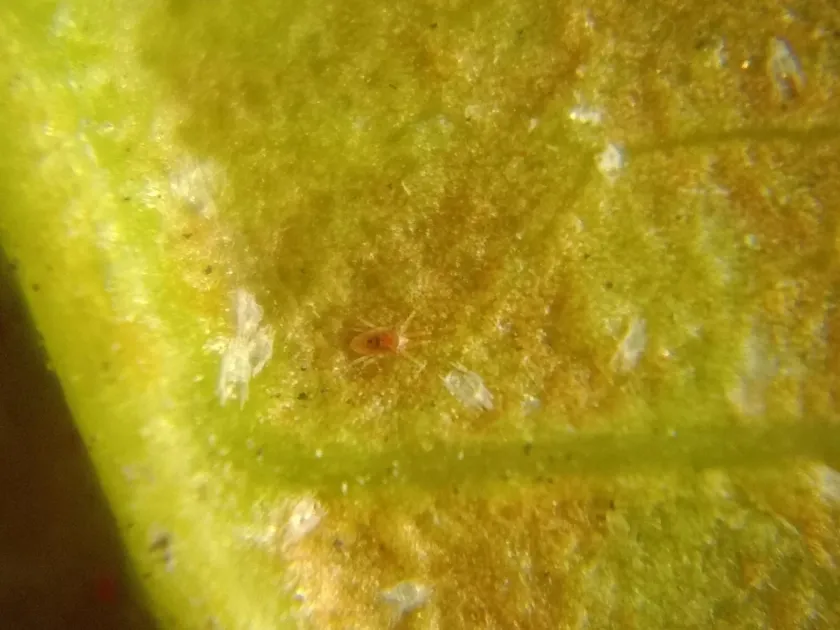
The Greenhouse flat mite (Brevipalpus obovatus) is a member of the Tenuipalpidae family. These mites are microscopic, typically measuring only 0.25–0.3 mm in length.
Adults exhibit a flattened, oval body, usually reddish or brownish in color. Unlike the common spider mites, they are relatively sedentary and do not produce webbing.
The life cycle consists of the egg, larva, protonymph, deutonymph, and adult stages. Development is highly dependent on temperature, completing in about two weeks under warm conditions.
Females lay eggs singly or in small clusters on the undersides of leaves or along veins. Parthenogenetic reproduction allows the population to expand rapidly in greenhouse environments.
These mites are highly successful at spreading via wind currents or through the movement of infested plant material between nursery sections.
What it damages
This pest affects a wide range of hosts including citrus, orchids, fuchsia, hibiscus, grapes, and various ornamental plants in controlled environments.
Feeding occurs by piercing the plant cells and extracting the contents, which destroys the chloroplasts and hinders the plant's photosynthetic capability.
Direct damage manifests as localized chlorosis, which eventually turns into necrosis. This severely weakens the plant and stunts new vegetative growth.
Severe infestations cause premature leaf drop and the potential for complete plant death, especially in smaller, more delicate ornamental species.
Crucially, Brevipalpus obovatus is a recognized vector for several plant viruses, posing an even greater threat than the direct physical damage suggests.
Signs of infestation
The first signs of infestation are minute pale or silver stippling on the leaves, which expand as the mite colony grows larger over time.
Leaves affected by flat mites eventually lose their natural shine, become leathery, or turn brown and brittle before falling off the plant.
Stunted shoots and deformed buds are common indicators, often mistaken for nutrient deficiencies or environmental stress by inexperienced growers.
Because these mites do not spin webs, they are often overlooked until the damage is severe and noticeable to the naked eye.
Frequent inspections using a magnifying glass are essential, specifically focusing on the undersides of leaves and near the leaf axils.
Control measures
Control requires the application of specialized acaricides, as general-purpose insecticides are often ineffective against the Tenuipalpidae family.
Rotation of chemical classes is essential to manage resistance, as these mites can rapidly develop tolerance to frequently used active ingredients.
Environmental management, including maintaining proper humidity levels and cleaning plant debris, helps reduce the proliferation of the mite population.
Implementing strict quarantine protocols for all incoming nursery stock is the most effective way to prevent an infestation from starting.
- Periodic monitoring with a 10x-20x magnifying lens
- Pruning and destroying heavily infested leaves or branches
- Introducing predatory mites (e.g., Phytoseiidae family)
- Chemical treatment with specific miticides following label instructions
Taxonomy
- Latin name
- Brevipalpus obovatus
- Order
- Mites
- Family
- Tenuipalpidae
- EPPO code
- BRVPOB
Discussion
No discussions yet — be the first.