
Bombardier beetle
Brachinus crepitans
Description
How to identify
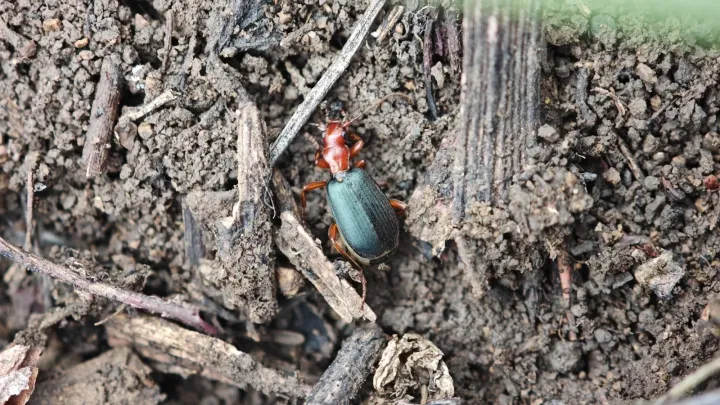
The bombardier beetle Brachinus crepitans is a species of ground beetle (family Carabidae). Adult beetles are typically 6–9 mm long, with a distinct reddish-orange head and pronotum, and dark blue or black metallic elytra.
The species is famous for its defensive mechanism: when threatened, it ejects a hot, noxious chemical spray from its abdomen accompanied by a loud popping sound, which acts as a powerful deterrent against predators.
The life cycle involves complete metamorphosis. Unlike plant-feeding insects, the larvae of this species are specialized parasitoids that develop within the pupae of other soil-dwelling beetles, primarily those considered pests in some contexts.
These beetles are commonly found in open habitats, meadows, and field margins. They are nocturnal and spend the daylight hours hiding under debris, stones, or within soil crevices.
In an agricultural context, they are rarely seen as a threat to crops. Their presence is generally viewed as an indicator of a diverse and healthy soil ecosystem capable of supporting predatory insect populations.
What it damages
The bombardier beetle does not feed on crops. It is not classified as a plant pest, as it does not damage leaves, roots, stems, or fruits of agricultural crops. It lacks the mouthparts and biological instinct to consume plant tissues.
As a predatory species, its diet consists of other insects and small invertebrates. Consequently, it has no negative impact on crop yield, quality, or plant health in any significant agricultural scenario.
There is no evidence of these beetles causing economic loss to farmers. Farmers should distinguish between plant-eating pests and beneficial predatory beetles, as mistaking the two leads to unnecessary agricultural costs.
Their role in the ecosystem is that of a natural control agent. By hunting other soil-dwelling organisms, they assist in regulating the population of potential agricultural pests, providing a service to the farming environment.
Ultimately, there is no economic threshold for this beetle because it poses zero risk to production. Any concern regarding crop loss should be directed toward actual phytophagous pests, not this beneficial beetle.
Control measures
There are no specific control measures required for the bombardier beetle, as it is a beneficial organism. Chemical control is strongly discouraged as it disrupts natural ecological processes.
Broad-spectrum insecticide use is counter-productive when beneficial predators are present. Eliminating these beetles can reduce the field's natural resilience against true pests, potentially leading to future outbreaks.
Integrated Pest Management (IPM) guidelines advocate for the preservation of these predators. Maintaining non-crop habitats, such as hedgerows and field margins, encourages these beetles to thrive and provide free pest suppression services.
If insect population monitoring shows a high number of ground beetles, it is a positive sign of a healthy field and requires no corrective chemical action. Sustainable farming relies on recognizing such beneficial species.
Agronomic practices should focus on maintaining a balanced soil environment through crop rotation and minimized soil disturbance, which protects the natural habitats required by the bombardier beetle to flourish.
Taxonomy
- Latin name
- Brachinus crepitans
- Order
- Coleoptera (beetles)
- Family
- Carabidae
- EPPO code
- BRHNCR
Discussion
No discussions yet — be the first.