
Silkworm
Bombyx mori
Description
How to identify
The silkworm (Bombyx mori) belongs to the order Lepidoptera, family Bombycidae. The adult is a large moth with a wingspan of up to 60 mm, typically featuring a light, creamy color with faint gray markings.
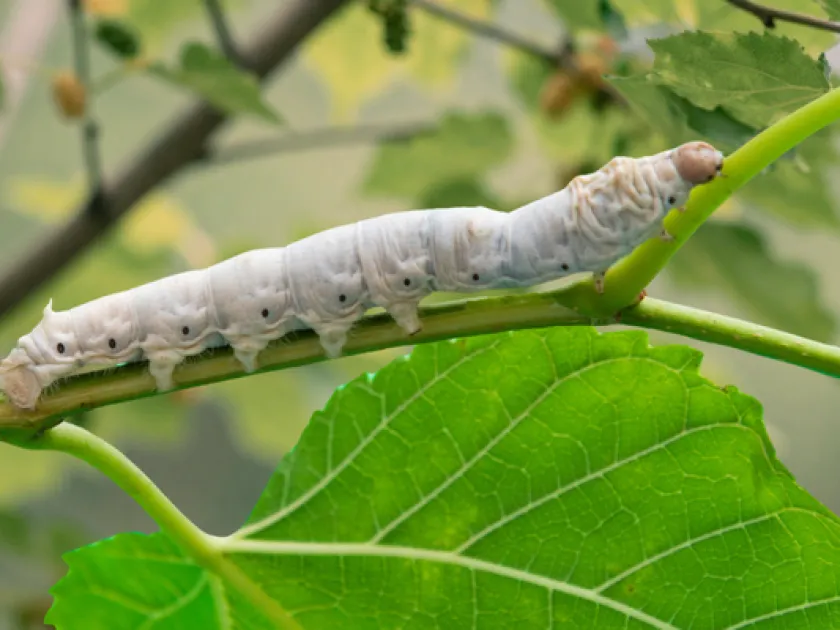
In the final stage, the caterpillar reaches up to 80 mm in length. Its body is cylindrical with a distinctive horn-like projection on the posterior end, appearing grayish-white or yellowish.
The biological cycle follows four stages: egg (grain), larva (caterpillar), pupa, and imago. Under natural conditions, the species reproduces once a year, overwintering at the egg stage.
Pupation occurs within a dense cocoon made of a single continuous silk thread up to 1500 meters long, which is of great industrial importance.
In modern times, the species is fully domesticated and has lost the ability to fly, making it more an object of sericulture than a major garden pest.
What it damages
The primary food source for silkworm caterpillars consists exclusively of leaves from mulberry trees of the genus Morus alba and Morus nigra.
In rare cases of severe food shortage, larvae may attempt to feed on other plants, but complete development and successful pupation are rarely achieved.
The pest damages the tree canopy by consuming leaf tissue, which can lead to significant defoliation (thinning of the branches) if the population density is high.
Damage manifests as skeletonized leaves or total leaf consumption, impairing photosynthesis and weakening the overall health of the tree.
Economic damage is typically associated with reduced immunity, making mulberry trees more susceptible to opportunistic secondary infections and other pests.
When it appears
Larval emergence from eggs coincides with the period of bud burst on mulberry trees, usually occurring in late spring (April–May).
Active feeding lasts for approximately 30 to 40 days, during which the caterpillars undergo five instar stages while rapidly increasing biomass.
Mating and egg-laying occur in early summer, after which the developmental cycle ceases until the following spring season.
Temperature is a critical factor: stable warmth and the absence of sudden spring frosts are required for successful larval development.
Monitoring for the pest should begin early in the growing season when young caterpillars first emerge to feed on fresh, tender foliage.
Signs of infestation
The first sign of infestation includes small, irregular holes in mulberry leaves, which enlarge rapidly as the larvae grow.
The presence of frass (excrement) on the leaf surfaces or beneath the tree crown is a clear indicator of active feeding by a pest colony.
Stripped branches and visible damage to the edges of leaf blades serve as strong evidence of a substantial caterpillar population.
Discovery of cocoons tucked away in tree bark crevices or deep within the canopy at the end of the season confirms successful reproduction.
Reduced berry production and the premature wilting of specific branches can be indirect indicators of chronic insect pressure.
Control measures
Agrotechnical measures include regular sanitary pruning and the cleaning of bark to remove areas where overwintering eggs may be deposited.
Manual collection and destruction of egg clusters and caterpillars is the safest and most effective method for home and small-scale gardens.
Biological insecticides, such as those based on Bacillus thuringiensis, are highly effective against younger larvae without harming the environment.
Chemical systemic insecticides should be reserved for severe outbreaks, ensuring strict adherence to pre-harvest intervals for fruit safety.
- Regular monitoring of tree health and foliage.
- Encouraging natural predators like birds and beneficial insects.
- Careful inspection of new nursery stock before planting.
Taxonomy
- Latin name
- Bombyx mori
- Order
- Lepidoptera (butterflies)
- Family
- Bombycidae
- EPPO code
- BOMBMO
Discussion
No discussions yet — be the first.