
Tea leaf roller
Andraca bipunctata
Description
How to identify
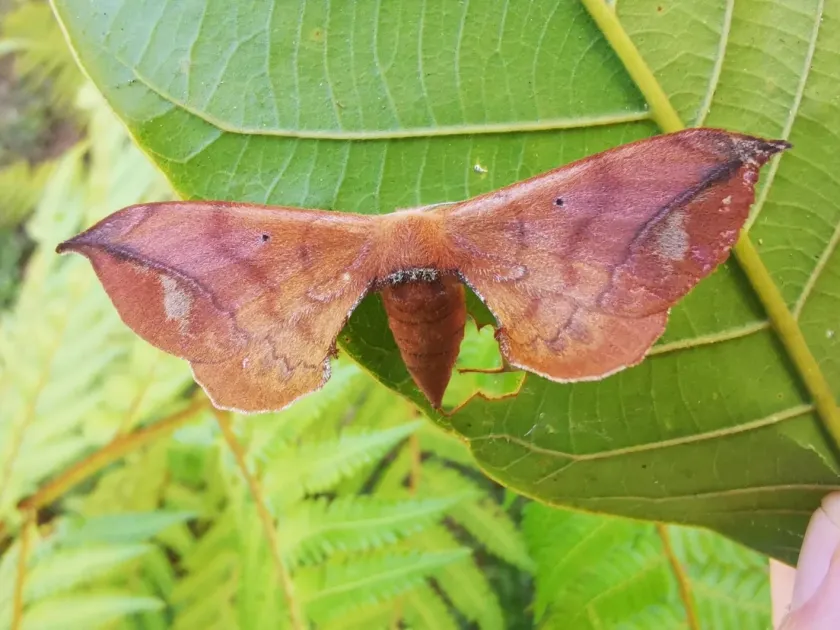
The tea leaf roller (Andraca bipunctata) is a member of the Endromidae family, order Lepidoptera. Adult moths typically feature a brownish coloration with two distinct dark spots on their forewings, allowing for easy identification in the field.
The larval stage consists of caterpillars that undergo several instars. Young caterpillars are often pale and gregarious, while older instars develop a more robust appearance with longitudinal stripes and visible hairs.
Female moths deposit their eggs in organized clusters on the underside of tea leaves. These egg masses are often covered in specialized scales, providing camouflage against predators and environmental stress.
Pupation occurs within dense, silk-like cocoons. These cocoons are strategically attached to the stems or mature leaves of the tea plant, protecting the developing insect through its transition phase.
The biological cycle is well-adapted to subtropical environments where tea grows. This allows the moth to complete multiple generations throughout the year, provided temperatures remain favorable.
What it damages
The tea plant (Camellia sinensis) is the primary host for Andraca bipunctata. Larvae show a strong preference for young, tender foliage, which is essential for their rapid growth and development.
Heavy infestations result in severe defoliation, where the larvae consume leaf tissue between the veins, leaving behind skeletal remains. This drastically reduces the photosynthetic surface area.
Loss of foliage impacts the overall vigor of the tea bush, leading to stunted growth and reduced yields. This is particularly problematic for young plantations or during peak flushing seasons.
In addition to physical tissue loss, the damage weakens the plant, making it more susceptible to various secondary pathogens and environmental stressors that can further reduce quality.
Commercial impact is significant as damaged leaves are often unsuitable for high-quality tea production, leading to economic losses and the need for expensive mitigation strategies.
When it appears
The activity of the tea leaf roller is highly dependent on seasonal fluctuations. Moths become most active during periods of warm weather and high humidity, which coincide with tea flushes.
Generation overlaps are common in tropical climates, meaning that life stages from egg to adult can be observed simultaneously on the same plantation throughout the active season.
The lifecycle is often synchronized with the vegetative rhythm of the tea plants, ensuring that a steady supply of fresh food is available for the emerging larvae.
As seasons change to drier or colder periods, the population typically declines. The insect may undergo a period of diapause or reduced reproductive activity until conditions improve.
Monitoring the onset of the season is crucial for planning interventions, as early control prevents the buildup of the massive population densities seen during peak months.
Signs of infestation
Presence of the pest is first marked by the appearance of small, skeletonized patches on the undersides of young leaves where larval clusters are feeding.
Accumulation of larval frass (excrement) on the leaf surface is a reliable indicator of an active feeding site, even if the larvae themselves are camouflaged or hidden.
Leaf rolling or webbing is another distinct symptom, as the larvae construct protective shelters by folding the leaf margins or binding adjacent leaves together with silk.
Stunted growth or chlorosis (yellowing) of the tea bushes in specific sectors often points to an underlying infestation that has gone unnoticed until significant damage occurred.
Visual inspection for cocoons on twigs is a key sign of the pest's presence. Finding these structures indicates that the generation is nearing completion and immediate action is required.
Control measures
Cultural control remains a first line of defense. Hand-picking egg clusters and infested leaves is highly effective in small-scale tea gardens to manage initial pest spread.
Biological control agents, including various parasitic wasps and predators, play a vital role in natural suppression of the population. Encouraging these beneficial species is a key management strategy.
Microbial insecticides, particularly those containing Bacillus thuringiensis (Bt), are highly specific and effective against the larvae while maintaining the safety of the tea crop.
Chemical control should be employed judiciously and only when necessary, adhering strictly to pre-harvest intervals to ensure the safety of the end consumer and ecosystem.
Integrated Pest Management (IPM) programs, which combine monitoring with cultural and biological techniques, are the most sustainable approach to handling the tea leaf roller.
Taxonomy
- Latin name
- Andraca bipunctata
- Order
- Lepidoptera (butterflies)
- Family
- Bombycidae
- EPPO code
- ANDRBI
Discussion
No discussions yet — be the first.